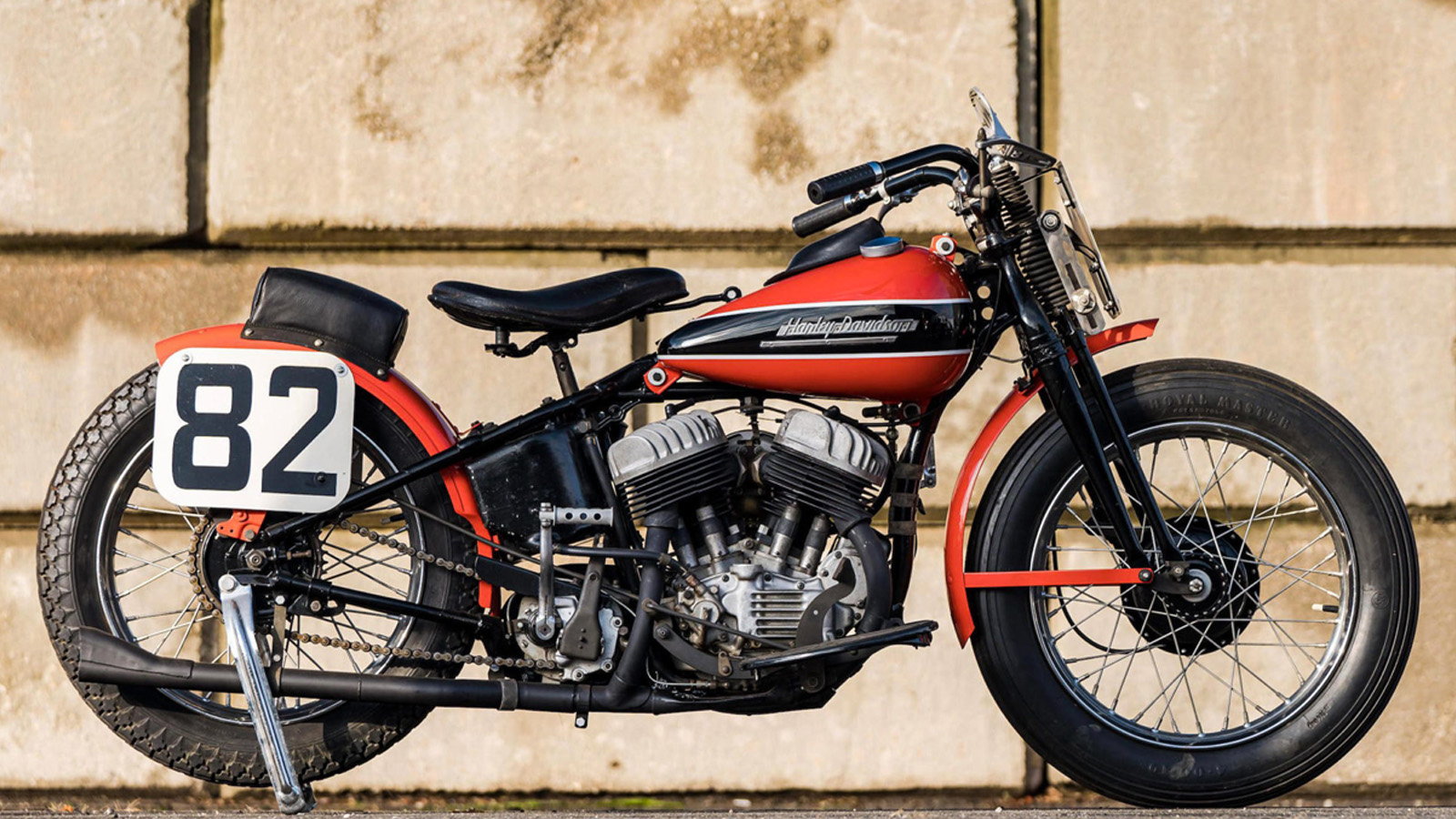
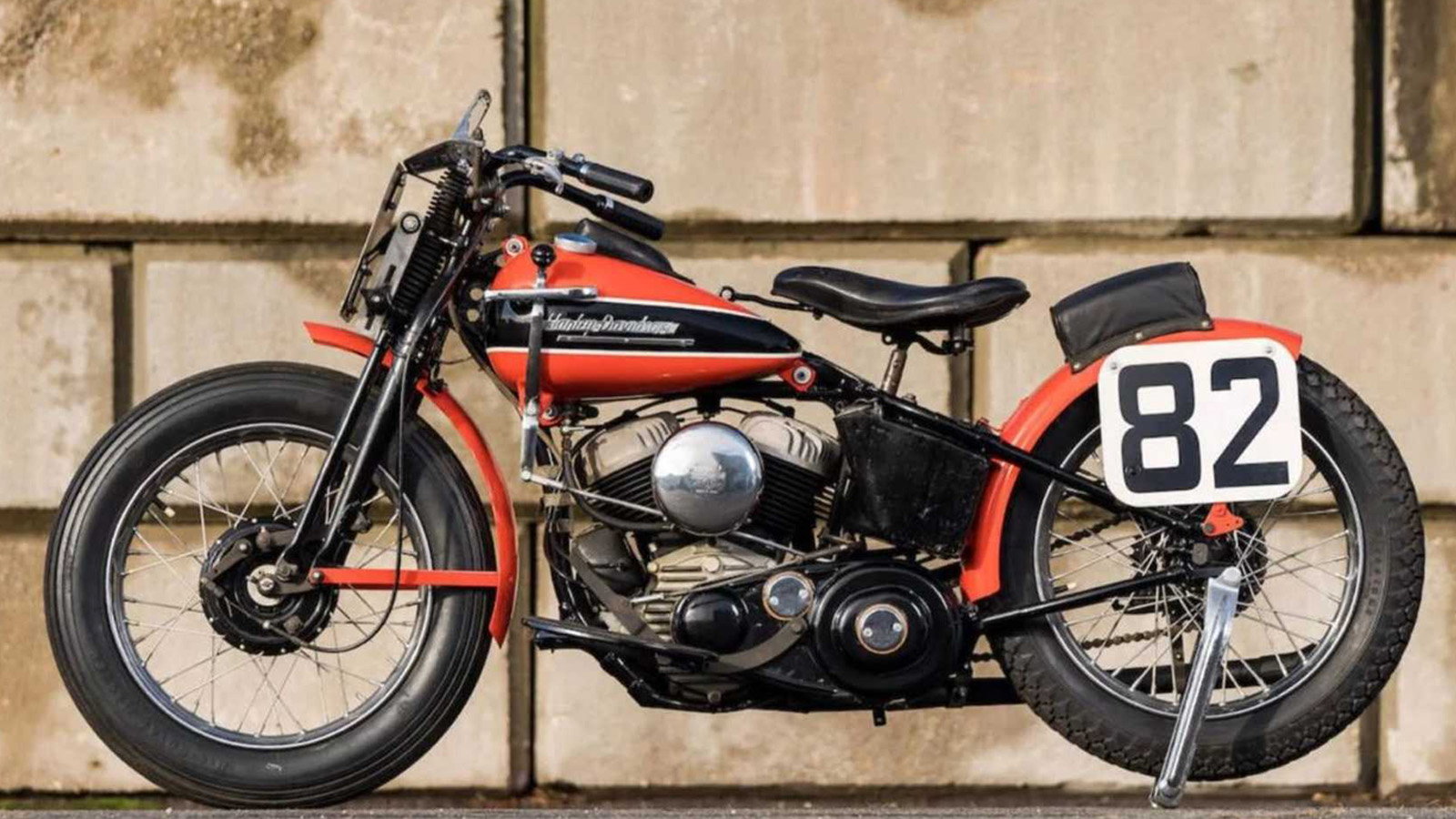
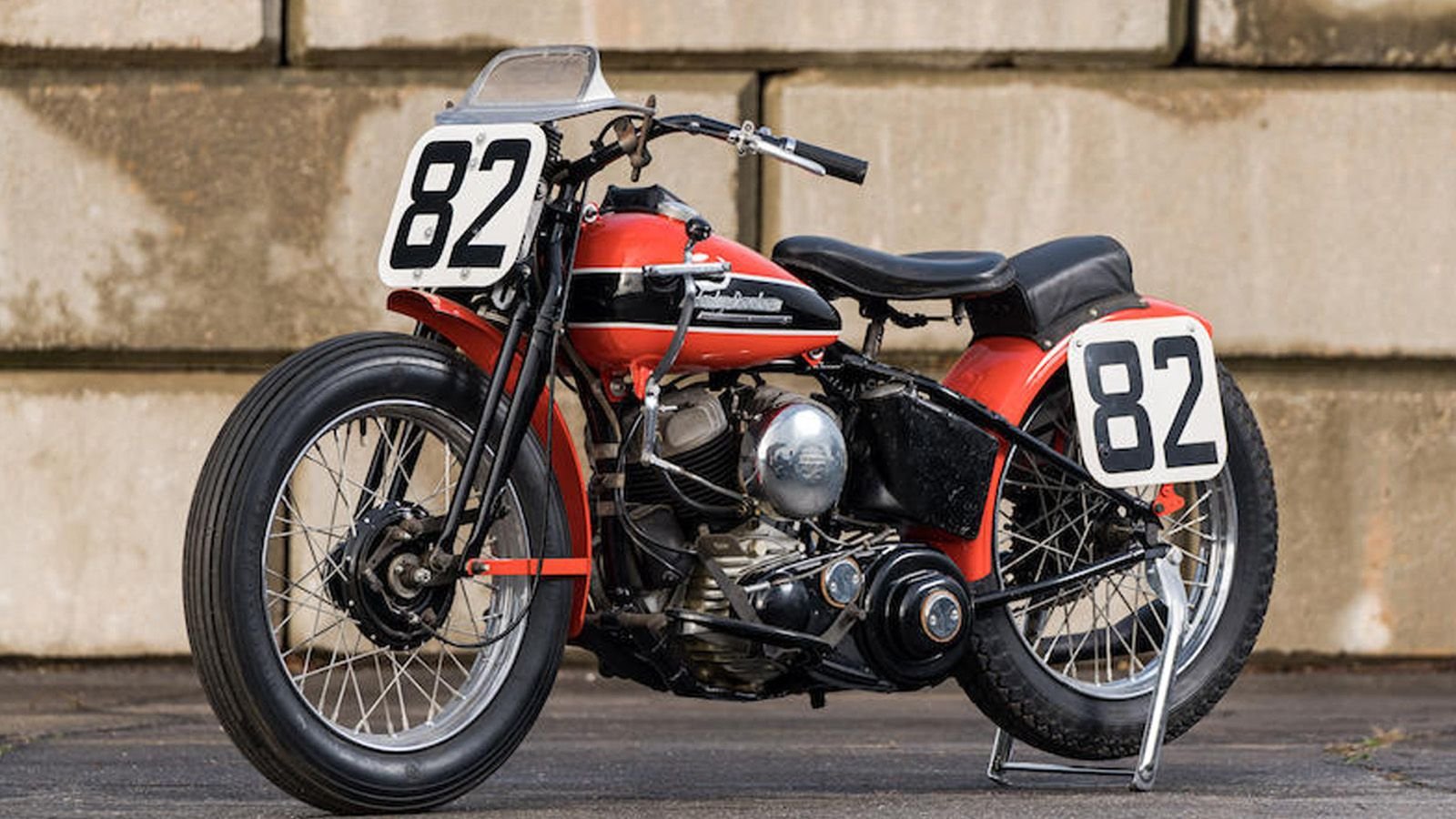
Designated 'Tourist Trophy,' the WRTT was a factory-built racer.
Class Racer
The Harley-Davidson WRTT was the road racing version of the WR flat track racer. Introduced in 1941 with the designation 'Tourist Trophy,' the WRTT was a factory-built racer. Produced in very low numbers until 1952, the WRTT is a rare, but significant part of the Motor Company's racing past.
Photos courtesy of Bonhams.
Correct Veteran
Restored by Leo Hulnick, this 1951 WRTT, is a documented veteran racer. The bike was first campaigned by national rider #82 Joseph Holoubek of Omaha, Nebraska, and later by #15K Harland Zobel of Pender, Nebraska. Dale Walksler of the Wheels Through Time Museum in Maggie Valley, North Carolina, stated that this Class C racer “might just be the nicest and most correct WRTT in the world.”
>>Join in the conversation about this 1951 WRTT right here in Harley-Davidson Forums.
Average Rider
Introduced in 1934, the AMA Class C democratized motorcycle racing in America. Prior to the class, racing was dominated by factory prototypes. Amidst dwindling interest and declining sales as a result of harsh economic conditions, the new class opened racing to the average rider with a production machine. The class also used the same size of machine for multiple types of racing.
>>Join in the conversation about this 1951 WRTT right here in Harley-Davidson Forums.
Professional Sportsman
The WRTT was specifically designed for endurance road racing and TT Steeplechase races — the precursor to modern dirt bike racing. The difference between oval flat track racing and TT races was the addition of at least one right-hand turn and a 'roller' jump. The AMA-sanctioned two types of TT racing. Steeplechase was professional races, and Scrambles received the amateur or Sportsman designation.
>>Join in the conversation about this 1951 WRTT right here in Harley-Davidson Forums.
Factory Ready
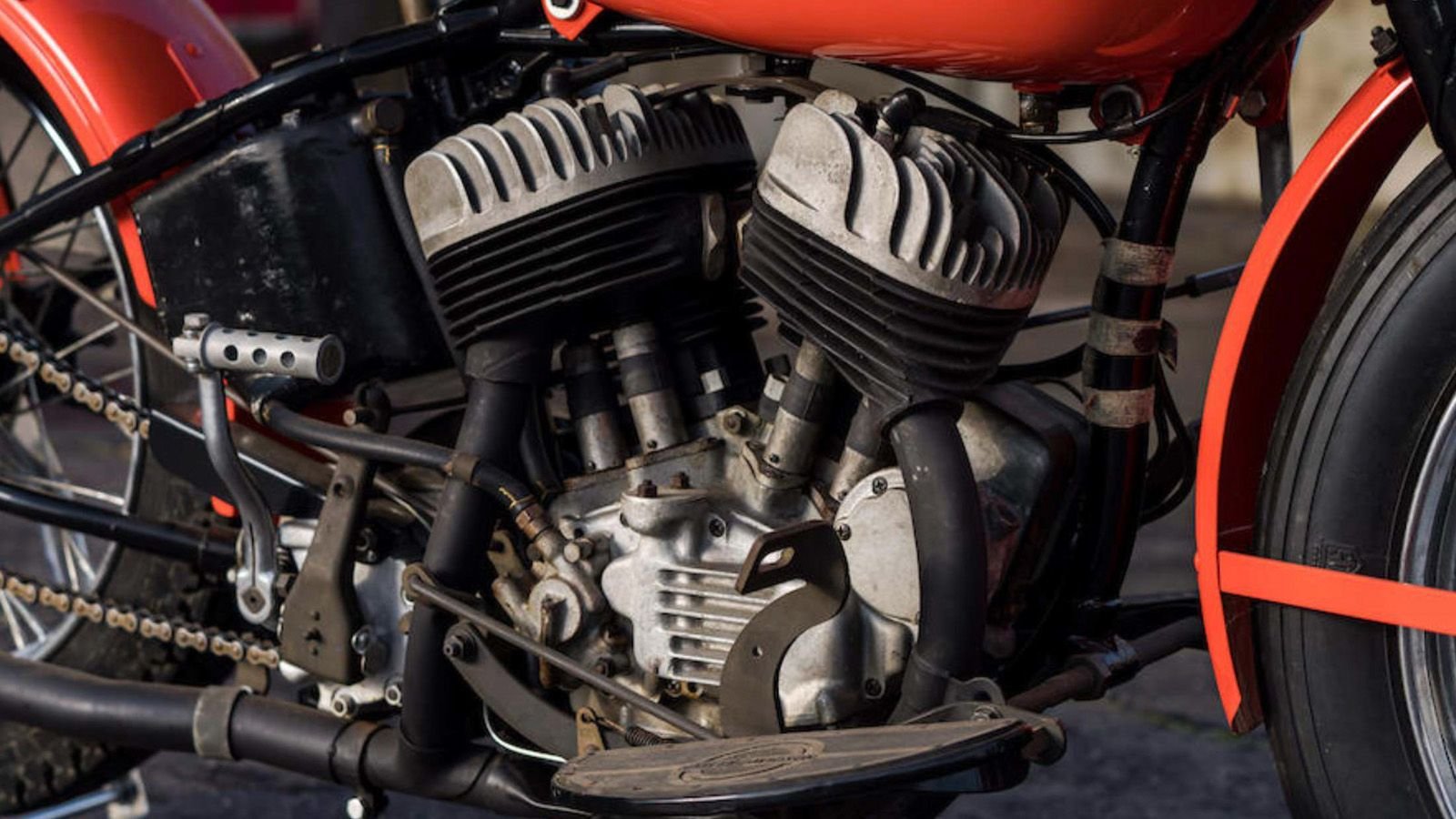
Powering the WRTT was Harley-Davidson's 45 cubic-inch Flathead motor. Introduced as the W-Series in 1936, the side-valve engine evolved from the 1929 Model D and the 1932 Model R. The WR and WRTT were ready to race from the factory. Capable of over 100 mph, the engines were fitted with a special cam and a 'Peek-A-Boo' ignition cover for easier timing adjustments.
>>Join in the conversation about this 1951 WRTT right here in Harley-Davidson Forums.
Rare Parts
Racing considerations are built into the WRTT. The primary is a 'skinny' cover with a matching narrow factory race clutch to facilitate left turn leans. The foot-actuated clutch is linked to a close-ratio three-speed transmission, stamped with a 'C.' Fuel delivery is via a rare MR3 Linkert race carburetor and the exhaust is a long factory-fitted road race pipe for better back pressure.
>>Join in the conversation about this 1951 WRTT right here in Harley-Davidson Forums.
Dominant Strategy
The WRTT was built for endurance road racing. To accommodate long courses, it was fitted with a five-gallon fuel tank, and an oversized factory 6-quart cast aluminum oil tank. The strategy worked and Harley-Davidson dominated the grueling Daytona 200 throughout the 1950s and 1960s. The three-speed race transmission is controlled by a tank shift — the norm of the day.
>>Join in the conversation about this 1951 WRTT right here in Harley-Davidson Forums.
Under the Paint
Front and rear brakes along with 19-inch road race wheels separate the WRTT from its oval track cousin. This rare machine also features a leather pillion, chin pad, and period-correct Jack Tracey windshield, enabling the rider to 'get under the paint' in the straightaways. To get an up-close look at this veteran racer, check out Buzz Kanter's 2014 video interview with Leo Hulnick.
>>Join in the conversation about this 1951 WRTT right here in Harley-Davidson Forums.
For help with your do-it-yourself maintenance and repair projects, please visit our how-to section in the forum.