LRST Engine Guard




Stellar HDF Member


Joined: Feb 2014
Posts: 2,710
Likes: 529
From: Lethbridge, Alberta Canada

- If you fall while riding, the end of the bar can become a "spear" that stabs into you
- If you fall, the bar itself can "snag" on any imperfection in the road surface (or a curb), and cause the bike to flip through the air isntead of just sliding
- When the very small surface area of the bar hits the ground, it will not bend to absorb the shock, but rather will transmit the shock perfectly into the frame's steering head, bend it, and then add more twisting torque to the frame as it (the bar) tries to resist being bent itself (it becomes a "torque wrench" working on the frame!), and thus total the frame.
The engine guards that make a complete loop are FAR better in actually protecting both the bike and you. They speard the impact force over a large area, they bend to absorb the impact forces instead of passing them on to you and the bike, and they protect your legs WAY betetr than a straight bar does. A shaped engine guard also provides way more possible positions for highway pegs.
Jim G

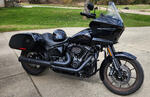


Tourer
Joined: Jul 2012
Posts: 309
Likes: 33
From: Littleton, CO
For safety and better protection as described above by Jim, would the two step Hogworkz engine guard be a better choice than the single straight bar?
I'm picking up a Low Rider S next week (hopefully) and will be buying an engine guard as my first purchase.
Black Highway Peg Two Step Crash Bar for Harley® Softail '18-'24 (hogworkz.com)
I'm picking up a Low Rider S next week (hopefully) and will be buying an engine guard as my first purchase.
Black Highway Peg Two Step Crash Bar for Harley® Softail '18-'24 (hogworkz.com)
Stellar HDF Member
Joined: Feb 2014
Posts: 2,710
Likes: 529
From: Lethbridge, Alberta Canada
The Two Step sitll has the same problems: The points of impact are still "hard small stiff points" versus bendable, and the extra "points" DOUBLE your chances of catching on a pavement edge or skewering you in your leg. You want a LARGE area that hits the ground and that can easily BEND to absorb the shock rather than transmit it to the bike and you. The best shapes are the plain "rounded rectangle" or the "Mustache".
One other thing to watch for: The TOP bolt, the one that fastens the engine guard to the frame of the bike just under the steering head, needs to be a grade 8 bolt. If it is NOT a grade 8 bolt, it will likely snap when the engine guard hits the ground. Then the engine guard can no longer protect you or the bike. You want thta bolt to HOLD during an impact, so that instead the engine guard tubong can BEND to absorb some of the shock of the impact. If the boilt breaks, the guard cannot do that.
That bolt on the genuoine HD guards is a grade 8 bolt, whereas on the aftermarket bolts it is often an unlabeled "unknown". So if you buy an aftermarket engine guard, also buy the HD grade 8 bolt from an HD dealer. The bottom bolts dpon't matter so much, but that top one is critical.
Jim G

One other thing to watch for: The TOP bolt, the one that fastens the engine guard to the frame of the bike just under the steering head, needs to be a grade 8 bolt. If it is NOT a grade 8 bolt, it will likely snap when the engine guard hits the ground. Then the engine guard can no longer protect you or the bike. You want thta bolt to HOLD during an impact, so that instead the engine guard tubong can BEND to absorb some of the shock of the impact. If the boilt breaks, the guard cannot do that.
That bolt on the genuoine HD guards is a grade 8 bolt, whereas on the aftermarket bolts it is often an unlabeled "unknown". So if you buy an aftermarket engine guard, also buy the HD grade 8 bolt from an HD dealer. The bottom bolts dpon't matter so much, but that top one is critical.
Jim G

Thread
Thread Starter
Forum
Replies
Last Post