
Forum Fix: Rivera Primo 6-Speed Transmission Softail Upgrade
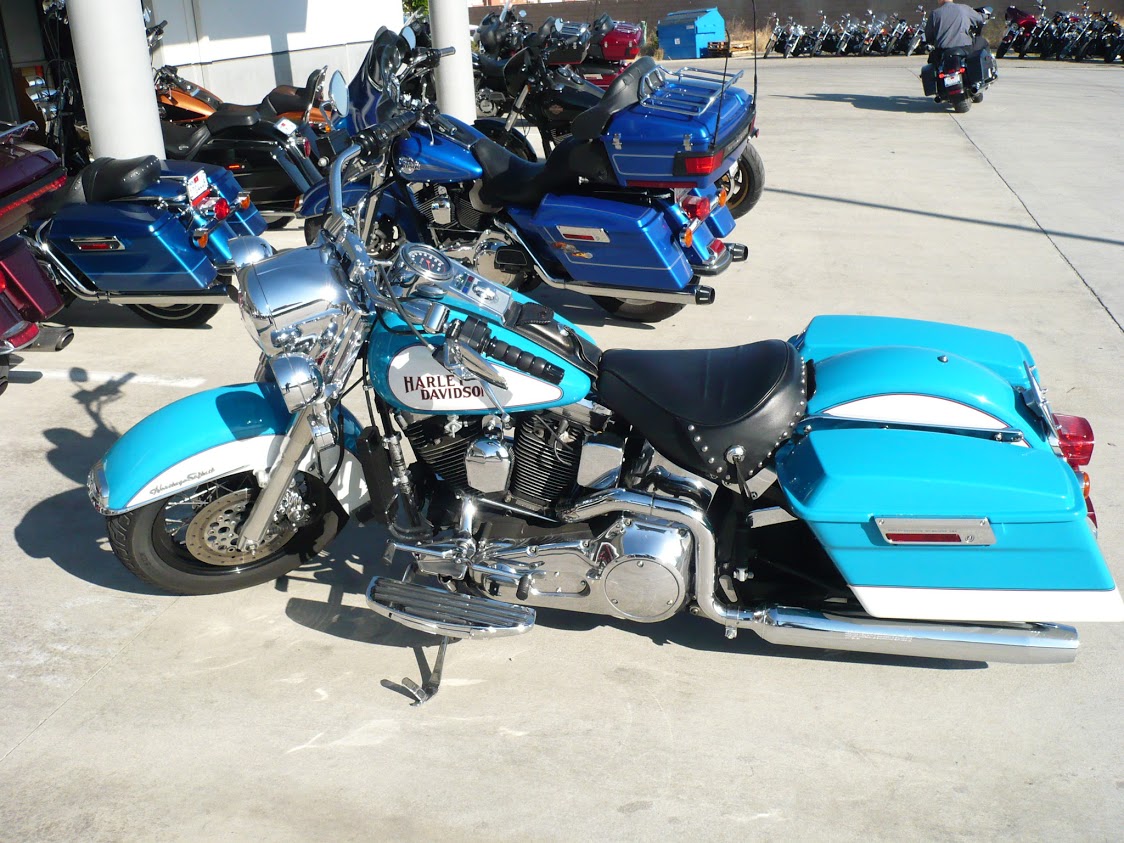
Recently I purchased a Rivera Primo 6-speed transmission for my 1991 FLSTC Softail. I looked at offerings from most of the big names: RevTech, Screamin’ Eagle, Ultima, Jim’s, Baker…
The primary reason I settled on Rivera Primo was three-fold: Rivera’s reputation for quality products; their status as a USA company (transmissions assembled in USA from parts made in the USA and South Korea); and cash outlay—the transmission was about a third of the cost of the notional top-of-the-line transmission manufacturer’s six-speed. Rivera has been building Softail 6-speed transmissions since 2007. Note: They also manufacture ‘bagger’ transmissions; they have a model for 1993-1998 Baggers with the oil bag under the trans; and a model for 2001-2006 Twin Cam Baggers.
I compared builder’s gear-sets to whole transmissions. I selected an entire transmission because the upcharge compared to the Rivera gear-set was only $100; and Rivera guarantees a ‘whole’ transmission for 2 years/unlimited miles. The gear-sets have a lesser warranty, i.e., 6 months for ‘manufacturing’ defects only. Besides which, I was hedging my bet as I wanted to retain the 5-speed in case the 6-speed didn’t work out. (The 5-speed is recently for sale).
Going about things in a “bass-ackwardly” way, after I purchased the transmission and it had been delivered…I called Rivera directly in order to ask a few questions about it…
I couldn’t find much information about Rivera Primo transmissions on the Internet. Several outlets sell them. But beyond the standard sales spiel, providing specs and prices, I found only a couple of customer comments, and no in depth reviews about the transmissions. Even YouTube had nothing to offer.
The lack of reviews didn’t deter me from my purchase. I was thinking something along the lines of ‘no news is good news, maybe’ when I placed my order. I know I’m more apt to bitch about something that doesn’t work quite right, than to praise something that does work. If it works ‘as advertised’, usually I just move on…to the next thing in my life that needs attention. There’s never any time, it seems. But that’s another thread…
When I called Rivera I was handed over to a factory technical representative with whom I chatted for a good twenty minutes.
I asked where the transmissions are manufactured. They are assembled in Paramount, California. Machining of gears is performed in Goleta, California, from one or more gear ‘blanks’ forged (for strength and reliability) in South Korea. During the machining process in Goleta, the gears are back-cut to limit ‘jumping’ out of gear under load.
So, to be absolutely clear about it the official stance of Rivera Primo on point of origin of their transmissions, is: The transmissions are assembled in the USA, from parts made in the USA and South Korea.
Transmissions are tested on the Rivera Primo assembly line for basic function, shifting, and inherent noise. There’s a dB (decibel) specification and test, and if the transmission does not pass the ‘noise’ specs in any gear it will not ship.
I asked why a gear-set is only about a hundred bucks less expensive than a full transmission. I was told the tooling to create the cases is very expensive. But the cases themselves are not particularly costly to manufacture. I got the sense from the technical expert I spoke with that Rivera Primo would just as soon sell whole transmissions versus gear-sets. Selling a whole, pre-installed gear-set in your own case eliminates the ‘middle man’ installer from the warranty equation. At least, it eliminates a lot of the potential for issues versus an installation of a gear-set in an existing case.
For what it’s worth (and for as long as it might last), for now Rivera Primo has a ‘feel’ to me of an organization that has not yet become ‘corporatized’. They are growing—they just moved into a big new building near Santa Barbara, California—but their size has not yet swallowed up their customer affinity. They still seem to be in touch with us.
You can call Rivera Primo, and talk directly to a person who knows what he/she is talking about. Try that with some big corporations, and you’ll see the instant contrast. From what I can tell, the guys who answer up for tech issues at Rivera have grease under their finger-nails.
Here are verbatim responses to a couple of my questions to the Rivera tech expert. I sent these questions in a follow-on (to our phone conversation) e-mail. These are the e-mailed responses, from Rivera Primo’s tech:
Question 1: To be clear about the warranty, it’s 24 months, unlimited miles, and covers the transmission itself, I.e., removal/re-install labor, and shipping are all the customers’ responsibility?
Answer: Tech expert’s response:
Rivera Primo®
PowerDrive™ Transmission
Limited Warranty
NOTE: This limited warranty covers only the original Consumer Purchaser of these parts and is not transferable.
Rivera Primo Inc.® (the “Company”) warrants these Powerdrive™ Transmissions to be free from defects in material and workmanship. If the parts become defective during the warranty coverage period, the Company will, at its option, repair or replace any, or all, defective parts. Repair or replacement of defective parts is the sole and exclusive remedy. The warranty coverage remains in force for a period of two (2) years from the date that the original Consumer Purchaser buys the parts. Warranty coverage will automatically terminate if the original Purchaser sells or otherwise transfers all or any portion of the purchased parts. The Company shall not pay or be responsible for the cost of shipping the defective parts to the Company for service under this warranty, nor will the Company pay for the cost of labor to remove and/or replace the defective parts. Moreover, the Company shall have no obligation under this warranty in the event that the parts become defective in whole or in part as a result of improper assembly, installation, break-in, maintenance, or use, or any other misuse or mistreatment of the parts, including, without limitation, operation of the parts with oils or lubricants not conforming to specifications published by the Company or continued operation of the parts after a defect or malfunction occurs or is identified or suspected. The Company shall have no obligation under this warranty for defects in parts with a polished finish, when that option is selected, if the defects are caused by, but not limited to, negligence of parties other than the Company; an accident; ordinary wear and tear; assembly or disassembly; power washing; natural occurrences like stone chips; bead blasting; improper maintenance including the use of any harsh cleaning agent, chemical or solvent; and salt or other substances used on streets and highways for maintenance and safety. It is the responsibility of the original Consumer Purchaser to cease operation as soon as a defect or malfunction is identified or suspected. The failure to cease operation once a defect or malfunction exists can cause substantial damage to the Company’s parts that could otherwise be avoided. In addition, the Company shall have no obligation under this warranty for parts defects caused by alteration including, but not limited to: polishing, disassembly, powdercoating, painting, removing or reconfiguring any components, modification, repair, or unauthorized service. The Company shall have no obligation under this warranty if the parts are used in racing or similar competitive activities. THE COMPANY SHALL NOT BE LIABLE FOR AND DISCLAIMS ALL CONSEQUENTIAL, INCIDENTAL, PUNITIVE OR SPECIAL DAMAGES ARISING OUT OF THE USE OF, OR INABILITY TO USE, THESE PARTS.
To make a warranty claim, you must return the product in question complete and assembled as it came new from the factory freight prepaid to: Rivera Primo®, 115 Robin Hill Rd., Goleta, CA 93117 · 562-907-2600.
Question 2: I could not find much information online, regarding these transmissions. There is basic sales-related info on your own Rivera-Primo site, and a couple of ‘press releases’ elsewhere, on various sites (most of these dealing with your ‘bagger’ transmissions). There were also a couple of ‘talking head’ videos with a gentleman named ‘Ben’, essentially speaking to Rivera’s reputation… I didn’t find any YouTube installation videos…which seemed kind of surprising. During my research (“…should I purchase Brand W, Brand X, Brand Y, or Brand Z?”), I performed pretty thorough Internet searches. Did I miss something obvious? If I missed something, a ‘factory tour’ photo-shoot/narrative, or other similar insight into manufacturing of the PowerDrive transmissions, please send the URL and I’ll include it in my write-up.
Answer: You missed nothing that I am aware of. We have been working on a video for our manufacturing and transmission assembly, but are still in the process with no immediate release date…(Our) social media endeavors are focused on Facebook and Instagram, but admittedly they fall short for a good marketing plan. We are a small team and it is sometimes difficult to do all the things that we need.
Question 3: When I put my write-up out there, I guarantee someone will ask “How much torque will these transmissions handle?” I presume you have not done destructive testing on them to determine their ‘maximum’ or nominal ratings. I suspect no one does this type of testing. To mention a certain brand (again), it’s said (by third parties on the forum I frequent) that they will handle 120 ft/lbs of torque (model a) and up to 160 ft/lbs. (model b). I have no confirmation that Brand Y has actually affirmed this. That is, as far as I’m able to determine (I haven’t called (them), and won’t) this is all hearsay. I can’t find a published spec attested to by Brand Y, for torque ratings. With that said, how would you characterize Rivera-Primo’s transmissions’ torque rating? I understand you might not want to put a ‘number’ on it. Would it be fair to say: “The PowerDrive transmissions are designed to handle a similar amount of torque as compared to other, top-line manufacturers’ units?”
Answer: Like most other manufacturers, we do not put a torque rating on our transmissions. That is a difficult number to assess as transmissions will react differently depending on the type of use. For example, do we base the tests on drag racing or oval track racing, typical road use or not so typical kick the s–t out of the bike road use? What I can tell you is our transmissions are used in many different applications with many different engine sizes and seem to bear up quite well. We engineered the transmissions to exceed the performance of the stock OE transmission and the materials that are used and the methods to machine the parts are such that will produce the best quality and longevity. I hope that is not too vague for you!
Question 4: You mentioned factory tours. Do you have an established program, e.g., a day and/or time during the week when factory tours are given? If so, I’ll publish it in my paper.
Answer: In regards to factory tours, we never had a regular scheduled tour, instead if a customer walked in the front door, I would take them around to show them what we do and how we do it. That was fairly easy in the Whittier plant, as everything was under one roof. Now our assembly is in Paramount, CA and our manufacturing is in Santa Barbara area, CA, so a “factory tour will be tougher. However, if a customer showed up we would have no problem showing them what we do at Rivera Primo®!
Summary:
I was interested in three basic things from a 6-speed transmission for my Softail:
I wanted it to be reliable, as reliable as the stock transmission, if not more so.
I wanted the transmission to shift smoothly, didn’t want to have to futz around every time I stop, trying to find neutral.
I didn’t want the transmission to hum, sing, whine, groan, moan, or otherwise make weird sounds. A little bit of noise would be fine. It’s a mechanical device, after all. But it couldn’t be any noisier than my stock 5-speed transmission had been.
As for reliability, it will take time for me to determine this definitively. But it’s been almost 1,000 miles now and there have been zero issues.
As for the way this transmission works: It ‘snaps’ into gears. It’s very precise, sort of ‘clicks’ from one gear to the next. It doesn’t ‘clunk’. (I have a Hayden chain adjuster which probably limits this on shifts to 1st). It’s a ‘Harley’ type transmission, and shifts like a ‘Harley’ (versus the ‘snick…snick…snick…’ of a crotch-rocket). But for a Harley, the shifting is smooth, and sure. I can ‘find’ neutral easily, every time. It’s better for this than the stock transmission was. (That could be a clutch adjustment issue…but nevertheless, the Rivera Primo transmission is faultless in terms of shifting to neutral easily).
As for ‘noise’, this transmission is no more noisy than the stock transmission. I wear a full-face helmet and the stock transmission, and the Rivera six-speed are ‘equivalent’ in terms of the noise they make (or in this case, don’t make).
One other thing was torque. You read a lot about stock bikes not having sufficient torque to use a 6-speed. This turned out, in my case at least, to be a non-issue.
There are those who say the 6-speed came into existence in order to meet EPA noise regs. I tend to believe this to be the case, rather than the argument that stock Harley Big Twin engines finally developed enough power (by 2007) to enable the installation of 6-speed transmissions. I mean, believe what you will. But based on my experience, I can be running at 60 MPH, on an incline, against a stiff (20 knot) wind…and still make enough ‘beans’ with my nearly stock 80 ci EVO to accelerate easily in sixth gear. If I need to pass quickly, I’d likely drop a gear, or two. But for freeway riding, sixth is great down to about 60 MPH.
The Rivera transmission has essentially the same gear ratios through the first five gears as the stock transmission. A minor exception is first gear on the Rivera is a little lower, 2.94 versus 3.27 (or is it 3.24?) But if anything this is an improvement. The bike doesn’t lug or want to stall. It holds the 2.94 ratio fine and it’s welcome to shift a little later from first to second. I think the comparison is ‘making it across an intersection without having to shift.’ The bike does this no problem.
I have a Cali spec bike, and according to that spec, it achieves its maximum torque at 2500 RPM, then falls off as RPMs increase. Non-Cali bikes of the same vintage develop their maximum torque higher (4000 RPM, I believe). So when I lower my RPMs (at least until I get down to 2500), the engine is actually developing a little more rather than less torque.
I don’t have a tach so I don’t know what RPMs I’m turning. It’s obviously less in sixth than it was/is in fifth. But how much less I can’t objectively measure.
For the record there is no issue on my nearly stock bike using 6th gear effectively from 60 MPH on up. It’s that simple. (Recall the first five gears (with the exception of the lower first) are the same ratios as the 5-speed I removed).
Finally, here’s some pictures. I had the transmission installed by Antelope Valley Harley-Davidson. But if you’re handy you could do the installation yourself. Be prepared to buy new primary gaskets, etc., spend some time cleaning the bike up around the transmission area while the tranny’s out of the way…etc.


The seasoned mechanic (John) that worked on my bike spent a full day (about 8 hours) working through the installation. He did a thorough job. Your install could require more or less time, depending upon what you have to remove to access the transmission, and any problems you might encounter. To be safe I’d plan on at least a full Saturday and a good part of a Sunday morning to pull your stock transmission and replace it. If you can do it faster, God bless you.
Again, I decided to write this up because there’s so little on the net regarding the Rivera Primo Softail transmission. Based on my experience, they are an excellent value. I’ll post every 5,000 miles with a ‘progress’ report.
There was one problem. The provided Rivera Primo ramp-and-ball assembly wouldn’t retain the coupler (for the clutch cable). The Rivera ramp-and-ball is a different dimension than the stock part, and the stock ramp-and-ball wouldn’t fit in the Rivera transmission end-cover. John ended up using both the stock transmission end-cover and ramp-and-ball assembly in order to complete the job (while I waited), and I set the Rivera parts aside.
I emailed Rivera. They asked for some pics of the parts. I sent the pictures and they identified the inner ramp was not machined correctly. This is a part that’s not tested at the factory, since you’d have to hook up a clutch cable to test it…and who’d think, after you’ve used hundreds of the same part over many years, that one would be an issue?
In any case, Rivera sent the replacement part (an entire new ramp assembly) and I plan to install it and the Rivera Primo end-cover…one of these days. I sent the faulty parts back, at Rivera’s request, so they could perform a post-mortem exam on the inner ramp.
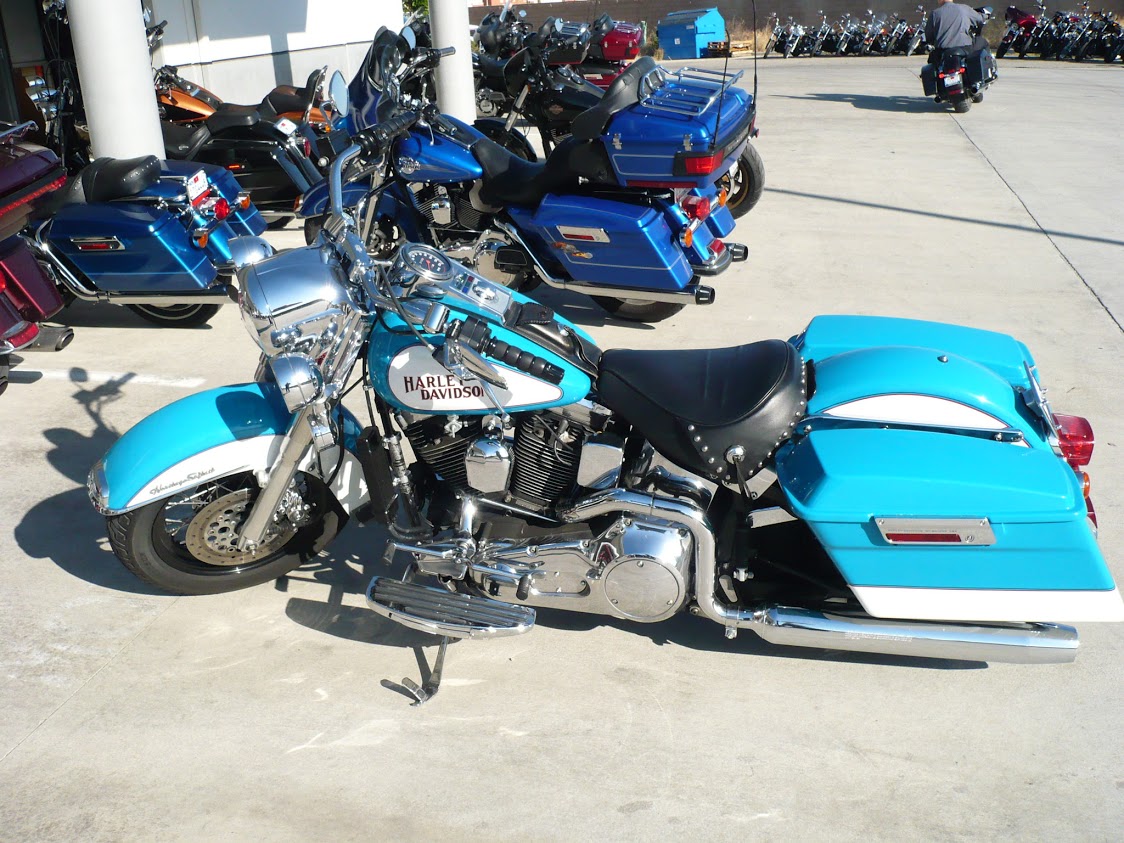 My bike…before the ‘Transmission-transplant’. 1991 FLSTC
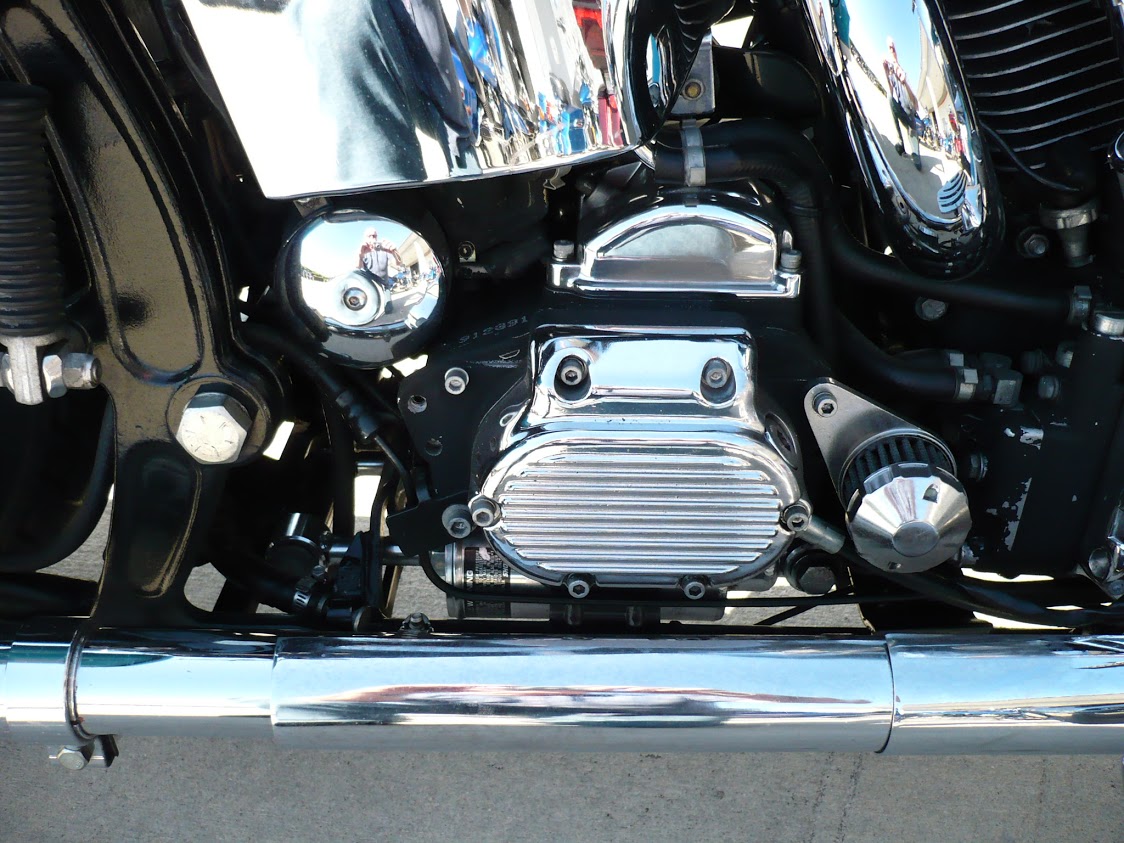 The stock 5-speed. John ended up using this cover and the stock ramp-and-ball (details in the narrative).
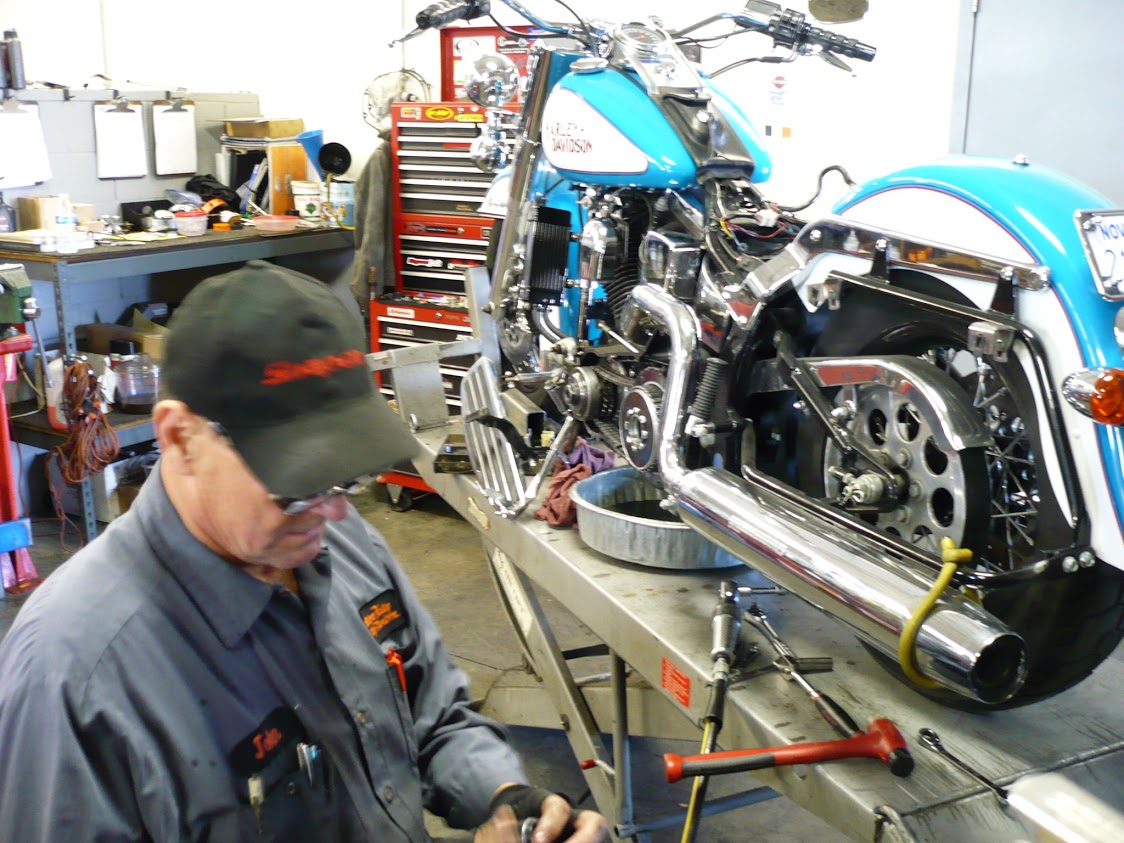 John ‘The Wrench” (a hard-working, precise, and thorough guy). The job he did has proven to be flawless…
 Naked primary. I have a Hayden M-6 installed. We left it in. So far, so good… Note the ‘caca’ on the primary around the bolt-holes (only way I could get the gasket to stay put when I re-assembled after installing the Hayden…I presume John, being a ‘pro’, had better luck. BTW, the ‘caca’ is actually Permatex High Tack Gasket Sealer…the goop equivalent of ‘duct tape’ in my book.)
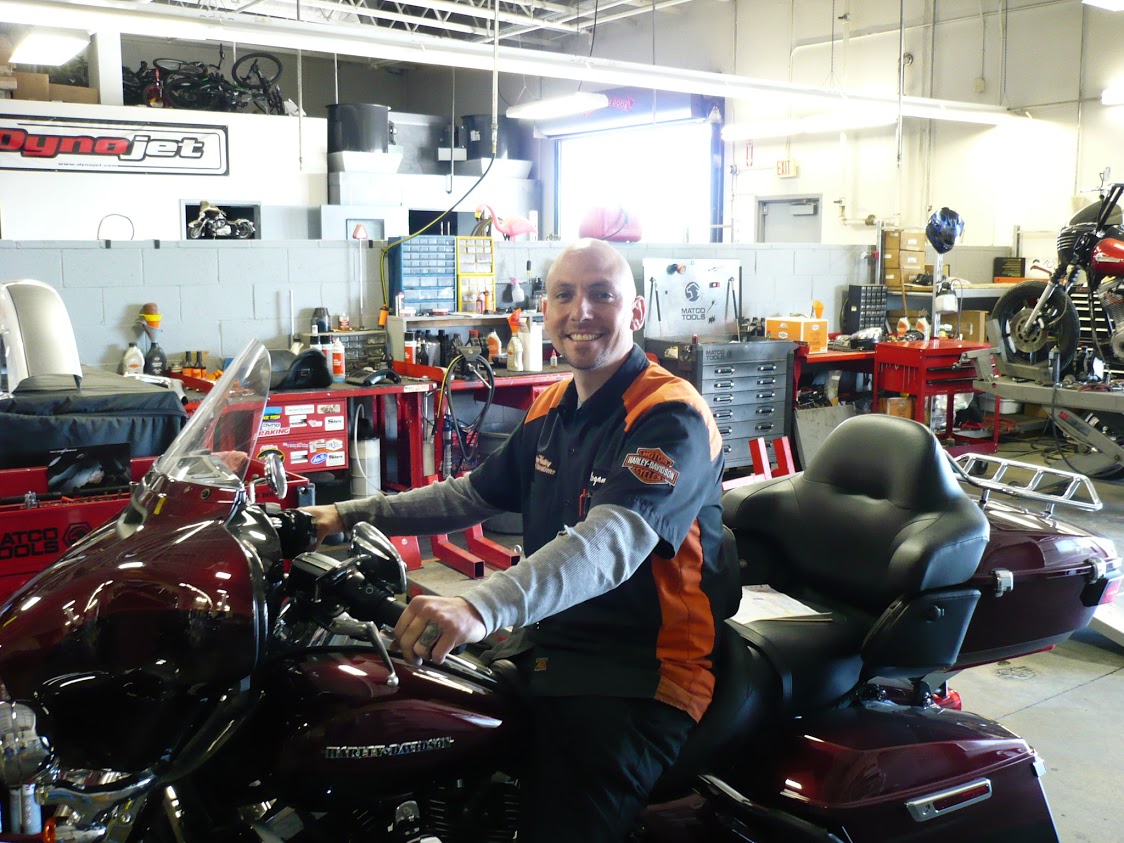 This is Logan. He’s Antelope Valley Harley’s Service Manager. I met him when he was just starting his career. He’s honest, and easy to deal with, one of the main reasons I keep going back to this dealer for service. He’s very good at balancing the customer’s interests with those of his employer.
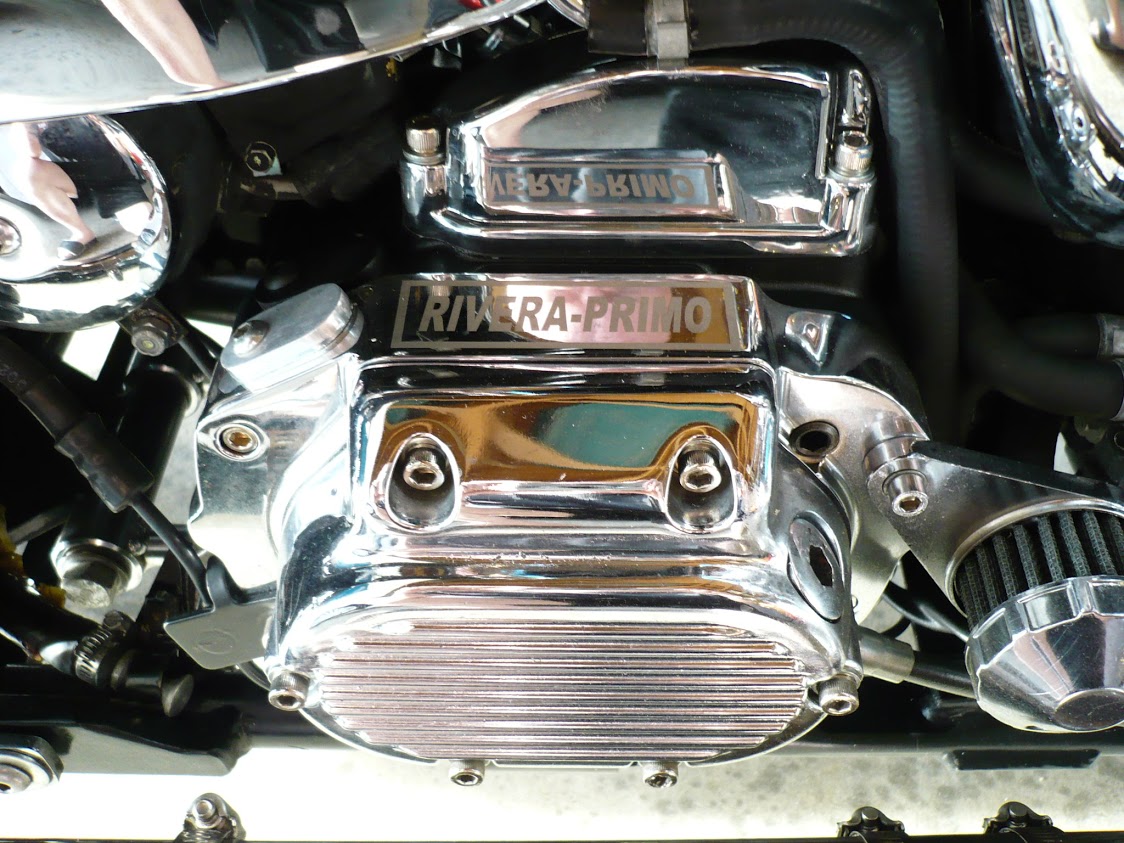
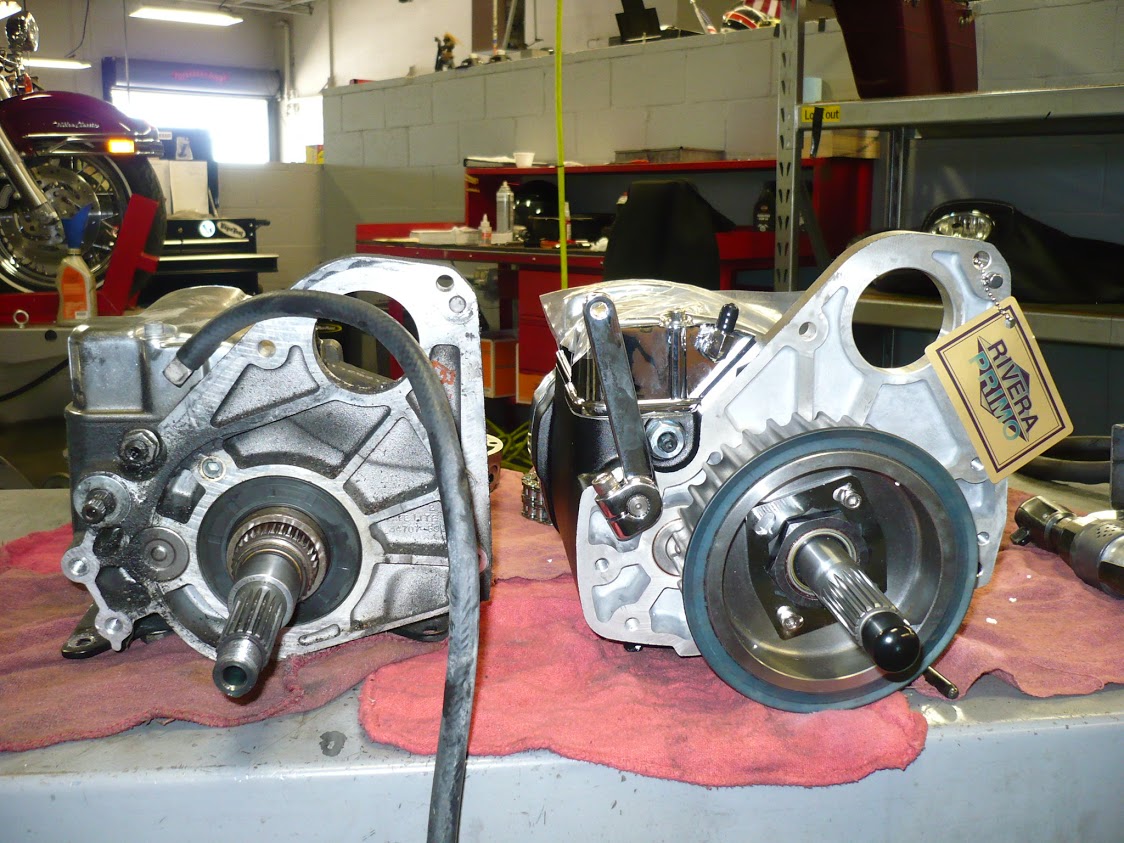 The old and the new. I bought a black/chrome transmission, but Rivera Primo sells a polished transmission for the same price. They also sell a chrome tranny for a little more.
 Close-up of the new six-speed. The ‘hatch’ on top is the access for the speedometer sensor, I believe. (My bike uses a cable hooked-up to the front wheel. You can have all that new-fangled sh…)
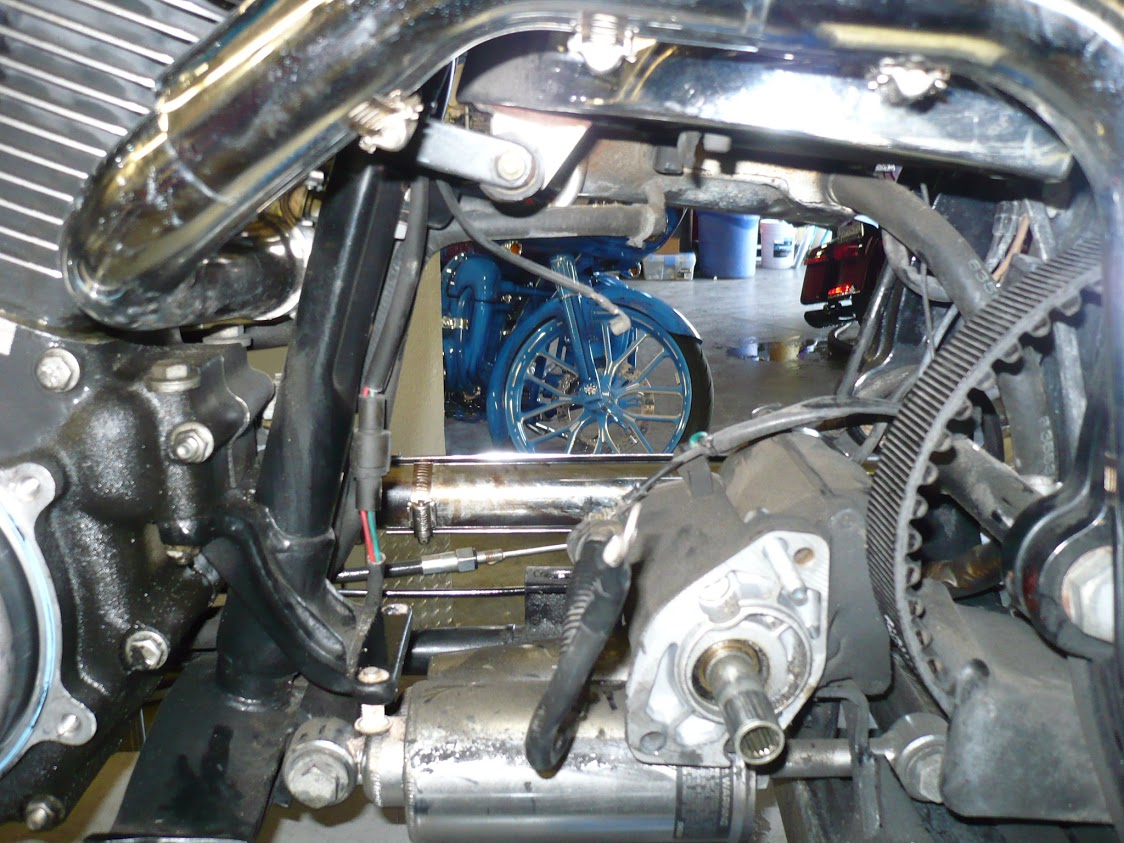 The ‘hole’ where the old transmission used to sit. John cleaned this all up before installing the new trans… Interestingly, he didn’t have to drop the oil ‘bag’. Note the ‘pretty’ blue bike in the background. No idea what it was in for. But it sure was…blue.
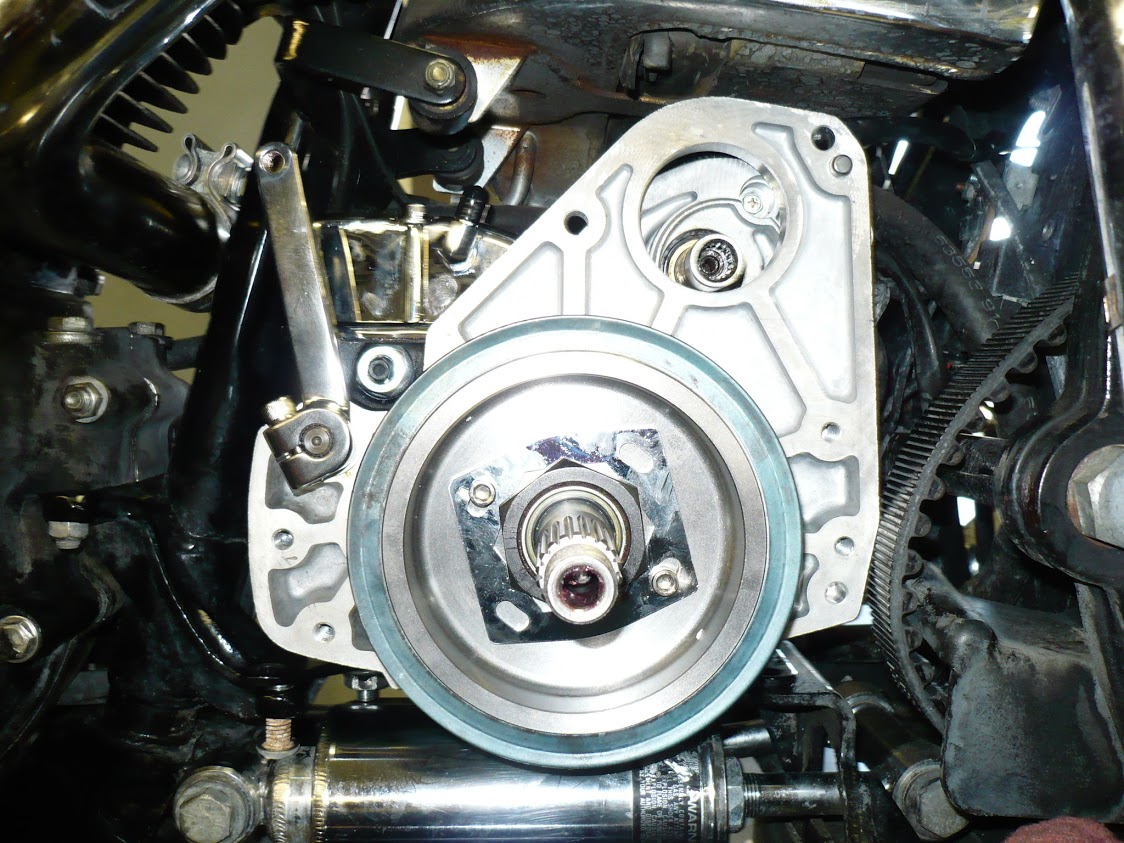 The new Rivera Primo model 1214-0004, 6-speed transmission in place on my ’91 Softail Heritage Custom (FLSTC)…
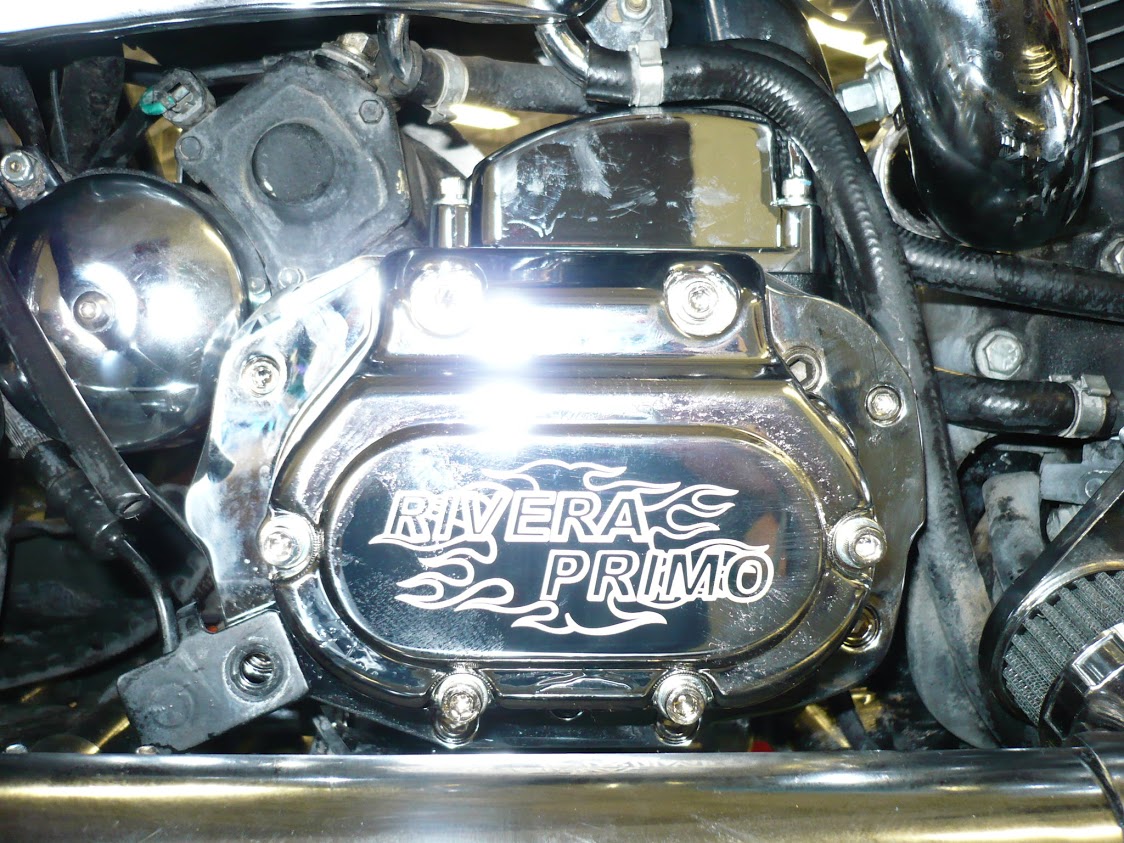 The other side. John had to replace this fancy end-cover with the stock cover, due to a ramp-and-ball/coupler assembly issue (see text). Rivera responded quickly to the issue and replaced the faulty part without complaint or hassle. I like the stock end-cover well enough (it’s low-key) so I might not ‘upgrade’ to this one right away. But I have the parts, for when I wish to do so…
The installation was an all-day affair, as I mentioned earlier. During the installation process, John found an issue with the shocks. An earlier servicer had used bolts that were too long to secure the forward end of the shocks to the frame. He called me back into the work area and demonstrated, wiggled a shock back-and-forth on the bolt for me, and said, simply: “Not right.” He fixed the situation at no additional charge. I think I would not have caught this issue had I installed the transmission myself. Sometimes that extra pair of ‘eyes’ (and extra experience) is a real help.
I waited around all day. I probably put 20 laps in, rambling around the store. I bought one hat. But nearly bought a bunch of other stuff. (Those new Softail Slim S bikes…110ci…cruise…ABS…are pretty nice, ya’ know? Naw…I love my EVO.) I’ve found impulsive shopping to occur with me when I have all that free time at the dealer. But all-in-all, it was a good day.
The final price-tag was $1100 for the transmission, and $750 for the installation (parts/labor). So, $1850 was the final ‘damages’. It’s not chicken-feed. But it was money well-spent.
You have to get everything lined-up correctly; you’ll be replacing gaskets for the primary, etc., and you’ll need one or two special tools for the installation. But if you’ve got those tools or can borrow them, a shop manual, and if you’ve got the talent and the inclination, you can save yourself ‘labor’, (you still need gaskets, etc.) if you perform the install yourself. I’m old, and I’m lazy. These days, the money is a little easier to come by than the time…and motivation. So I had AV-Harley-Davidson do it for me.
Like I said, I’ll drop a note along about every 5,000 miles, detailing how this transmission has fared in my bike. As I mentioned earlier, once installed, everything has literally been flawless in 1,000 miles.
 The End
Join the discussion in the forum.>>
Content and photos by Alan Stansbery.
Thanks Alan!
You must be logged in to post a comment.