
Lane Splitting: Is it For Everyone?
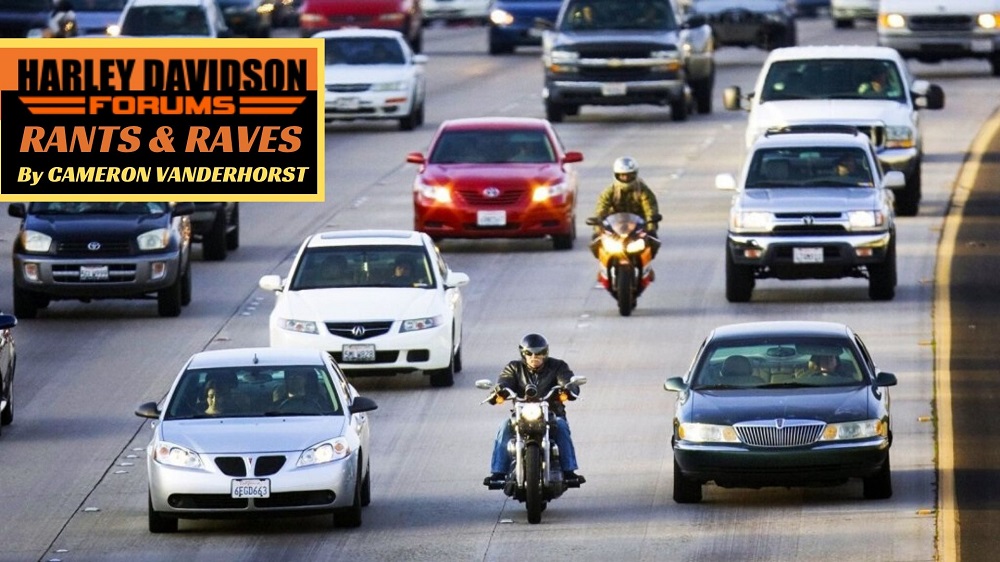
If we want lane splitting to spread across America, we need to make a few changes first.
Lane splitting: To some, it represents a forbidden fruit, a way to use the naturally nimble nature of a motorcycle to avoid traffic jams. To others, lane splitting is a potentially dangerous act that could harm more motorcyclists than it helps. Last year, the practice officially became legal in California.
How did Californians adapt? By my estimation, quite well. Last December, I visited Southern California for the first time, and subsequently got my first taste of LA traffic. Despite being aware of lane splitting, I still found myself surprised when a motorcycle would ride by in traffic, just a few inches away from my car door.
In the bumper-to-bumper traffic of Los Angeles, seeing motorcyclists casually disappear into the distance while I inched along was a dramatic confirmation of lane splitting’s congestion-relieving abilities. The National Highway Traffic Safety Administration (NHTSA) famous Hurt Report found other benefits.
Despite its age, the Hurt Report offers perhaps the most comprehensive picture available of motorcycle safety in a practical sense. Although data was collected beginning in 1976, it wasn’t published until 1981. In that report, it was found that lane splitting reduced fatalities from rear-end collisions by 30%.
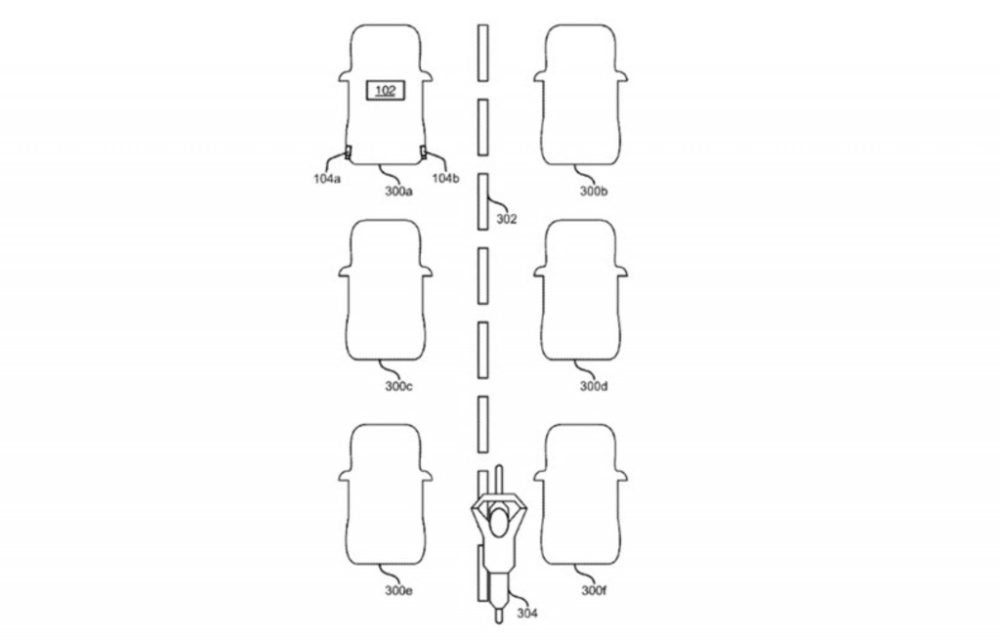
It makes perfect sense. Motorcycles are often lost in the visual overload represented by a long line of traffic, and it’s very likely that a car driver won’t stop in time to avoid a collision with a stopped motorcycle. Allowing motorcycles to continue moving through traffic removes the opportunity for this to happen.
It sounds like a win-win for everyone involved, although it is mostly motorcyclists benefiting. Do I think that all states should legalize lane splitting? Not at all.
To the uninitiated, it looks like total chaos. But after a few days of driving in L.A., I began to understand and even participate in the perfectly choreographed automotive ballet for myself.
I would say that California is a unique situation that’s almost tailor-made for lane splitting. While the population density of metropolitan areas is jaw-dropping, resulting in heavy traffic, the driving culture has adapted to make the best of the situation. In my experience, California drivers are, surprisingly, among the most courteous and the most cautious I’ve ever encountered.
While this runs counter to nearly every anecdotal stereotype you’ve likely heard, I discovered quickly that merging and changing lanes was easier in many cases than it was in my home state of Ohio, even in peak rush-hour traffic. Despite the cramped spaces and high speeds, other drivers were always willing to make a space for me.
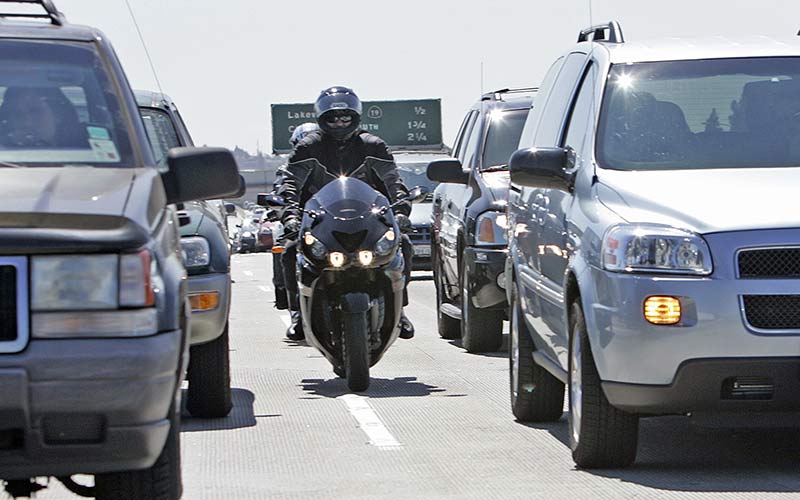
Aggressive drivers do exist, but like a gemstone in a rock tumbler, those sharp edges are gradually worn away by abrasion and attrition. Discourteous, inattentive drivers simply do not last long in Los Angeles.
As a result, I soon discovered my habits changing as well. Instead of my usual defensive, somewhat territorial driving style honed by years of dodging potholes, errant construction barrels, and clueless drivers back home in Ohio, I adapted to a decidedly more Californian outlook.
In short, lane splitting could be an excellent way to reduce congestion and encourage more people to treat their motorcycles like real, useful commuter vehicles instead of toys.
Much like Southern California itself, the prevailing driving attitude perfectly balances the duality of a simultaneously fast-paced and laid-back environment. As if California drivers believe in some sort of universal traffic karma, they were happy to accommodate every other driver on the road, knowing that others would do the same when they needed to change lanes, merge, or adjust speed.
To the uninitiated, it looks like total chaos. But after a few days of driving in L.A., I began to understand and even participate in the perfectly choreographed automotive ballet for myself.
What this means is that motorcyclists who are splitting lanes have resolved to trust every car they pass on either side to not only remain squarely in their lane, but not to dart out without fair warning and careful consideration. It represents a huge leap of faith on the part of the motorcyclist, but given the environment outlined above, it represents acceptable risk for many.
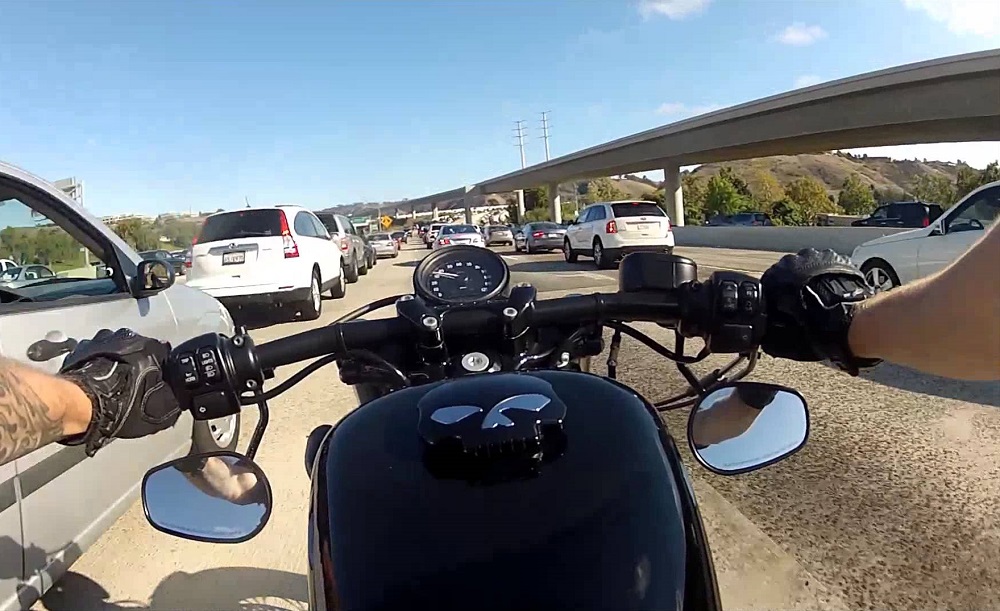
In short, lane splitting could be an excellent way to reduce congestion and encourage more people to treat their motorcycles like real, useful commuter vehicles instead of toys. However, to work effectively without causing more problems than it solves, our country’s driving culture requires a serious overhaul.
In a world where getting motorists to even acknowledge the presence of motorcycles within the normal traffic lanes is a struggle, it seems impossible. Perhaps it can start with you. Next time you drive your car, think of this article, and try to drive more courteously and patiently. In the words of Gandhi, “Be the change you wish to see in the world.”
Me? Getting all touchy-feely and quoting Gandhi? Maybe I spent too much time out there and it rubbed off on me. As much as it pains me to say it, they really do have the right idea in California.
Join the Harley-Davidson Forums now!

You must be logged in to post a comment.