When you click on links to various merchants on this site and make a purchase, this can result in this site earning a commission. Affiliate programs and affiliations include, but are not limited to, the eBay Partner Network.
Well I got plenty of time on my hands, got the idea to build a boosted HD via a non waste gated turbo.
Out of the two kits on the market they are not the best looking... mostly due to bolt flanged vs v band setups, followed on by waste gated turbos, and some rinky dink bov behind the air Intake vs a tial.
Trask has the better looking "kit" however they are still lacking in areas in my opinion. No ceramic coating options or visible bov and no straight pipe option cause let's be real, who wants a baffle on a tubo'ed bike?
Came here to look at turbo sizing and options.
Chocked it up to most running a GT22 turbo size and most even custom setups are only pushing 8lbs on the bike. For some reason I have a feeling a lot more boost could be had and further push a 103-107 engines.
I know no bike could push a T4 flanged turbo or be considered usable gains outside drag racing if that.
Would love to hear what y'all think, engine building is not a new "hobby" to me, diesel game is where I hail from.
Last edited by Sch3rfn3r; Oct 10, 2023 at 12:32 AM.
Reason: Spelling
My 96" Fat Boy has a Sean Ray turbo kit from about 10 years ago. He's out of the biz now, but I really liked the setup. I did have to add the BOV and boost controller as it was originally set up on kill for Bonneville. 20psi on race gas. Now I've got a E-Boost street controller. Turn the power switch off and I get 8.5psi from the WG spring. Setting 1 is 10psi (where I usually ride it) and setting 2 is 14psi, the max for pump gas I've found. I do run Aces IV fuel additive in 91 pump gas.
Last edited by WS6_Keith; Oct 10, 2023 at 01:07 PM.
My 96" Fat Boy has a Sean Ray turbo kit from about 10 years ago. He's out of the biz now, but I really liked the setup. I did have to add the BOV and boost controller as it was originally set up on kill for Bonneville. 20psi on race gas. Now I've got a E-Boost street controller. Turn the power switch off and I get 8.5psi from the WG spring. Setting 1 is 10psi (where I usually ride it) and setting 2 is 14psi, the max for pump gas I've found. I do run Aces IV fuel additive in 91 pump gas.
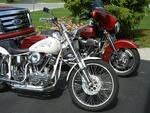
nice buster but I like the legs in the background better.
My 96" Fat Boy has a Sean Ray turbo kit from about 10 years ago. He's out of the biz now, but I really liked the setup. I did have to add the BOV and boost controller as it was originally set up on kill for Bonneville. 20psi on race gas. Now I've got a E-Boost street controller. Turn the power switch off and I get 8.5psi from the WG spring. Setting 1 is 10psi (where I usually ride it) and setting 2 is 14psi, the max for pump gas I've found. I do run Aces IV fuel additive in 91 pump gas.
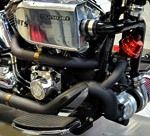
Truth be told that's one of the more interesting turbo mounted locations I have seen. How I would hate cleaning **** off that hot section of the turbo... couldn't imagine **** cooking on it.
If you don't mind me asking, why did you go with an electric boost controller when it all can be vacuum ran? As is you say, you switch it off? No need for an E controller if you plumb vac/boost lines and know how to add different springs and pre load via them "coins" that micro adjust the tension further.
Or is the e controller the actual boost and vac solenoid distributing "brain"? Cause that's how cars be doing it these days using solenoid vac and E-BoV's via pcm demands. Long gone are the days of anything being simple with out the need for a computer Vs a vacuum/boost manual gauge.
Also what's the turbo size if you don't mind me asking.
And further more why add an e controller when for a bov you only need to know idle HG pulled for bov activation and boost physically controls a waist gate activation and I do not see any electrical wires to your waist gate let alone bov.
And truth be told IMHO a waist gate is really only for turbo over speed prevention. Cause if you are using it regulate boost, your turbo isn't truly dialed in for application unless a wide range of boost is wanted for different riding conditions, meaning just bouncing around town vs going to the track on the same bike as you did describe.
Sorry if I am overbearing, just looking for your thought process.
Last edited by Sch3rfn3r; Oct 11, 2023 at 04:21 AM.
And truth be told on my end, I am asking all these questions cause id rather build a bike that does fine in town on just displacement alone and really light off on the turbo around 3000-3500 on boost...
No sense in switching maps and crap all the time when a tubo can make up for where low end power dies off on the top end and re wake it up.
Not much psi is truly needed in a decently high compression engine until it falls on itself in the higher rpm range.
And that's just my thoughts on the theory....
Cause some big ol jugs with a fat ****in snail would be legit on a twin cam....
Cause let's be real, there is replacement for displacement via boost.
For some reasons I have a feeling, that looking at boost on a V twin is probably not as linear as it would be on a 4cyl or larger engine.
I would imagine there would be a ton of waist gate flutter and to prevent compressor stall, one would want a bov to bleed off boost when both cylinders are not intaking air.
I'd imagine keeping stable turbine/compressor speed is the probably one of the bigger issues with turbo'ing a Harley.
I could see an electronic BoV being beneficial with boost controller as most cars with electronic bovs benefit from being slightly over boosted and venting off boost via Recirc systems.
Venting boost to atmosphere prevents compressor speed from falling when air is at a standstill and preventing compressor stall just as a car vents off during a shift to prevent turbine speed from decreasing and staying in the optimal range, same applies to a bike, more issues are added though to that due to being just a V twin.
Then coming from the diesel world, VGT turbos are huge, meaning allowing a larger turbo being able to produce boost quicker at a lower rpm range than what it's non VGT counterpart could do.
If VGT turbos could be made to a smaller size, then the VGT system could make up for over boosting when the V twin isn't on an Intake stroke however via a controller could manipulate boost control via the veins instead of a waist gate fluttering or electronic bov venting to atmosphere.
With the VGT system opening up around the turbine wheel, could prevent over boost conditions but with correct VGT closing timing around the turbine, could in essence maintain boost when the intake cycle comes back around.
Funny thing about that thought is that VGT turbos primarily fail due to unison rings locking up... being on diesel trucks, most stay at cruising speed on the highway for long periods of time with little Vaine manipulation. This causes soot to lock them up and the frying of the control solenoid. Hence most people asking tuners to add in idle VGT manipulation in attempt to keep the unison ring and veins from becoming caked up with soot.
Now if a VGT system can handle the temperatures of a gas engine, on a V twin, i would suspect that a vgt system that is constantly moving, would prevent premature failure due to a unison rings locking up and at most a solenoid.
Problem is, most VGT turbos use oil pressure to manipulate the veins. At least in the case of the 6.0. I believe Cummins was the first to use electronic solenoid if my memory serves me correctly.
First they started with just moving veins for engine braking, then onto a full system for low end boost.
For some reasons I have a feeling, that looking at boost on a V twin is probably not as linear as it would be on a 4cyl or larger engine.
I would imagine there would be a ton of waist gate flutter and to prevent compressor stall, one would want a bov to bleed off boost when both cylinders are not intaking air.
I'd imagine keeping stable turbine/compressor speed is the probably one of the bigger issues with turbo'ing a Harley.
I could see an electronic BoV being beneficial with boost controller as most cars with electronic bovs benefit from being slightly over boosted and venting off boost via Recirc systems.
Venting boost to atmosphere prevents compressor speed from falling when air is at a standstill and preventing compressor stall just as a car vents off during a shift to prevent turbine speed from decreasing and staying in the optimal range, same applies to a bike, more issues are added though to that due to being just a V twin.
Then coming from the diesel world, VGT turbos are huge, meaning allowing a larger turbo being able to produce boost quicker at a lower rpm range than what it's non VGT counterpart could do.
If VGT turbos could be made to a smaller size, then the VGT system could make up for over boosting when the V twin isn't on an Intake stroke however via a controller could manipulate boost control via the veins instead of a waist gate fluttering or electronic bov venting to atmosphere.
With the VGT system opening up around the turbine wheel, could prevent over boost conditions but with correct VGT closing timing around the turbine, could in essence maintain boost when the intake cycle comes back around.
Funny thing about that thought is that VGT turbos primarily fail due to unison rings locking up... being on diesel trucks, most stay at cruising speed on the highway for long periods of time with little Vaine manipulation. This causes soot to lock them up and the frying of the control solenoid. Hence most people asking tuners to add in idle VGT manipulation in attempt to keep the unison ring and veins from becoming caked up with soot.
Now if a VGT system can handle the temperatures of a gas engine, on a V twin, i would suspect that a vgt system that is constantly moving, would prevent premature failure due to a unison rings locking up and at most a solenoid.
Problem is, most VGT turbos use oil pressure to manipulate the veins. At least in the case of the 6.0. I believe Cummins was the first to use electronic solenoid if my memory serves me correctly.
First they started with just moving veins for engine braking, then onto a full system for low end boost.
An electronic BOV would be redundant, controlling boost pressure is done on the exhaust side via the wastegate, weather you use an internal wastegate or external wastegate is up to you. And the Intake Pulses from the Odd Fire twin are/can be absorbed by a plenum, which is why good turbo setups for a V-twin use at least some amount of plenum volume between the compressor and intake port....the more the better. The shaft speeds are a result of the amount of airflow of the engine relative to the compressor map of the compressor, and how close or far you are to the center of the map (center efficiency island being ideal). The thing is, turbo's blow hot air when they're too small and when they're too big. All you have to do is look at the efficiency islands of a compressor map to see.
Non diesel, gas turbines can't utilize VGT due to heat as you alluded to, but Twin Scroll turbochargers and spool valves are a possible avenue for quicker spool, though in my opinion, a properly sized turbo will have so little lag only the most picky "I'm an all motor guy" types will fault it, but to be fair, they'll fault anything other than a blower
P.S. The GT2252 is an excellent turbo, even if you're turning up the boost and even if you have motor work. And Guess what else? That turbo is smack dab in it's most efficent range, from as low as 120HP to as high as 250HP, and the map tops out at 28lb/minute, or roughly enough to support 280HP @ crank. So unless you plan on going past the 250whp mark, you'd pick up very small amounts of power going bigger, but also pick up a ton of lag.
Well I got plenty of time on my hands, got the idea to build a boosted HD via a non waste gated turbo.
Out of the two kits on the market they are not the best looking... mostly due to bolt flanged vs v band setups, followed on by waste gated turbos, and some rinky dink bov behind the air Intake vs a tial.
Trask has the better looking "kit" however they are still lacking in areas in my opinion. No ceramic coating options or visible bov and no straight pipe option cause let's be real, who wants a baffle on a tubo'ed bike?
Came here to look at turbo sizing and options.
Chocked it up to most running a GT22 turbo size and most even custom setups are only pushing 8lbs on the bike. For some reason I have a feeling a lot more boost could be had and further push a 103-107 engines.
I know no bike could push a T4 flanged turbo or be considered usable gains outside drag racing if that.
Would love to hear what y'all think, engine building is not a new "hobby" to me, diesel game is where I hail from.
If you're looking for kits look up Ron Poole on Facebook he's in Texas. Here's his email rpoole@yahoo.com he's making 285hp with boost with a built 124"
If you're looking for kits look up Ron Poole on Facebook he's in Texas. Here's his email rpoole@yahoo.com he's making 285hp with boost with a built 124"
Hey thanks for the info and reply.
As for the long post, I think a lot more can be done with turbos, manufacturing and design is where people Intentionally slow **** down cause idk who you are, jet engines run hotter than anything and they are a self supporting turbo 😉
When people don't discuss other avenues, advancement never happens, and most of these turbo kits offered out of a box type deal, are trash. And I'll say that openly. Cause if I had the money that most these folks have, id have a kit that appearance wise would murder the market. and after meeting all the big name turbo manufactures when I was in Detroit, they have no excuse for crappy looking exhaust housings, they decided to be cheap and literally just get an off the shelf turbo that was designed for a car.




 Boosting a Harley...