


Knurled Pistons


Thread Starter
|
Road Warrior


Joined: May 2017
Posts: 1,313
Likes: 1,997
From: Phoenix
 Knurled Pistons
It's winter and I'm off work due to a knee replacement. So I'm bored.
Back in the 80's I bought a 77 fxe drivetrain in a Ridgid frame. A nice Frankenstein chopper.
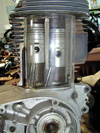
When I tore it down for rebuild I found the original pistons had the skirts knurled. I was green and never really thought about it then.
I had it bored out and put in new pistons.
This morning I did a little research on piston knurling and it looks like it was a popular way of cheaply rebuilding engines with worn out cylinders. Places like NAPA had a machine designed to do it.
Has anybody else ever come across knurled pistons?
Back in the 80's I bought a 77 fxe drivetrain in a Ridgid frame. A nice Frankenstein chopper.
When I tore it down for rebuild I found the original pistons had the skirts knurled. I was green and never really thought about it then.
I had it bored out and put in new pistons.
This morning I did a little research on piston knurling and it looks like it was a popular way of cheaply rebuilding engines with worn out cylinders. Places like NAPA had a machine designed to do it.
Has anybody else ever come across knurled pistons?
Seasoned HDF Member

Joined: Aug 2008
Posts: 5,034
Likes: 981
nothing new under the sun, they did valve guides also, especially so before replaceable guides became common. it raised the surface and added oil entrapment to boot.
https://www.google.com/search?q=knur...Hg&sclient=img
https://www.google.com/search?q=knur...Hg&sclient=img


Seasoned HDF Member
Joined: Jan 2009
Posts: 5,134
Likes: 2,951
From: WACO
There was article in Easy Rider magazine back when it was a rag by bikers for bikers about knurling pistons. Low on funds scooter tramps knurling out of spec pistons for one more rebuild. If I remember correctly. Their method involved clamping the piston in a vise with files on each vice jaw and pulling the files to knurl the piston. Not very technical. But. What to except from drunk scooter tramps back in the day? To buy a case of beer.
Come a long way? Huh?
Come a long way? Huh?
Last edited by OLD 96; Feb 8, 2024 at 09:02 PM.

Seasoned HDF Member
Joined: Aug 2008
Posts: 5,034
Likes: 981
recipe for disaster!!!!
all that would do is remove material so you are going in the opposite direction.
the piston is held in a fixture so that pressure can be applied against it with the knurling wheel, often, the backside was braced to prevent distortion and breakage.
as the knurl wheel rolled across the surface, valleys were created which push up the surround metal into hills. by using diff wheels, you controlled the cross hatch and depth.
all that would do is remove material so you are going in the opposite direction.
the piston is held in a fixture so that pressure can be applied against it with the knurling wheel, often, the backside was braced to prevent distortion and breakage.
as the knurl wheel rolled across the surface, valleys were created which push up the surround metal into hills. by using diff wheels, you controlled the cross hatch and depth.

Road Master

Joined: Mar 2012
Posts: 958
Likes: 915
From: Ohio
Knurling pistons became a common practice for mechanics during the second world war. Raw metal materials were hard to acquire in the US, so replacement parts were hard to come by. They had to have a way to add some life to the worn pistons, so mechanics would knurl the skirted area of the pistons.

Stellar HDF Member
Joined: Mar 2012
Posts: 2,008
Likes: 595
From: Columbus, OH
It's funny to read these forums and watch everybody fuss over every detail to the Nth degree of a nat's ***. But in other situations how what we consider compromised parts will run in an engine and for sometimes a surprisingly long time. I worked for a guy one time building 2 stroke Detroits for old Terex equipment, I had to put almost everything I knew about building engines aside to to get things done the way he wanted, I would show him parts that I thought should be scrapped and he would tell me to use it again, one time I put a set of liners and pistons in the scrap bin another guy went and took them out cleaned up the scoring with a roloc disc, flap disc on the liner bore, and a new set of rings, and that motor ran for a couple of years, and the failure was a rod through the block, not the cylinders. I really learned the meaning of all it's got to do is run. It was an interesting job but not my style at all so I moved on after a few years

Trending Topics

Seasoned HDF Member

Joined: Jan 2011
Posts: 157,110
Likes: 56,613
From: Michigan 15 Minutes East Of Hell
There was article in Easy Rider magazine back when it was a rag by bikers for bikers about knurling pistons. Low on funds scooter tramps knurling out of spec pistons for one more rebuild. If I remember correctly. Their method involved clamping the piston in a vise with files on each vice jaw and pulling the files to knurl the piston. Not very technical. But. What to except from drunk scooter tramps back in the day? To buy a case of beer.
Come a long way? Huh?
Come a long way? Huh?
Seasoned HDF Member
Joined: Aug 2008
Posts: 5,034
Likes: 981
well, you have a parts changer, NOT a mechanic!
but that also goes back to the company. some do not want the downtime because it is cheaper to replace. just a couple of simple tests will verify the need or not. sadly, the detroit two cycle has been phase out, but there are still plenty out there. my favorite was the 149, a baby emd.
but that also goes back to the company. some do not want the downtime because it is cheaper to replace. just a couple of simple tests will verify the need or not. sadly, the detroit two cycle has been phase out, but there are still plenty out there. my favorite was the 149, a baby emd.

Club Member


Joined: Apr 2016
Posts: 11,358
Likes: 8,197
From: Inland NW

It's funny to read these forums and watch everybody fuss over every detail to the Nth degree of a nat's ***. But in other situations how what we consider compromised parts will run in an engine and for sometimes a surprisingly long time. I worked for a guy one time building 2 stroke Detroits for old Terex equipment, I had to put almost everything I knew about building engines aside to to get things done the way he wanted, I would show him parts that I thought should be scrapped and he would tell me to use it again, one time I put a set of liners and pistons in the scrap bin another guy went and took them out cleaned up the scoring with a roloc disc, flap disc on the liner bore, and a new set of rings, and that motor ran for a couple of years, and the failure was a rod through the block, not the cylinders. I really learned the meaning of all it's got to do is run. It was an interesting job but not my style at all so I moved on after a few years

I was one of the techs taking care of old 567 and 645 EMDs in stationary power plants up in AK, and "wear limits" was a very real thing. You would spend a week tearing down 16 cylinder kits at 645 in/3 per cylinder to measure and inspect. As a younger tech, I just wanted to replace it all!
This however, was not cost effective to the end customer
