


What cam is in a stock 2019 cvo 117


Thread Starter
|
Ultimate HDF Member
Joined: Oct 2016
Posts: 5,063
Likes: 2,582
From: On my bike!
 What cam is in a stock 2019 cvo 117
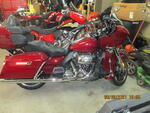
What cam is in a stock 2019 cvo 117? Is it similar to say putting a tq cam in a 107? Just wondering cause it doesn't sound any different than a stock 107, expected it to have a little lope, got slip ons coming so maybe that will bring out any if it has it. Thanks!
Last edited by Quik; Oct 26, 2018 at 07:18 PM.
Road Master
Joined: Aug 2009
Posts: 874
Likes: 80
From: new york
Unlike the CVO 114" that had the same cam as the 107", the 117" has better than the 114" cam timing. I think that is why they don't list the torque cam for the 117".
2018/9 CVO cam timing looks like this,
-9/17 188 .438 intake
48/-16 212 .432 exhaust
Torque cam
0/17 197 .447 intake
42/5 217 .462 exhaust
Stock 2017 114" CVO cam
7/1 174 350 intake
33/14 199 374 exhaust
2018/9 CVO cam timing looks like this,
-9/17 188 .438 intake
48/-16 212 .432 exhaust
Torque cam
0/17 197 .447 intake
42/5 217 .462 exhaust
Stock 2017 114" CVO cam
7/1 174 350 intake
33/14 199 374 exhaust
Thread Starter
|
Ultimate HDF Member
Joined: Oct 2016
Posts: 5,063
Likes: 2,582
From: On my bike!
Unlike the CVO 114" that had the same cam as the 107", the 117" has better than the 114" cam timing. I think that is why they don't list the torque cam for the 117".
2018/9 CVO cam timing looks like this,
-9/17 188 .438 intake
48/-16 212 .432 exhaust
Torque cam
0/17 197 .447 intake
42/5 217 .462 exhaust
Stock 2017 114" CVO cam
7/1 174 350 intake
33/14 199 374 exhaust
2018/9 CVO cam timing looks like this,
-9/17 188 .438 intake
48/-16 212 .432 exhaust
Torque cam
0/17 197 .447 intake
42/5 217 .462 exhaust
Stock 2017 114" CVO cam
7/1 174 350 intake
33/14 199 374 exhaust



Unlike the CVO 114" that had the same cam as the 107", the 117" has better than the 114" cam timing. I think that is why they don't list the torque cam for the 117".
2018/9 CVO cam timing looks like this,
-9/17 188 .438 intake
48/-16 212 .432 exhaust
Torque cam
0/17 197 .447 intake
42/5 217 .462 exhaust
Stock 2017 114" CVO cam
7/1 174 350 intake
33/14 199 374 exhaust
2018/9 CVO cam timing looks like this,
-9/17 188 .438 intake
48/-16 212 .432 exhaust
Torque cam
0/17 197 .447 intake
42/5 217 .462 exhaust
Stock 2017 114" CVO cam
7/1 174 350 intake
33/14 199 374 exhaust

Thread Starter
|
Ultimate HDF Member
Joined: Oct 2016
Posts: 5,063
Likes: 2,582
From: On my bike!
Best I can find seems like the 117 has what would be considered the horsepower power cam instead of tq cam, I'm not sure though, found some dyno videos and they are not very impressive but I never expected it to be a race horse anyway.
Thread Starter
|
Ultimate HDF Member
Joined: Oct 2016
Posts: 5,063
Likes: 2,582
From: On my bike!
Looks like a stock 107 M8 with a drop in cam puts out better numbers than the stock 117, that seems crazy to me, especially since the 117 is supposed to have a high performance cam in it from the factory. I guess it's really not a big deal or maybe I'm just looking at it all wrong.

Intermediate
Joined: May 2017
Posts: 37
Likes: 78
From: Rim Country
For starters, the specs listed above are missing some important “negative” signs. For instance, the timing numbers for the Stock 2017 114" CVO cam (which is the same as the stock 107 cam) don’t add up.
When you add 7 + 1 + 180 intake degrees, it adds up to 188 degrees, but it should add up to 174 degrees. And when you add 33 + 14 + 180 exhaust degrees, it adds up to 127 degrees, but it should total 199 degrees.
Following are the correct specs for the stock 2017 114" CVO cam (and stock 107 cam): The SE Performance Parts Catalog is wrong in several areas.
Timing Dur Lift
-7/1 174 .350 intake
33/-14 199 .374 exhaust
Now, when you add -7 + 1 + 180, it totals out to 174 degrees intake duration, as it should.For the exhaust, 33 + -14 + 180 now correctly totals 199 degrees duration.
The SE8-447 Torque cam’s intake timings are correct, but the exhaust closing is missing a “minus” sign. Following are the correct SE8-447 Torque cam O/C timings:
SE8-447 Torque cam:
0/17 197 .447 intake ( 0 + 17 + 180 = 197)
42/-5 217 .462 exhaust (42 + -5 + 180 = 217 duration)
Regarding the 2018/9 CVO cam timing, the opening and closing timings for both valves do add up to 188 and 212 durations, respectively, but those are not the currently published MoCo opening and closings for that cam.
Following is what the MoCo “should be” publishing in its 2019 SE Performance Parts catalog for the stock 2018/19 CVO 117 cam:
2018/9 CVO cam timing:
-11/19 188 .432 intake (-11 + 19 + 180 = 188)
47/-15 212 .445 exhaust (47 + -15 + 180 = 212)
Take note that the MoCo forgot the necessary “minus” signs in their 2019 SE Performance Parts catalog.
However, there’s a logical explanation for the discrepancy between the originally posted CVO 117 cam timing numbers (the Cam Doctor numbers) and the published MoCo timings:
The originally posted timing numbers were obtained by an aftermarket high-performance shop that had a stock CVO 117 cam rolled on a Cam Doctor before the MoCo published any timing figures. The MoCo only officially published their timing numbers as of September 2019 in their 2019 SE Performance Parts Catalog.
I’d bet that the Cam Doctor numbers for the specific cam that was tested are correct for that camshaft. The MoCo’s timing numbers are what they are shooting for on a typical production line. So, take them with a grain of salt.
You got to remember that the MoCo has never been known as an engineering company. Instead, it is a “high-powered” marketing company, and always has been! If you don’t believe me, just look at how successful they have been at selling $50k-plus M8 CVOs with sumping engines and tranny oil-transfer problems. And their FUD (fear, uncertainty and doubt) program works very well. Plus, their Q3 2018 Financial Report shows stunning creativity and orange-and-black hype. I wish I could afford such clever accountants.
The difference between the Cam Doctor and the MoCo’s cam specs are only two degrees on the intake and one degree on the exhaust, which are minuscule at this low performance level. I would disregard them. However, if you were blueprinting a serious race engine, you would want to verify the exact cam timing specs.
Another thing to note about M8 cam timing specs are that they are taken at .050” tappet lift and not at .053” lift, which is the standard for previous Harley engines like the Twin Cam, Evo, etc. In the 1950s, Tom Sifton (Harley racer, engine builder, dealer, cam grinder) set the de facto measuring standard at .053”. Since then, automotive companies and others have mostly standardized on .050” lift, and the MoCo adopted it as their M8 cam standard. The difference between measuring at .053” and .050” is small, but it does exist. Duration specs will be slightly larger for cams measured at .050” tappet lift than at .053”. I’ve noticed that some companies published M8 cam specs are ambiguous as to what measurement their specs were taken at. Be sure to check or ask when in doubt.
For a given engine combination, a cam’s duration and intake valve closing (IVC) are the most important followed by exhaust valve opening (EVO) and overlap. And there are sound reasons for this. Power can only be made between when the valves are closed: between intake valve close and exhaust valve open. Think about that! Duration is what gives an engine “breathing” power, the opening and closing timing of the intake and exhaust valves can optimize cylinder filling and exhaust blow-down, and overlap can optimize cylinder filling and exhaust scavenging.
Your first question in post #1 asks if the CVO 117 cam would sound much different in your 107 (I assume you have a 107 M8) than the SE8-447 torque cam. Personally, I doubt it. The torque cam has slightly more duration, and both cams close the intake at nearly the same time. But it’s mostly “overlap” that gives the V-Twin the desirable lopey idle. Both cams have negative (meaning Zero) overlap, although the torque cam has less negative overlap than the CVO 117 cam. Regarding sound, I think you are splitting hairs, and there will be little if any difference.
If you want a lopey idle, install a Zipper’s Red Shift 468 cam. It has much more overlap (28 degrees) for great sound, and it performs well in a 107. It also closes the intake at a moderate 16.5-degrees abdc, which is a good compromise for cylinder filling, low-end torque, and high rpm running on a relatively low-compression 10:1 107 motor.
Also, note that most stock 107 motors do not have a true 10:1 static compression ratio. Most are at least a third of a point “or more” lower due to a negative piston deck height in the cylinder of at least 0.015” inch, and a large combustion chamber that is usually closer to 88cc - 89cc in volume than the needed 85cc that is required for a true 10:1 ratio. Many owners do not take that little ditty into consideration.
Notice that the three cams listed have negative or zero overlap, and the CVO 117 cam has a very wide lobe separation angle (113 deg). That’s due to EPA restrictions. The negative overlap, short duration, and an early closing intake all contribute to the stock M8’s high low-end torque and it’s early running out of breath, or air, at roughly 3800-4000 rpm. It’s the cam that gives an engine its personality. Within limits, you can rock an engine’s performance curve either left or right by changing the cam specs. But usually there is no free lunch. You typically gain on one side and lose on the other. The trick is to pick a happy medium for your engine combo, application and riding style. That’s the “art” part of engine building. There’s also a “science” part.
From a performance standpoint, the optimum cam overlap for a give engine is determined by the combustion chamber design (both the chamber roof at the top and the piston dome at the bottom), the intake track, and the exhaust tract’s scavenging characteristics. Too much overlap and you are tossing fuel, power and fuel economy out the exhaust. Too little and you are not filling the cylinder as much as you could have, again leaving power on the table. The lopey idle sound is a byproduct of overlap. Also, higher compression will also give more a “cracking” sound to the exhaust note.
Looking at the “corrected” cam timing numbers listed above, it now makes sense that a stock 107 M8 with a longer (more duration) bolt-in cam produces better power numbers than a stock CVO 117 with a shorter cam. The reason is that most mild 107 bolt-in cams range between 200 and 235 duration and have positive overlap, whereas the stock CVO 117 cam has short durations of 188/212, and zero overlap. Duration gives an engine time to breathe, especially at higher rpms where the filling cycle has much less time due to increased piston speed. And positive overlap can help stuff the cylinder even further. Essentially, a smaller 107 motor with improved cylinder filling provided via a bolt-in cam has more air/fuel to burn than a larger 117 that’s stuffed up, especially in the higher rpm range.
Sound engine building principles are a combination of science and art, but you have to first understand the science (i.e., the engine building fundamentals) before you can get to the “art” part of engine building. That’s why it’s important to educate yourself on engine fundamentals, even if you will never build your own engine. It will allow you to ask the important questions and help you select the right engine builder and parts combination for your project. In this example, knowing the correct answers to your questions should save you the time and money from buying a zero-overlap cam and expecting it to sound much more lopey than the zero-overlap stock cam.
You also need to know product specs to correctly build an engine or to draw even basic hypothetical conclusions. If we never knew the correct specs to the three cams listed above, we would never have been able to draw the conclusions we did. We would be flying blindly, looking only at some dyno chart and endlessly wondering why is “that” happening, or speculating why the engine sounds so wimpy after a cam change. We'd be only gussing. This thread is a classic example of why knowing engine fundamentals and part specifications can save you a bunch of time, money and disappointment.
So, despite what some would have you believe, it is crucial knowing the specs of your parts when building an engine or making buying decision, even for mild engines like the ones described above.



Trending Topics



HD EFI Guru


Joined: Jan 2008
Posts: 4,418
Likes: 4,635
The reason these cam numbers don’t make sense is because they include incorrect timing values. With the correct numbers, they will all make sense.
For starters, the specs listed above are missing some important “negative” signs. For instance, the timing numbers for the Stock 2017 114" CVO cam (which is the same as the stock 107 cam) don’t add up.
When you add 7 + 1 + 180 intake degrees, it adds up to 188 degrees, but it should add up to 174 degrees. And when you add 33 + 14 + 180 exhaust degrees, it adds up to 127 degrees, but it should total 199 degrees.
Following are the correct specs for the stock 2017 114" CVO cam (and stock 107 cam): The SE Performance Parts Catalog is wrong in several areas.
Timing Dur Lift
-7/1 174 .350 intake
33/-14 199 .374 exhaust
Now, when you add -7 + 1 + 180, it totals out to 174 degrees intake duration, as it should.For the exhaust, 33 + -14 + 180 now correctly totals 199 degrees duration.
The SE8-447 Torque cam’s intake timings are correct, but the exhaust closing is missing a “minus” sign. Following are the correct SE8-447 Torque cam O/C timings:
SE8-447 Torque cam:
0/17 197 .447 intake ( 0 + 17 + 180 = 197)
42/-5 217 .462 exhaust (42 + -5 + 180 = 217 duration)
Regarding the 2018/9 CVO cam timing, the opening and closing timings for both valves do add up to 188 and 212 durations, respectively, but those are not the currently published MoCo opening and closings for that cam.
Following is what the MoCo “should be” publishing in its 2019 SE Performance Parts catalog for the stock 2018/19 CVO 117 cam:
2018/9 CVO cam timing:
-11/19 188 .432 intake (-11 + 19 + 180 = 188)
47/-15 212 .445 exhaust (47 + -15 + 180 = 212)
Take note that the MoCo forgot the necessary “minus” signs in their 2019 SE Performance Parts catalog.
However, there’s a logical explanation for the discrepancy between the originally posted CVO 117 cam timing numbers (the Cam Doctor numbers) and the published MoCo timings:
The originally posted timing numbers were obtained by an aftermarket high-performance shop that had a stock CVO 117 cam rolled on a Cam Doctor before the MoCo published any timing figures. The MoCo only officially published their timing numbers as of September 2019 in their 2019 SE Performance Parts Catalog.
I’d bet that the Cam Doctor numbers for the specific cam that was tested are correct for that camshaft. The MoCo’s timing numbers are what they are shooting for on a typical production line. So, take them with a grain of salt.
You got to remember that the MoCo has never been known as an engineering company. Instead, it is a “high-powered” marketing company, and always has been! If you don’t believe me, just look at how successful they have been at selling $50k-plus M8 CVOs with sumping engines and tranny oil-transfer problems. And their FUD (fear, uncertainty and doubt) program works very well. Plus, their Q3 2018 Financial Report shows stunning creativity and orange-and-black hype. I wish I could afford such clever accountants.
The difference between the Cam Doctor and the MoCo’s cam specs are only two degrees on the intake and one degree on the exhaust, which are minuscule at this low performance level. I would disregard them. However, if you were blueprinting a serious race engine, you would want to verify the exact cam timing specs.
Another thing to note about M8 cam timing specs are that they are taken at .050” tappet lift and not at .053” lift, which is the standard for previous Harley engines like the Twin Cam, Evo, etc. In the 1950s, Tom Sifton (Harley racer, engine builder, dealer, cam grinder) set the de facto measuring standard at .053”. Since then, automotive companies and others have mostly standardized on .050” lift, and the MoCo adopted it as their M8 cam standard. The difference between measuring at .053” and .050” is small, but it does exist. Duration specs will be slightly larger for cams measured at .050” tappet lift than at .053”. I’ve noticed that some companies published M8 cam specs are ambiguous as to what measurement their specs were taken at. Be sure to check or ask when in doubt.
For a given engine combination, a cam’s duration and intake valve closing (IVC) are the most important followed by exhaust valve opening (EVO) and overlap. And there are sound reasons for this. Power can only be made between when the valves are closed: between intake valve close and exhaust valve open. Think about that! Duration is what gives an engine “breathing” power, the opening and closing timing of the intake and exhaust valves can optimize cylinder filling and exhaust blow-down, and overlap can optimize cylinder filling and exhaust scavenging.
Your first question in post #1 asks if the CVO 117 cam would sound much different in your 107 (I assume you have a 107 M8) than the SE8-447 torque cam. Personally, I doubt it. The torque cam has slightly more duration, and both cams close the intake at nearly the same time. But it’s mostly “overlap” that gives the V-Twin the desirable lopey idle. Both cams have negative (meaning Zero) overlap, although the torque cam has less negative overlap than the CVO 117 cam. Regarding sound, I think you are splitting hairs, and there will be little if any difference.
If you want a lopey idle, install a Zipper’s Red Shift 468 cam. It has much more overlap (28 degrees) for great sound, and it performs well in a 107. It also closes the intake at a moderate 16.5-degrees abdc, which is a good compromise for cylinder filling, low-end torque, and high rpm running on a relatively low-compression 10:1 107 motor.
Also, note that most stock 107 motors do not have a true 10:1 static compression ratio. Most are at least a third of a point “or more” lower due to a negative piston deck height in the cylinder of at least 0.015” inch, and a large combustion chamber that is usually closer to 88cc - 89cc in volume than the needed 85cc that is required for a true 10:1 ratio. Many owners do not take that little ditty into consideration.
Notice that the three cams listed have negative or zero overlap, and the CVO 117 cam has a very wide lobe separation angle (113 deg). That’s due to EPA restrictions. The negative overlap, short duration, and an early closing intake all contribute to the stock M8’s high low-end torque and it’s early running out of breath, or air, at roughly 3800-4000 rpm. It’s the cam that gives an engine its personality. Within limits, you can rock an engine’s performance curve either left or right by changing the cam specs. But usually there is no free lunch. You typically gain on one side and lose on the other. The trick is to pick a happy medium for your engine combo, application and riding style. That’s the “art” part of engine building. There’s also a “science” part.
From a performance standpoint, the optimum cam overlap for a give engine is determined by the combustion chamber design (both the chamber roof at the top and the piston dome at the bottom), the intake track, and the exhaust tract’s scavenging characteristics. Too much overlap and you are tossing fuel, power and fuel economy out the exhaust. Too little and you are not filling the cylinder as much as you could have, again leaving power on the table. The lopey idle sound is a byproduct of overlap. Also, higher compression will also give more a “cracking” sound to the exhaust note.
Looking at the “corrected” cam timing numbers listed above, it now makes sense that a stock 107 M8 with a longer (more duration) bolt-in cam produces better power numbers than a stock CVO 117 with a shorter cam. The reason is that most mild 107 bolt-in cams range between 200 and 235 duration and have positive overlap, whereas the stock CVO 117 cam has short durations of 188/212, and zero overlap. Duration gives an engine time to breathe, especially at higher rpms where the filling cycle has much less time due to increased piston speed. And positive overlap can help stuff the cylinder even further. Essentially, a smaller 107 motor with improved cylinder filling provided via a bolt-in cam has more air/fuel to burn than a larger 117 that’s stuffed up, especially in the higher rpm range.
Sound engine building principles are a combination of science and art, but you have to first understand the science (i.e., the engine building fundamentals) before you can get to the “art” part of engine building. That’s why it’s important to educate yourself on engine fundamentals, even if you will never build your own engine. It will allow you to ask the important questions and help you select the right engine builder and parts combination for your project. In this example, knowing the correct answers to your questions should save you the time and money from buying a zero-overlap cam and expecting it to sound much more lopey than the zero-overlap stock cam.
You also need to know product specs to correctly build an engine or to draw even basic hypothetical conclusions. If we never knew the correct specs to the three cams listed above, we would never have been able to draw the conclusions we did. We would be flying blindly, looking only at some dyno chart and endlessly wondering why is “that” happening, or speculating why the engine sounds so wimpy after a cam change. We'd be only gussing. This thread is a classic example of why knowing engine fundamentals and part specifications can save you a bunch of time, money and disappointment.
So, despite what some would have you believe, it is crucial knowing the specs of your parts when building an engine or making buying decision, even for mild engines like the ones described above.
For starters, the specs listed above are missing some important “negative” signs. For instance, the timing numbers for the Stock 2017 114" CVO cam (which is the same as the stock 107 cam) don’t add up.
When you add 7 + 1 + 180 intake degrees, it adds up to 188 degrees, but it should add up to 174 degrees. And when you add 33 + 14 + 180 exhaust degrees, it adds up to 127 degrees, but it should total 199 degrees.
Following are the correct specs for the stock 2017 114" CVO cam (and stock 107 cam): The SE Performance Parts Catalog is wrong in several areas.
Timing Dur Lift
-7/1 174 .350 intake
33/-14 199 .374 exhaust
Now, when you add -7 + 1 + 180, it totals out to 174 degrees intake duration, as it should.For the exhaust, 33 + -14 + 180 now correctly totals 199 degrees duration.
The SE8-447 Torque cam’s intake timings are correct, but the exhaust closing is missing a “minus” sign. Following are the correct SE8-447 Torque cam O/C timings:
SE8-447 Torque cam:
0/17 197 .447 intake ( 0 + 17 + 180 = 197)
42/-5 217 .462 exhaust (42 + -5 + 180 = 217 duration)
Regarding the 2018/9 CVO cam timing, the opening and closing timings for both valves do add up to 188 and 212 durations, respectively, but those are not the currently published MoCo opening and closings for that cam.
Following is what the MoCo “should be” publishing in its 2019 SE Performance Parts catalog for the stock 2018/19 CVO 117 cam:
2018/9 CVO cam timing:
-11/19 188 .432 intake (-11 + 19 + 180 = 188)
47/-15 212 .445 exhaust (47 + -15 + 180 = 212)
Take note that the MoCo forgot the necessary “minus” signs in their 2019 SE Performance Parts catalog.
However, there’s a logical explanation for the discrepancy between the originally posted CVO 117 cam timing numbers (the Cam Doctor numbers) and the published MoCo timings:
The originally posted timing numbers were obtained by an aftermarket high-performance shop that had a stock CVO 117 cam rolled on a Cam Doctor before the MoCo published any timing figures. The MoCo only officially published their timing numbers as of September 2019 in their 2019 SE Performance Parts Catalog.
I’d bet that the Cam Doctor numbers for the specific cam that was tested are correct for that camshaft. The MoCo’s timing numbers are what they are shooting for on a typical production line. So, take them with a grain of salt.
You got to remember that the MoCo has never been known as an engineering company. Instead, it is a “high-powered” marketing company, and always has been! If you don’t believe me, just look at how successful they have been at selling $50k-plus M8 CVOs with sumping engines and tranny oil-transfer problems. And their FUD (fear, uncertainty and doubt) program works very well. Plus, their Q3 2018 Financial Report shows stunning creativity and orange-and-black hype. I wish I could afford such clever accountants.
The difference between the Cam Doctor and the MoCo’s cam specs are only two degrees on the intake and one degree on the exhaust, which are minuscule at this low performance level. I would disregard them. However, if you were blueprinting a serious race engine, you would want to verify the exact cam timing specs.
Another thing to note about M8 cam timing specs are that they are taken at .050” tappet lift and not at .053” lift, which is the standard for previous Harley engines like the Twin Cam, Evo, etc. In the 1950s, Tom Sifton (Harley racer, engine builder, dealer, cam grinder) set the de facto measuring standard at .053”. Since then, automotive companies and others have mostly standardized on .050” lift, and the MoCo adopted it as their M8 cam standard. The difference between measuring at .053” and .050” is small, but it does exist. Duration specs will be slightly larger for cams measured at .050” tappet lift than at .053”. I’ve noticed that some companies published M8 cam specs are ambiguous as to what measurement their specs were taken at. Be sure to check or ask when in doubt.
For a given engine combination, a cam’s duration and intake valve closing (IVC) are the most important followed by exhaust valve opening (EVO) and overlap. And there are sound reasons for this. Power can only be made between when the valves are closed: between intake valve close and exhaust valve open. Think about that! Duration is what gives an engine “breathing” power, the opening and closing timing of the intake and exhaust valves can optimize cylinder filling and exhaust blow-down, and overlap can optimize cylinder filling and exhaust scavenging.
Your first question in post #1 asks if the CVO 117 cam would sound much different in your 107 (I assume you have a 107 M8) than the SE8-447 torque cam. Personally, I doubt it. The torque cam has slightly more duration, and both cams close the intake at nearly the same time. But it’s mostly “overlap” that gives the V-Twin the desirable lopey idle. Both cams have negative (meaning Zero) overlap, although the torque cam has less negative overlap than the CVO 117 cam. Regarding sound, I think you are splitting hairs, and there will be little if any difference.
If you want a lopey idle, install a Zipper’s Red Shift 468 cam. It has much more overlap (28 degrees) for great sound, and it performs well in a 107. It also closes the intake at a moderate 16.5-degrees abdc, which is a good compromise for cylinder filling, low-end torque, and high rpm running on a relatively low-compression 10:1 107 motor.
Also, note that most stock 107 motors do not have a true 10:1 static compression ratio. Most are at least a third of a point “or more” lower due to a negative piston deck height in the cylinder of at least 0.015” inch, and a large combustion chamber that is usually closer to 88cc - 89cc in volume than the needed 85cc that is required for a true 10:1 ratio. Many owners do not take that little ditty into consideration.
Notice that the three cams listed have negative or zero overlap, and the CVO 117 cam has a very wide lobe separation angle (113 deg). That’s due to EPA restrictions. The negative overlap, short duration, and an early closing intake all contribute to the stock M8’s high low-end torque and it’s early running out of breath, or air, at roughly 3800-4000 rpm. It’s the cam that gives an engine its personality. Within limits, you can rock an engine’s performance curve either left or right by changing the cam specs. But usually there is no free lunch. You typically gain on one side and lose on the other. The trick is to pick a happy medium for your engine combo, application and riding style. That’s the “art” part of engine building. There’s also a “science” part.
From a performance standpoint, the optimum cam overlap for a give engine is determined by the combustion chamber design (both the chamber roof at the top and the piston dome at the bottom), the intake track, and the exhaust tract’s scavenging characteristics. Too much overlap and you are tossing fuel, power and fuel economy out the exhaust. Too little and you are not filling the cylinder as much as you could have, again leaving power on the table. The lopey idle sound is a byproduct of overlap. Also, higher compression will also give more a “cracking” sound to the exhaust note.
Looking at the “corrected” cam timing numbers listed above, it now makes sense that a stock 107 M8 with a longer (more duration) bolt-in cam produces better power numbers than a stock CVO 117 with a shorter cam. The reason is that most mild 107 bolt-in cams range between 200 and 235 duration and have positive overlap, whereas the stock CVO 117 cam has short durations of 188/212, and zero overlap. Duration gives an engine time to breathe, especially at higher rpms where the filling cycle has much less time due to increased piston speed. And positive overlap can help stuff the cylinder even further. Essentially, a smaller 107 motor with improved cylinder filling provided via a bolt-in cam has more air/fuel to burn than a larger 117 that’s stuffed up, especially in the higher rpm range.
Sound engine building principles are a combination of science and art, but you have to first understand the science (i.e., the engine building fundamentals) before you can get to the “art” part of engine building. That’s why it’s important to educate yourself on engine fundamentals, even if you will never build your own engine. It will allow you to ask the important questions and help you select the right engine builder and parts combination for your project. In this example, knowing the correct answers to your questions should save you the time and money from buying a zero-overlap cam and expecting it to sound much more lopey than the zero-overlap stock cam.
You also need to know product specs to correctly build an engine or to draw even basic hypothetical conclusions. If we never knew the correct specs to the three cams listed above, we would never have been able to draw the conclusions we did. We would be flying blindly, looking only at some dyno chart and endlessly wondering why is “that” happening, or speculating why the engine sounds so wimpy after a cam change. We'd be only gussing. This thread is a classic example of why knowing engine fundamentals and part specifications can save you a bunch of time, money and disappointment.
So, despite what some would have you believe, it is crucial knowing the specs of your parts when building an engine or making buying decision, even for mild engines like the ones described above.
Now lets talk about the cam timing due to the sloppy timing gears fitment in the HD engines. Just the fit of the crankshaft gear allows for +/- 3 deg variation alone! The worst I have measured is +/- 4 deg. So unless you have the tools to tear the engine apart, check and fit all the parts properly, your wasting your time chasing cam specifications! If you have the necessary equipment to re-machine all the HD parts, correct them and hand fit the engine together, you most likely have the equipment to measure the cam and do not need the camcard with BS numbers on them anyways. This is where people can get too carried away with mild camshafts like a HD uses for street applications.
Now let's talk about what a Camcard really tells you and what it does not! You get some supposed measurements that some feel are real important, so let's talk about them. First, take a piece of paper and draw three horizontal lines on it. The lowest line on the paper would be the zero line, the next above it is the 0.050" lobe lift point and the third (top) one is the peak valve lift. Now you need to remember that the camcard gives you what is called open and close points that truly are NOT valve open or Close points! They are when the lobe reaches 0.050" or 0.053" lift. It also gives you a supposed Max valve lift which would be your top line on the paper. So if you add a couple dots to the 0.050" line about 2" in from both sides of your papers edge. Now you have drawn what the card gives you for a lobe. So now you need to draw a line that starts at the zero line then goes through the first dot you put on the 0.050" line. It must continue up to the Max lift line and then head back down to the other dot you put on the 0.050" line and on back down to the zero line. Where you start on the zero line is not given to you, how you get to the first 0.050" point is not given to you, how you get to the Max lift line is not given to you, how you go back down to the second 0.050" dot, not given and how you get back to the zero line, not given!
With all that's missing you can draw hundreds if not thousands of lines on your paper that meet those specifications and I can assure you they will perform vastly different, but according to the camcard specifications they can be all the same! The amount of REAL overlap at 0.050" can vary greatly but doesn't show up on a cam card! The area that the valve is open, also greatly varies based on how you draw that line! All these missing items are what make a camshaft work. Sure, there are things you cannot/shouldnot do but what you can do, is what causes cams to make better Torque and Hp. Things we design for a racing applications that only has to run for 500 miles is vastly different than what we would design for something that needs to go 50,000 miles! My example is to make it simple for people to understand and see what is and isn't on a camcard for specifications, not to be the end all be all of showing it all.
So you have a choice, believe that the numbers really mean something or to believe the measured results that people are getting when using them. Just because the given specifications may or maynot be very similar, doesn't mean they will perform the same or even close to one another!
Last edited by Steve Cole; Oct 28, 2018 at 04:04 PM.

Thread Starter
|
Ultimate HDF Member
Joined: Oct 2016
Posts: 5,063
Likes: 2,582
From: On my bike!
I'm not, just asking about the stock cam and why it pits out less than a stage 2 107, will not be touching this motor at all, no tuner, AC, etc.. I am putting a set of slip ons on it but that's it, too much money for this thing to be monkeying around with it!