
We Rode the New Harley-Davidson LiveWire…Sort Of

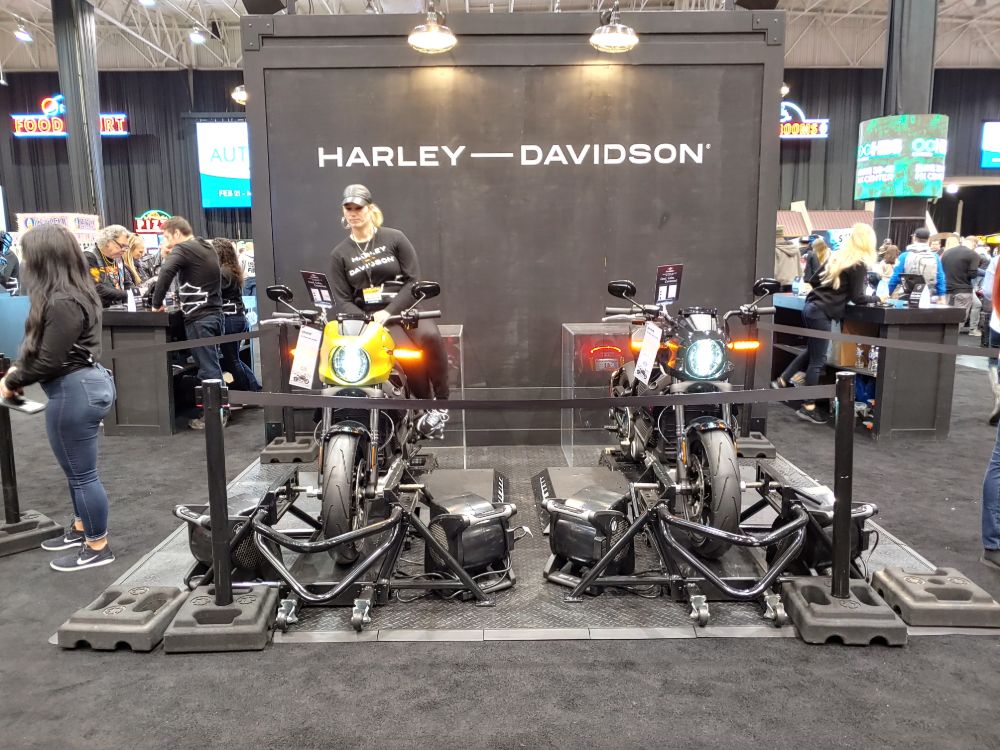
Harley-Davidson’s stationary display shows off the LiveWire’s downright electrifying acceleration characteristics.
So, I got to ride a LiveWire. Sort of. Each January, the International Motorcycle Show rolls through Cleveland, Ohio, which gives me a shot at checking out the hottest new bikes a few months ahead of the riding season.
As usual, Harley-Davidson dominated the show floor with a massive display, showing off their newest bikes, and even a few that weren’t even available yet (in this case, the Bronx and the Pan America, which we’ll cover in another post).

Settling In
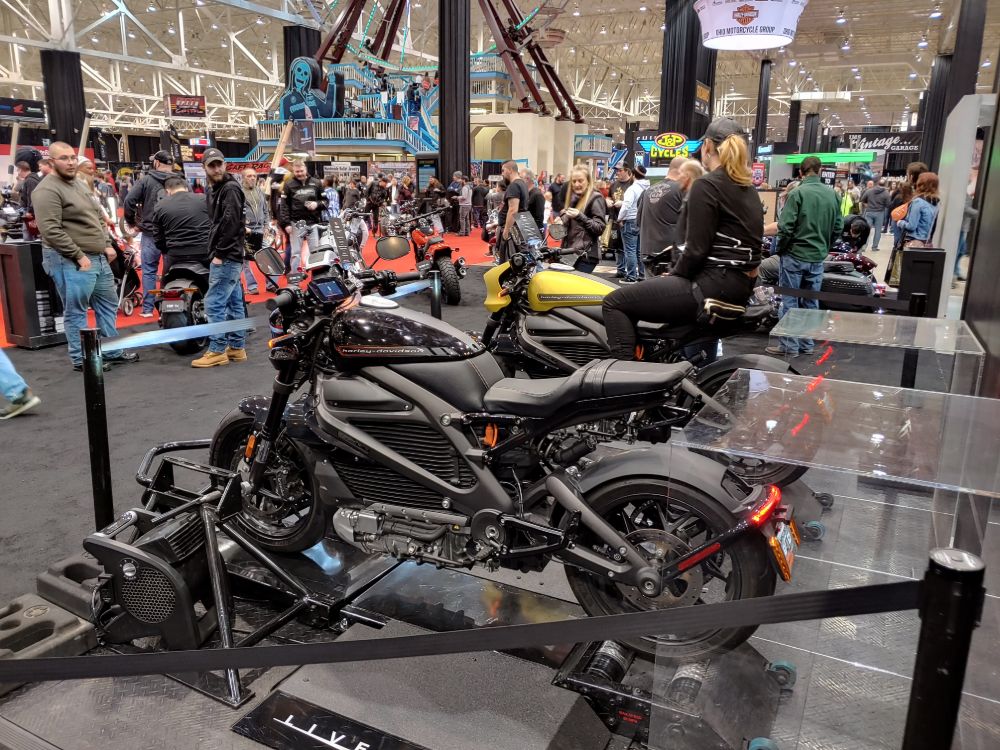
Naturally, the biggest star of the show was the all-new, all-electric LiveWire. This was my first time seeing one in person, and I was immediately struck by its size. In photos, it looks big and chunky. In person, however, it’s much smaller and sleeker, although it still has a substantial, strong, tough look to it.
Swinging a leg over the saddle, I was immediately struck by how well Harley-Davidson nailed the ergonomics on this motorcycle. As far as mainline Harley-Davidsons go, I’d say that its closest analogue would be the Sportster Roadster.

Your knees tuck in comfortably on either side of the surprisingly slim “tank,” and the foot position is more or less ideal. Unlike the aforementioned Sportster, there’s no air cleaner taking up the space where your right knee belongs.
Like most Harleys, it has a low center of gravity that, combined with its upright riding position, will likely make it an absolute superstar of a city bike. We may appreciate the open-road confidence of our Harley-Davidsons, but we don’t give them nearly enough credit for their slow-speed maneuverability. That’s one area in which we hope the LiveWire is similar to its more conventional stablemates.

The handlebars are at a comfortable height, and they have a nice sweep to them. Overall, it’s a very modern-feeling bike. The only thing that takes getting used to is the lack of a shifter of a clutch lever.
Fit and finish is what you’d expect for a Harley, with rugged switchgear that gives a satisfying, authoritative “click”. The gauge cluster is well laid-out and easy to read, although I’d like to see how it handles glare off the show floor and out in the real world.

I say that the faux fuel tank is “surprisingly slim” because, in photos, the whole bike looks wider, and, well, beefier. In person, it manages to look and feel trimmer, yet at the same time, it looks exactly as it does in photos. In short, Harley-Davidson nailed the proportions, too.
Get Turned On
It’s one thing to sit on a bike on a carpeted show floor — to actually riding one is another feeling entirely. To that end, Harley-Davidson had set up a pair of what my friend Phil called “LiveWires in captivity” — stationary motorcycles bolted to stands that could be “ridden” in place. It’s the same setup Harley-Davidson uses for their “Jumpstart” program.

So, while I didn’t get to ride a LiveWire on the road, I at least got a feel for the overall experience. Having ridden a few electric bikes, I had an idea of what to expect — or so I thought.
The process to start a LiveWire is understandably different than what most of us are used to. A Harley-Davidson representative instructed me to flip the kill switch to the “run” position, then wait for the digital gauge cluster to power on before ”starting” the bike.

That’s when something unexpected happened. Underneath me, I felt a somewhat familiar, if muted, rumble. The asymmetrical, irregular rhythm of the pulses in my seat felt a bit like a combination of an idling V-twin and powerful electronics coming to life. Later, another Harley-Davidson representative would explain that this “haptic heartbeat” was designed to create a sense of occasion, as well as alert riders that bike was indeed “running.”
It’s entirely artificial, and as corny as it sounds, I think it’s a cool feature. It made me feel like I was riding some electrified, futuristic monster that was poised to spit sparks instead of exhaust pops and crackles. Still, I would suffer suggestive (and, admittedly, hilarious) jokes about this feature from my non-Harley-riding friends for the duration of our stay at the show.
Cracking the Throttle
With the bike started and running, I was instructed to accelerate slowly to 60 miles per hour and keep it there. Now, before finding my calling — and my career — in motorcycle journalism, I studied engineering in college. I have a fairly nuanced understanding of how electric motors work, and how they deliver torque. Still, I was entirely unprepared for how (REDACTED)ing fast this bike was.
It took about zero point none seconds for this thing to hit 60 and I blew well past that without even trying. The representative seemed entirely unfazed, if not bemused by the big, stupid grin on my face. I’m sure it was a grin he saw dozens, if not hundreds of times throughout the weekend as many shared my experience.
The noise of the LiveWire is unlike anything else. Again, I’ve ridden my share of electric motorcycles, but the LiveWire’s unique bevel gear drive produces an awesome, electromechanical howl that constantly reminds you that there is a real machine working hard underneath you.
After letting the bike coast back down to zero — I was told not to use the brakes — I asked if I could take it up to 60 one more time. The representative obliged — what’s another few seconds, anyway? — and, again, the speedometer hit 60 before I really had much time to contemplate what was going on. My only regret is that I never had a chance to hit wide open throttle.

Of course, there’s very little resistance on those rollers, and actual on-road acceleration will feel very different. Still, it was a very cool trick — one I was happy to experience, and one I hope to try out in the real world very soon. If the LiveWire’s handling and road manners live up to its acceleration, build quality, and ergonomics, Harley-Davidson has a real winner on their hands.
Photos by Cam VanDerHorst for H-D Forums
Join the Harley-Davidson Forums now!

You must be logged in to post a comment.