When you click on links to various merchants on this site and make a purchase, this can result in this site earning a commission. Affiliate programs and affiliations include, but are not limited to, the eBay Partner Network.
Dyna Glide ModelsSuper Glide, Super Glide Sport, Super Glide Custom, Dyna Glide Convertible, Super Glide T-Sport, Dyna Glide Police, Dyna Switchback, Low Rider, Street Bob, Fat Bob and Wide Glide.
Alright did a search here and Googled the heck out of this - what is the difference between stepped and an unstepped exhaust? What is a stepped header?
I am considering the Basani Road Rage pipe and they make these two options...the unstepped version seems to be what I want aesthetically but what is the true difference beyond looks?
Thanks!! Oh also anyone who has this pipe chime in on how you like it...I'll be switching from a VH Pro Pipe!
what is the difference between stepped and an unstepped exhaust? What is a stepped header? . . . what is the true difference beyond looks?
Thanks!! Oh also anyone who has this pipe chime in on how you like it...
Which Road Rage are you wanting to buy? Bassani for some reason has several different "Road Rage" models. However, the difference between stepped and unstepped Bassani exhausts is that the Road Rage 1D18R, 13221R, 13222R, 13312R, 13311R, 13212J and maybe some others have 1-3/4" head pipes stepped to 1-7/8". Whereas the Road Rage 1D5250 has a 1 piece construction 1-3/4" head pipe. Some of you horsepower gurus can chime in and say what that means performance wise on a stock H-D motor, because I've no idea.
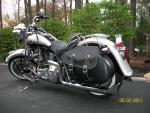
I have run the 1D5250 on a '10 FXDC and the 1D5250B on my '02 FXDX, bought both from eBay. I went from stock pipes and was pleased with the sound and quality of construction. Bigger pics for comparison attached.
Stepped headers is a performace plus, how much, not sure but if you are chasing power then get the Bassani's with them.
One result I can tell you is that after my engine build I was using the unstepped 1D5250s and was disappointed in their performance. So I switched to the stepped D&D Fat Cat exhaust and the increase in performance was dramatic.
You can look at my dyno charts towards the end of my engine build Thread:
A "stepped"exhaust helps eliminate any reversion of the exhaust gases that try to flow back into the head-pipe and heads when the exhaust valves open which can rob horsepower from the engine by displacing the fresh incoming air and fuel mixture with the spent exhaust gases.
Last edited by OldEnuf2NoBtr; Jan 20, 2016 at 05:10 PM.
The steps, or increase in pipe diameter creates exhaust velocity. As the pipes expand, so does the exhaust. With the expansion, the gases pick up speed. As also mentioned above, this velocity helps prevent reversion.
The steps, or increase in pipe diameter creates exhaust velocity. As the pipes expand, so does the exhaust. With the expansion, the gases pick up speed. As also mentioned above, this velocity helps prevent reversion.
Not, with the expansion the gases slow down. Just like when you open a hose completely the water has a slower velocity vs restricting with a nozzle. You may be confusing one large (2") pipe compared to a 1 3/4 pipe stepped up to 2". With the later, you will have higher velocity at the 1 3/4 section of the pipe.
The reversion pulses are reduced as they encounter the ridges of the smaller pipe (stepped pipes) on the way back towards the head.
Not, with the expansion the gases slow down. Just like when you open a hose completely the water has a slower velocity vs restricting with a nozzle. You may be confusing one large (2") pipe compared to a 1 3/4 pipe stepped up to 2". With the later, you will have higher velocity at the 1 3/4 section of the pipe.
The reversion pulses are reduced as they encounter the ridges of the smaller pipe (stepped pipes) on the way back towards the head.
Interesting. I always thought that once the gases expand, they pickup velocity.
Not, with the expansion the gases slow down. Just like when you open a hose completely the water has a slower velocity vs restricting with a nozzle. You may be confusing one large (2") pipe compared to a 1 3/4 pipe stepped up to 2". With the later, you will have higher velocity at the 1 3/4 section of the pipe.
The reversion pulses are reduced as they encounter the ridges of the smaller pipe (stepped pipes) on the way back towards the head.
He is correct. V=Q/A
V is velocity
Q is flow which is constant in this case
A is area which increases making the velocity decrease ; 1/4 is less than 1/2







 Basani Stepped vs. Unstepped?