When you click on links to various merchants on this site and make a purchase, this can result in this site earning a commission. Affiliate programs and affiliations include, but are not limited to, the eBay Partner Network.
Dyna Glide ModelsSuper Glide, Super Glide Sport, Super Glide Custom, Dyna Glide Convertible, Super Glide T-Sport, Dyna Glide Police, Dyna Switchback, Low Rider, Street Bob, Fat Bob and Wide Glide.
Anyone here know the length of stock risers on 2017 Wide Glide? Also, has anyone changed them out with slightly taller, pulled back ones? I am just starting out with a new bike and like the bars, but could use them an inch or two closer. I didn't want to get into changing the bars just yet, so thought a new set of slightly different risers would do the job for now. If anyone has done this, did you need to change any cables? I'm hoping an extra inch wouldn't require too much in the way of changes.
Thanks for the reply...I considered spacers first, but I've seen some risers with a slight pullback; spacers will raise the bar and back slightly, but not like a 1" or 1 1/2" bend back would.
I've found a couple lengths for stock risers, that's why I was asking, just to confirm..most say 4"...maybe they are measuring from different places on the riser? Are they usually measured to centerline of the bar or to the base of the bar, or top of the top clamp? I've seen 5 1/2" risers advertised, which would be ideal if the stock ones are 4" and they are both measure the same way. Didn't want to spend $150 on risers that turn out to be same length.
Thanks for the reply...I considered spacers first, but I've seen some risers with a slight pullback; spacers will raise the bar and back slightly, but not like a 1" or 1 1/2" bend back would.
I've found a couple lengths for stock risers, that's why I was asking, just to confirm..most say 4"...maybe they are measuring from different places on the riser? Are they usually measured to centerline of the bar or to the base of the bar, or top of the top clamp? I've seen 5 1/2" risers advertised, which would be ideal if the stock ones are 4" and they are both measure the same way. Didn't want to spend $150 on risers that turn out to be same length.
At one time I found a cool graphic that showed how to measure but can't seem to locate...
Found this though. Good luck!
Those who are looking for motorcycle handlebar risers solely for comfort need to do some work before beginning the shopping process. These buyers need to consider the size of the risers they will need to achieve the comfort they desire.
Most motorcycle handlebar risers measure 4 inches and are intended to extend the handlebars. However, that may not be a sufficient distance for all riders and there may even be a need for the bars to be lowered. To determine the proper measurement for handlebar risers, motorcycle riders should follow these three steps. Step 1: Current Measurement
Begin the measurement process by getting a friend and a tape measure or carpenter's square to help out with numbers. Sit on the motorcycle with hands on the bars, take off the kickstand to simulate a riding position. At this point, have the friend measure the distance from the height of the hands to the ground. Write this number down. Step 2: Desired Measurement
Next, get off the bike and secure it with the kickstand. Loosen the bolts that hold the handlebars onto the risers by using a socket wrench. Then, push the handlebars out of the way and resume the simulated riding position from step one. However, this time it is necessary to pretend that handlebars are there and place them (and your hands) at the most comfortable angle for riding. Have the friend take the same measurement from hand to ground in this new position. Write this number down. Step 3: Determining Proper Rise
Figuring out the proper measurement for handlebar risers is as simple as subtracting the number generated in Step 1 from the one generated in Step 2. A negative measurement means that the current handlebars or handlebar risers (if present) are too high, and smaller ones should be substituted. A positive number means that larger risers are in order. The correlating handlebar risers that are purchased should be as close as possible to this measurement for optimal comfort.
kidnapped photo of some unknown wide glide enthusiast's bike
Heh
The stock risers are 4.5" from the base of the riser to the bottom of the saddle cutout for the bars. I've used both 2" and 3" riser extensions, they will get your bars up and back.
At 3" my clutch cable is done and will need to be changed out to go any higher, still 2+" on the throttle and bar wiring and another 1" on the brake line.
I got away without any problems on my brake line for 2 reasons; my bike is non-ABS and the caliper adapter for the Big Brake rotor gave me some brake line back.
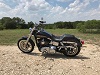
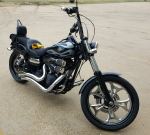
Two profile shots of my ride, the first is with 2" 'fat' riser extensions, the second is the 'fat' 3" extensions. You can see how the bars are moved toward the rider with the extensions...
1. raising the bars will create more leverage and pummel the stock rubber bushings that dampen vibration in the bars.. may want to go. Solid or poly on the bushings
Sorry to bring up this super old post. I am trying to do exactly same thing as you do if you are still around.
Can you show me what spec of your drag bar is? brand? length? pull back?
So with 3" riser, I don't have to change any cable at all right?
How would you compare with the 8" riser/drag bar with original 5" riser/beach bar?
and how did you get rid of your taillamp?
Dyna Wide Glide rocks!
many thx
Originally Posted by TinCupChalice
Heh
The stock risers are 4.5" from the base of the riser to the bottom of the saddle cutout for the bars. I've used both 2" and 3" riser extensions, they will get your bars up and back.
At 3" my clutch cable is done and will need to be changed out to go any higher, still 2+" on the throttle and bar wiring and another 1" on the brake line.
I got away without any problems on my brake line for 2 reasons; my bike is non-ABS and the caliper adapter for the Big Brake rotor gave me some brake line back.
Two profile shots of my ride, the first is with 2" 'fat' riser extensions, the second is the 'fat' 3" extensions. You can see how the bars are moved toward the rider with the extensions...
Sorry to bring up this super old post. I am trying to do exactly same thing as you do if you are still around.
Can you show me what spec of your drag bar is? brand? length? pull back?
So with 3" riser, I don't have to change any cable at all right?
How would you compare with the 8" riser/drag bar with original 5" riser/beach bar?
and how did you get rid of your taillamp?
Dyna Wide Glide rocks!
many thx
TC hasn't been seen since Nov 2018 - so don't hold your breath
eta Oh.., and before he left - he converted his WG (one you quoted) to a trike
Ghost
Last edited by Ghost_13; Feb 13, 2020 at 10:22 PM.
Slideshow: Jason Momoa's latest restoration project blends 1920s Harley-Davidsons with modern electric technology, creating some of the most unusual hybrid motorcycles ever built.
Harley-Davidson Fat Boy Becomes a Dark, Decepticon-Inspired Custom
Slideshow: Killer Custom's latest build relies on styling changes rather than performance upgrades, giving the cruiser an entirely different personality.
7 Surprising Harley-Davidson Products that Are Not Motorcycles
Slideshow: The bar-and-shield logo shows up on far more than motorcycles, some of the company's most unexpected products have nothing to do with riding.
Slideshow: From the troubled AMF years to modern misfires, these bikes earned reputations for reliability issues, questionable engineering, or disappointing performance.
Crazy Bunderbike Build Looks Amazing, But Is It Impossible to Ride?
Slideshow: The Swiss custom shop has taken a Harley Softail and stretched it into something so long and low that it looks closer to a rolling sculpture than a conventional motorcycle.







 Wide Glide Risers