When you click on links to various merchants on this site and make a purchase, this can result in this site earning a commission. Affiliate programs and affiliations include, but are not limited to, the eBay Partner Network.
I would open up the area cut like this.. With the motor spinning at 4000 rpm, the shaft is spinning at about 3000.. That enough for the nut / washer to pick up any oil any and fling it. As the picture is viewed, the tranny shaft spins counter-clockwise. I'd also cut the boss at the bottom to keep oil from building up in the section between the actuator boss and cover.
So you are going to make a washer nut? Going to heat treat it? The width of the nut is 2.125?
The washer nut and the machined nut for the seal are two different things and it is an either or proposition. The nut and seal I have no doubt will fix the problem and yes I think it may be necessary to harden the surface the seal rides on. The washer nut is part of a simpler cheaper route that may be a solution.
The width of the stock nut is .40". I have welded a .030" washer to a few that is spaced up about 1/8" or .120". That is to clear the spring clip that holds the bearing in place. I then changed the design and welded a .060 washer flush with one side of the nut. I then propose using two thrust washers to space it up .120 on the shaft so that is clears the spring clip. Either will work, the latter just gives a little more nut to get the socket on. This won't completely block the flow of oil through the bearing, but it should slow it down considerably. From what Steve Cole was saying the higher the rpm the faster the transfer, so there must be something else at work here other than the slave cylinder pumping oil across. As I've said before, possibly a combination of things forming the perfect storm.
I also believe that it's a combination of things causing the issue.. I'm not sure how much you want to thin the nut. If it comes loose you'll have problems... A 1 piece nut that has 4 drive holes in it to torque the nut to spec would be a better way to go but it requires a special tool to install.. A single shield on the bearing would be nice but the bearing is really too thin thin to add one..
I still think that running down, the pressure plate in the clutch may be may flexing due to it's slip assist feature. It may simply be the addition of the backlash gear and smaller chamber of the new hydraulic clutch housing causing the issue.
I also believe that it's a combination of things causing the issue.. I'm not sure how much you want to thin the nut. If it comes loose you'll have problems... A 1 piece nut that has 4 drive holes in it to torque the nut to spec would be a better way to go but it requires a special tool to install.. A single shield on the bearing would be nice but the bearing is really too thin thin to add one..
I still think that running down, the pressure plate in the clutch may be may flexing due to it's slip assist feature. It may simply be the addition of the backlash gear and smaller chamber of the new hydraulic clutch housing causing the issue.
Well you may have something there. If the clutch is flexing and pushing on the clutch push rod that could be pulsing the actuator that is then acting like a pump pushing oil across the mainshaft. Therefore, if the RPM's are higher and the clutch is flexing faster it would pump more oil. The gears are picking up oil and helical cut gears are pushing it toward the bearing where first gear is pushing it through the bearing. Using the washer nut and opening up the side cover for drainage should keep oil from collecting at the end of the mainshaft and end the migration.
Here is a picture of the washer nut. It still has about .34" left to get a socket on so there should be no problem torquing it. I just looked on Grainger and there is a .010 thrust washer available for spacing, so it could be set even closer to the bearing.
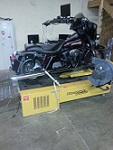
I've been working with $tonecold on this and have his modified nut in a bike now. Testing will start later this week and we will see if anything changes. As for the slave pulsing and pushing fluid I do not think that is the case. I've run the test at higher RPMS on the dyno where there is NO pulsing going on and NO shifting going on............ still get plenty of transfer. I have also made a slinger ring that pushed into the mainshaft reducing the clearance between the pushrod and mainshaft and it changed things little if any. I hope this larger slinger ring on the nut will block the fluid coming from the bearing and toss it out of the way, to clear the fluid build-up in this area. While this is not solving the root cause, the hope is it will block enough oil build up to work.
I've been working with $tonecold on this and have his modified nut in a bike now. Testing will start later this week and we will see if anything changes. As for the slave pulsing and pushing fluid I do not think that is the case. I've run the test at higher RPMS on the dyno where there is NO pulsing going on and NO shifting going on............ still get plenty of transfer. I have also made a slinger ring that pushed into the mainshaft reducing the clearance between the pushrod and mainshaft and it changed things little if any. I hope this larger slinger ring on the nut will block the fluid coming from the bearing and toss it out of the way, to clear the fluid build-up in this area. While this is not solving the root cause, the hope is it will block enough oil build up to work.
I know it's a WAG but any clearance between the plates and the basket could be translated to the wedging action of the pressure plate.. I do think we all agree that the issue is not simply from one issue but a combination of things. Otherwise, the fix would have been easy.
I've been working with $tonecold on this and have his modified nut in a bike now. Testing will start later this week and we will see if anything changes. As for the slave pulsing and pushing fluid I do not think that is the case. I've run the test at higher RPMS on the dyno where there is NO pulsing going on and NO shifting going on............ still get plenty of transfer. I have also made a slinger ring that pushed into the mainshaft reducing the clearance between the pushrod and mainshaft and it changed things little if any. I hope this larger slinger ring on the nut will block the fluid coming from the bearing and toss it out of the way, to clear the fluid build-up in this area. While this is not solving the root cause, the hope is it will block enough oil build up to work.
Get out and ride that thing... Let's see how this modified nut/slinger works at controlling the transfer. I'll be anxiously awaiting the results of your testing.
On another note, I just got my 2017 a few weeks ago so I'm just getting started with my first-hand look at this issue. My bike is only transferring 2-3 oz./1,000 miles as best I can tell with limited mileage so far (just over 2,000). I need a few more miles of testing before I can characterize my transfer rate with confidence.
Two days ago I pulled the clutch actuator out to have a look in there. One of my first thoughts in searching for a "simple" fix was to fabricate a bushing to press into the mainshaft to decrease the clearance between the pushrod and mainshaft. Reading your post I see that you've already tried that with unsatisfactory, or only marginal, improvement. Thanks, you save me a little time.
Another idea I had involved fabricating a spring wound insert to slide into the mainshaft that would act as a screw mechanism to drive the oil in the mainshaft back towards the transmission. The theory here is that rather than controlling the source of the oil from entering the mainshaft, the screw thread will keep whatever oil is there from flowing to the primary. The limited clearance between the pushrod and mainshaft (approx. .070") may render this idea unfeasible though.
Oh well, I'm just joining the party. It will be interesting to see where this all leads.
The hope is that the larger slinger works. If it does, we have a few different ideas of how to make it but on the flip side if it's proven to work, MoCo is going to copy it anyways.
Here is a picture of the washer nut. It still has about .34" left to get a socket on so there should be no problem torquing it. I just looked on Grainger and there is a .010 thrust washer available for spacing, so it could be set even closer to the bearing.
If the problem is really caused by the volume of oil passing through the mainshaft bearing I would suggest closing the spaces between the hex and the washer. That should improve the desired efficiency. For these early prototypes you could fill the voids with RTV or something similar. Then if it works you could design a more permanent way of filling the void, or better yet, machine a new nut with the flange as one solid piece.
Originally Posted by $tonecold
Yes, the nut will be machined down about half it’s width to 1.0625”. That should leave just enough hex to get a socket on...
If I understand this correctly the mainshaft nut will be sealed to the side cover inboard of the clutch actuator via your design. Is that correct? And if so, how is the primary going to vent?
7 Surprising Harley-Davidson Products that Are Not Motorcycles
Slideshow: The bar-and-shield logo shows up on far more than motorcycles, some of the company's most unexpected products have nothing to do with riding.
Slideshow: From the troubled AMF years to modern misfires, these bikes earned reputations for reliability issues, questionable engineering, or disappointing performance.
Crazy Bunderbike Build Looks Amazing, But Is It Impossible to Ride?
Slideshow: The Swiss custom shop has taken a Harley Softail and stretched it into something so long and low that it looks closer to a rolling sculpture than a conventional motorcycle.
Engraved Rebellion: Inside Bundnerbike's Glam Rock II
Slideshow: A standard cruiser becomes an intricate metal canvas in the hands of a Swiss custom house known for pushing Harley-Davidson platforms far beyond their factory brief.
Slideshow: Harley-Davidson's challenges aren't abstract; they show up in dropping shipments, shrinking dealer traffic, and strategic decisions that aren't yet translating into growth.