





A/C Internal vs External Breathing

Thread Starter
|
Road Captain


Joined: Jun 2014
Posts: 508
Likes: 31
From: California
 A/C Internal vs External Breathing
CV carbed 2005 Dyna - currently running external breather bolts on my aftermarket A/C. Switching to an elbow style A/C and decided to go with the Aircharger from K&N.
I noticed the backing plate that comes with the KN kit is internally vented. To use the full kit, it looks like I have to delete my external breather bolts and support bracket and go back to internal breathing. Or, I just use the elbow and bolt it to my existing bracket (which means I essentially paid $300 for a chrome elbow and filter).
Pros and cons to internal vs external breathing? Should I just keep my current external setup and bolt the elbow up, or use the full KN setup?
I noticed the backing plate that comes with the KN kit is internally vented. To use the full kit, it looks like I have to delete my external breather bolts and support bracket and go back to internal breathing. Or, I just use the elbow and bolt it to my existing bracket (which means I essentially paid $300 for a chrome elbow and filter).
Pros and cons to internal vs external breathing? Should I just keep my current external setup and bolt the elbow up, or use the full KN setup?
I honestly can't come up with one 'pro' argument to venting crankcase gasses internally. The crankcase gas is oxygen depleted, hot, and oily and compromises the performance and longevity of your engine; engines prefer cold dry air.
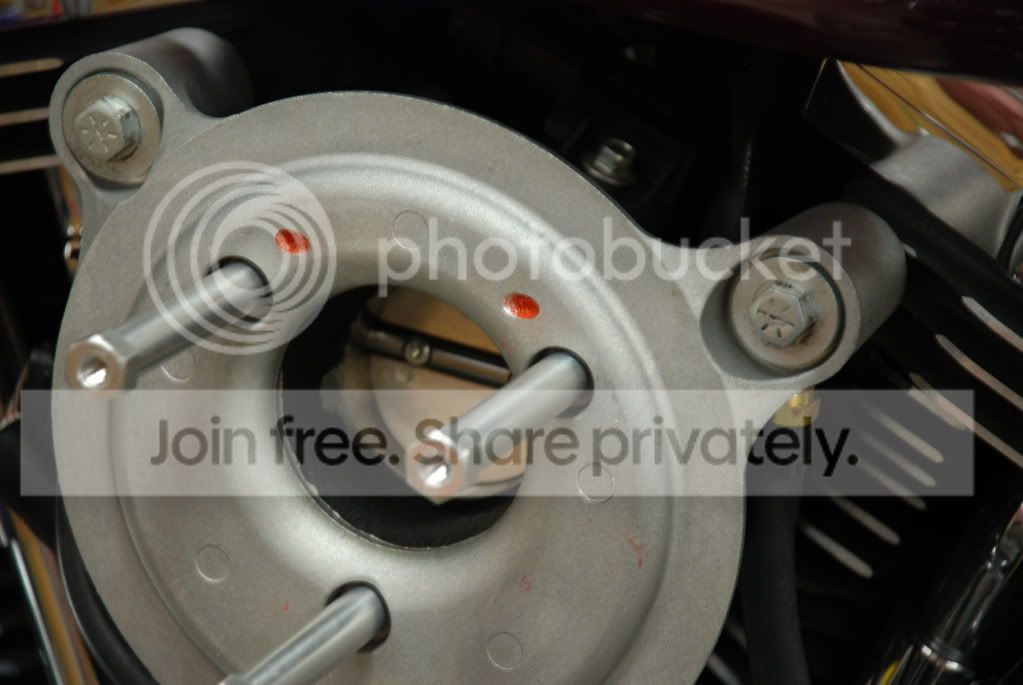
With your K&N one option you would have would be to use the DK Custom Products DIY Discrete Breather System With the DIY kit you can drill and tap the stand-offs on the back plate, the kit includes 6 feet of hose for maximum flexibility in filter placement so you can discretely tuck it away.
The kit uses hose barbs that are drilled/tapped in to the stand-offs, the 11/32" drill bit and 1/8" NPT tap are options available for the DIY kit.
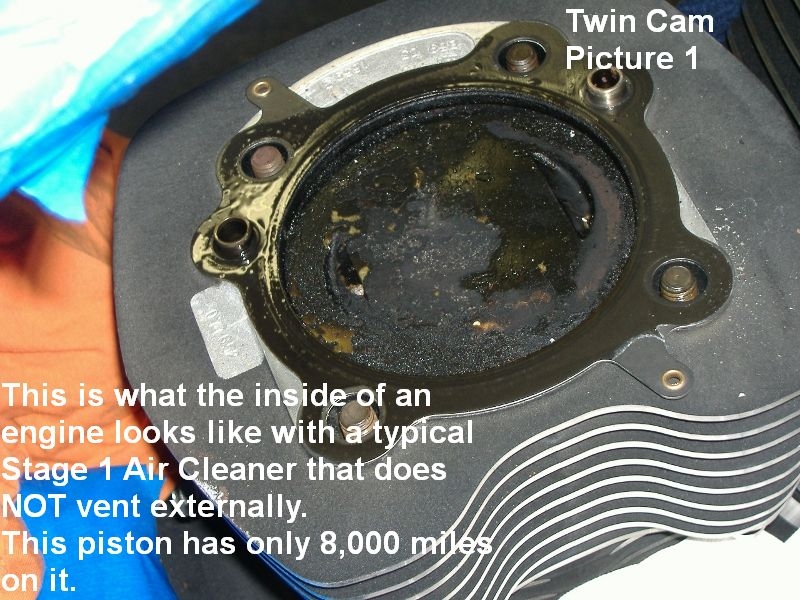
Check out the images of the differences between internally vented and externally vented!
.jpg)

With your K&N one option you would have would be to use the DK Custom Products DIY Discrete Breather System With the DIY kit you can drill and tap the stand-offs on the back plate, the kit includes 6 feet of hose for maximum flexibility in filter placement so you can discretely tuck it away.
The kit uses hose barbs that are drilled/tapped in to the stand-offs, the 11/32" drill bit and 1/8" NPT tap are options available for the DIY kit.
Check out the images of the differences between internally vented and externally vented!
__________________
www.DKCustom.com
662-252-8828 Voice
662-420-4891 Text & Voice
Support@DKCustomProducts.com
www.DKCustom.com
662-252-8828 Voice
662-420-4891 Text & Voice
Support@DKCustomProducts.com

Outstanding HDF Member
Joined: Sep 2014
Posts: 2,717
Likes: 273
From: Minnesota
Ok Darryl, then what does a feller do with the grooves in the backer plate that are there for the factroy rubber tubes?

Advanced
Joined: Jul 2015
Posts: 93
Likes: 2
From: Oregon
I honestly can't come up with one 'pro' argument to venting crankcase gasses internally. The crankcase gas is oxygen depleted, hot, and oily and compromises the performance and longevity of your engine; engines prefer cold dry air.
With your K&N one option you would have would be to use the DK Custom Products DIY Discrete Breather System With the DIY kit you can drill and tap the stand-offs on the back plate, the kit includes 6 feet of hose for maximum flexibility in filter placement so you can discretely tuck it away.
The kit uses hose barbs that are drilled/tapped in to the stand-offs, the 11/32" drill bit and 1/8" NPT tap are options available for the DIY kit.
Check out the images of the differences between internally vented and externally vented!
With your K&N one option you would have would be to use the DK Custom Products DIY Discrete Breather System With the DIY kit you can drill and tap the stand-offs on the back plate, the kit includes 6 feet of hose for maximum flexibility in filter placement so you can discretely tuck it away.
The kit uses hose barbs that are drilled/tapped in to the stand-offs, the 11/32" drill bit and 1/8" NPT tap are options available for the DIY kit.
Check out the images of the differences between internally vented and externally vented!
This is one example of RTV:


No difference, they're both means to an end. The goal is to vent the crankcase gasses to atmosphere and both the breather bolts and the DIY kit will do it equally well; it's all about what configuration works best for your bike's setup.

Tourer

Joined: Jul 2013
Posts: 338
Likes: 44
From: Colorado
I have purchased a dk external breather kit for my 2014 LR with HD heavy breather but wanted to read/learn before drilling/installing.
Searching/reading many threads here leave me wondering ...
The DK pics with 8000 mile externally-vented are impressive and everywhere. Problem is we don't know about how full the crankcase oil was run ... or what weight oil was. Consensus seems to be that when correct oil and correct level (1/2 way between full/fill line) are run there is little to no oil/sludge in blow-by.
So, if oil fill and weight are run correctly, the only problem I see with internal vent would be a slight increase in intake temps due to hot air from crankcase being added to incoming filtered air.
I haven't seen anyone draw this conclusion -- what am I missing?? Also, details about DK pic (if available) would be helpful.
Thanks!
Searching/reading many threads here leave me wondering ...
The DK pics with 8000 mile externally-vented are impressive and everywhere. Problem is we don't know about how full the crankcase oil was run ... or what weight oil was. Consensus seems to be that when correct oil and correct level (1/2 way between full/fill line) are run there is little to no oil/sludge in blow-by.
So, if oil fill and weight are run correctly, the only problem I see with internal vent would be a slight increase in intake temps due to hot air from crankcase being added to incoming filtered air.
I haven't seen anyone draw this conclusion -- what am I missing?? Also, details about DK pic (if available) would be helpful.
Thanks!
Trending Topics

Seasoned HDF Member
Joined: Oct 2015
Posts: 13,404
Likes: 34,319
From: Pine Flat Dam/South Bay Area, CA
Any oil mist in the intake is bad news. It lowers the octane of the incoming air/fuel mix & causes carbon buildup in the combustion chamber that leads to hot spots & detonation.
HD Forum Stories
The Best of Harley-Davidson for Lifelong Riders

10 Worst Harley-Davidson Motorcycles Ever
Pouria Savadkouei
Killer Custom's Jail Break Is The Breakout That Refused to Blend In
Verdad Gallardo
Crazy Bunderbike Build Looks Amazing, But Is It Impossible to Ride?
Verdad Gallardo
Harley-Davidson Reveals Super Cool Cafe Racer Concept
Verdad Gallardo
Engraved Rebellion: Inside Bundnerbike's Glam Rock II
Verdad Gallardo
10 Motorcycles You Should Never Buy
Joe Kucinski
10 Things Harley-Davidson Needs to Fix in 2026
Verdad Gallardo
Southpaw Super Glide: A Left-Hand-Drive 1979 Harley FXE Built to Fit the Rider
Verdad Gallardo
The Best and Worst Harley-Davidson Moves of 2025
Verdad Gallardo
Extreme HDF Member
Joined: Feb 2015
Posts: 10,907
Likes: 8,756
From: Galt's Gulch - MI
Externally vented will always be a superior way of routing the hot, oxygen depleted, oily gas. One aspect to consider is not all bikes will have oil carryover in the same way or to the same degree. I've now owned 4 Twin Cams and my '13 Wide Glide 103" is indeed a 'puker'. She'll puke oil no matter how careful you are. I run SAE 50 and 60 weight oils and I'm absolutely methodical about my oil level; she still coughs up a bit of oil.
I've experimented with different oil viscosity and the straight weights give me the least amount of venting oil. I ran LiquiMoly 10W-60 synthetic for a time and using breather bolts she'd completely saturate my K&N filter in under 100 miles; to the point it's dripping all over the cam cover and blowing back my leg. No Bueno. 20W50 was better but it's the straight weight VR1 that keeps it to a minimum.
Do you think I want that hot oily gas shoved back in my A/C? NOT
I scour the interwebs looking for a set of Doherty Myst Free breathers; no luck yet. I plan on pulling the rocker covers and plates and enlarging the oil drain holes to see if that might help somewhat. Eh, it's a work in progress
There is no good reason to internally vent that nasty crap and a multitude of reasons to vent it to atmosphere. The only people who are happy with internally venting are your EPA overlords...
I've experimented with different oil viscosity and the straight weights give me the least amount of venting oil. I ran LiquiMoly 10W-60 synthetic for a time and using breather bolts she'd completely saturate my K&N filter in under 100 miles; to the point it's dripping all over the cam cover and blowing back my leg. No Bueno. 20W50 was better but it's the straight weight VR1 that keeps it to a minimum.
Do you think I want that hot oily gas shoved back in my A/C? NOT
I scour the interwebs looking for a set of Doherty Myst Free breathers; no luck yet. I plan on pulling the rocker covers and plates and enlarging the oil drain holes to see if that might help somewhat. Eh, it's a work in progress
There is no good reason to internally vent that nasty crap and a multitude of reasons to vent it to atmosphere. The only people who are happy with internally venting are your EPA overlords...

Advanced
Joined: Dec 2010
Posts: 84
Likes: 1
From: Okc, OK
externally vented will always be a superior way of routing the hot, oxygen depleted, oily gas. One aspect to consider is not all bikes will have oil carryover in the same way or to the same degree. I've now owned 4 twin cams and my '13 wide glide 103" is indeed a 'puker'. She'll puke oil no matter how careful you are. I run sae 50 and 60 weight oils and i'm absolutely methodical about my oil level; she still coughs up a bit of oil.
I've experimented with different oil viscosity and the straight weights give me the least amount of venting oil. I ran liquimoly 10w-60 synthetic for a time and using breather bolts she'd completely saturate my k&n filter in under 100 miles; to the point it's dripping all over the cam cover and blowing back my leg. No bueno. 20w50 was better but it's the straight weight vr1 that keeps it to a minimum.
Do you think i want that hot oily gas shoved back in my a/c? Not
i scour the interwebs looking for a set of doherty myst free breathers; no luck yet. I plan on pulling the rocker covers and plates and enlarging the oil drain holes to see if that might help somewhat. Eh, it's a work in progress
there is no good reason to internally vent that nasty crap and a multitude of reasons to vent it to atmosphere. The only people who are happy with internally venting are your epa overlords... :d
I've experimented with different oil viscosity and the straight weights give me the least amount of venting oil. I ran liquimoly 10w-60 synthetic for a time and using breather bolts she'd completely saturate my k&n filter in under 100 miles; to the point it's dripping all over the cam cover and blowing back my leg. No bueno. 20w50 was better but it's the straight weight vr1 that keeps it to a minimum.
Do you think i want that hot oily gas shoved back in my a/c? Not
i scour the interwebs looking for a set of doherty myst free breathers; no luck yet. I plan on pulling the rocker covers and plates and enlarging the oil drain holes to see if that might help somewhat. Eh, it's a work in progress
there is no good reason to internally vent that nasty crap and a multitude of reasons to vent it to atmosphere. The only people who are happy with internally venting are your epa overlords... :d