




Unwanted Vibration

Thread Starter
|
Stage I
Joined: Apr 2026
Posts: 1
Likes: 0
From: UT
 Unwanted Vibration
Wondering if anyone has had this problem? Took my 2006 Harley Road Glide in for the 60,000 mile check and got it back with a harmonic vibration at 1100 RPM only. The steering head was tightened along with the front motor mount was replaced . They didn't know why it vibrated at 1100 RPM ( just off of idle, then disappears below or above that RPM) . The vibration manifests itself in the fairing windshield area . Have taken it back three times and the last was told that my fly wheels were out of balance and the major engine rebuild is required for thousands of dollars. It doesn't make sense to me. Any inside from anyone?

Seasoned HDF Member


Joined: Mar 2010
Posts: 38,673
Likes: 6,465
From: Honah Lee
The alternator spline may have stripped letting it index around.
Just a guess. Mine went and it affected balance.
Harley part man told me they had replaced a bunch of the old 10 spline alternator rotors over the years.
Harley changed it to serrations. There much easier to produce to close tolerances and much stronger. They sorta look weaker but unlike the 10 spline, there is a lot less material machined away.
Once rotor spline strips, the compensator spring will drive it. However, it will eventually wear the slipping faces and it will first appear compensator bolt is loose.
Left long enough, it will let front sprocket move over and the chain will nip edges of sprockets. I discovered mine by the ticking that it made.
Mine wore that far because they had tighted compensator twice under warranty without looking deeper into the issue.
The rotor is balanced and its fairly heavy with the magnets in it. They have drilled material removed to balance them.
Welcome to the HDFORUM.
Just a guess. Mine went and it affected balance.
Harley part man told me they had replaced a bunch of the old 10 spline alternator rotors over the years.
Harley changed it to serrations. There much easier to produce to close tolerances and much stronger. They sorta look weaker but unlike the 10 spline, there is a lot less material machined away.
Once rotor spline strips, the compensator spring will drive it. However, it will eventually wear the slipping faces and it will first appear compensator bolt is loose.
Left long enough, it will let front sprocket move over and the chain will nip edges of sprockets. I discovered mine by the ticking that it made.
Mine wore that far because they had tighted compensator twice under warranty without looking deeper into the issue.
The rotor is balanced and its fairly heavy with the magnets in it. They have drilled material removed to balance them.
Welcome to the HDFORUM.
Last edited by Jackie Paper; Apr 12, 2026 at 04:37 PM.
Seasoned HDF Member
Joined: Dec 2005
Posts: 19,960
Likes: 8,056
From: poway
I'd suspect that you need to put some miles on the mount up to about 1000. The rubber can be a little stiff.. One thing you can do is loosen the bolt in the middle, start the bike, let idle, shut off then tighten the bolt.. I'd also check the front mount plate for tightness along with the rubber mount base bolts.

Grand HDF Member


Joined: May 2014
Posts: 3,855
Likes: 1,184
From: florida
Max is on the right treack, actually loosen all 3 bolts, the center one and the 2 on the sides that hold the mount to the frame,,,,run it for a bit, shut down and re-tighten it all up...allows the mount to find a happy center.
m
m

Intermediate

Joined: Aug 2018
Posts: 29
Likes: 10
From: Cave Creek, AZ
It may be related to the change in your mounts but doubtful that the mounts are the problem. Harley designed their mount system to have a natural frequency at 1800 RPM. Since you have a vibration at 1100 RPM it would require a very soft mount to cause this, which is unlikely given the mounts are new. New mounts are generally stiff, which would push the natural frequency higher than 1800 RPM, which is not your situation.
A more likely scenario is that the original mounts became soft over time and were isolating the natural frequency of something else on your bike, something in the fairing windshield area or something new/non-OEM in that area. When you changed to new mounts, the new stiffness is now exciting that natural frequency.
A more likely scenario is that the original mounts became soft over time and were isolating the natural frequency of something else on your bike, something in the fairing windshield area or something new/non-OEM in that area. When you changed to new mounts, the new stiffness is now exciting that natural frequency.
Seasoned HDF Member
Joined: Dec 2005
Posts: 19,960
Likes: 8,056
From: poway
I'm not a vibes expert but generally when you have a natural oscillation different harmonics can excite that oscillation. Is it possible that another oscillation point occurs at 1/2 1800 or 900 rpm. In that case the stiffer mount might shift up that natural level to from 900 to 1100 rpm? I suspect this because my 07 egc like to vibrate at idle if I run the idle that low.. Also I find that a custom FXR that I have that uses the same mounts likes to vibrate at 2700 rpm. It's smoothest at 3100.
Trending Topics
Intermediate
Joined: Aug 2018
Posts: 29
Likes: 10
From: Cave Creek, AZ
Vibration isolation theory is a fairly complex topic whereas everything in the world has a natural frequency and as you couple different things together the frequency response changes. The natural frequency/natural oscillation is the fundamental frequency. Harmonics are integral multiples of the natural frequency. A harmonic does not change the natural frequency, although a change in the natural frequency will change the harmonics. There could be something in the engine that causes a natural frequency at 1100 RPM but I thinks it's best to evaluate what is known, i.e. the motor mounts were changed and the steering head was tightened.
Max, I respect your knowledge with mount systems. One of the few people I have come across on these forums that really understands. Take a look at a vibration isolation curve (also called a transmissibility curve). Now put in 1800 RPM as the natural frequency (point of highest amplitude). You'll notice that the output over input response is approximately 1:1 at the low initial frequencies and steadily rises to the peak. 1100 RPM will have some level of amplification. As frequency continues to rise past 1800 RPM, the output over input starts to fall. At approximately 2500 RPM there is a crossover point where the output over input is less than 1. This region now becomes the vibration isolation region. Harley engineers were very aware of this. That's why they put the vibration isolation region coinciding with the riding RPMs...smooth at 3100 RPM.
Max, I respect your knowledge with mount systems. One of the few people I have come across on these forums that really understands. Take a look at a vibration isolation curve (also called a transmissibility curve). Now put in 1800 RPM as the natural frequency (point of highest amplitude). You'll notice that the output over input response is approximately 1:1 at the low initial frequencies and steadily rises to the peak. 1100 RPM will have some level of amplification. As frequency continues to rise past 1800 RPM, the output over input starts to fall. At approximately 2500 RPM there is a crossover point where the output over input is less than 1. This region now becomes the vibration isolation region. Harley engineers were very aware of this. That's why they put the vibration isolation region coinciding with the riding RPMs...smooth at 3100 RPM.
HD Forum Stories
The Best of Harley-Davidson for Lifelong Riders

6 Weirdest Harley-Davidsons Ever Sold to the Public
Verdad Gallardo
7 Times Harley-Davidson Chucked Tradition Out the Window
Verdad Gallardo
7 Surprising Harley-Davidson Products that Are Not Motorcycles
Verdad Gallardo
8 Best Harley-Davidson Motorcycles Ever
Pouria Savadkouei
10 Worst Harley-Davidson Motorcycles Ever
Pouria Savadkouei
Killer Custom's Jail Break Is The Breakout That Refused to Blend In
Verdad Gallardo
Crazy Bunderbike Build Looks Amazing, But Is It Impossible to Ride?
Verdad Gallardo
Harley-Davidson Reveals Super Cool Cafe Racer Concept
Verdad Gallardo
Engraved Rebellion: Inside Bundnerbike's Glam Rock II
Verdad Gallardo
Seasoned HDF Member
Joined: Mar 2010
Posts: 38,673
Likes: 6,465
From: Honah Lee
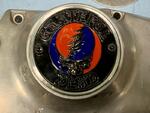
Now just guessing, it only had a couple spot drill balance areas but the spline also was so hollowed out, magnets were close to hitting the stator coils.
The first shot is the old one out of my 04. Don't have a shot of the other side but it had two spot drilled areas to balance it. The new one had no spots.
The second attachment from another rotor just to show balance mark.
Now of course my first post was just a thought and opinion.
I sure wouldn't overhaul it if it went away driving it. If the spline is stripped, it's going to start making a noise in the primary after awhile.


Seasoned HDF Member
Joined: Dec 2005
Posts: 19,960
Likes: 8,056
From: poway
Interesting stuff..
My question was mainly whether the 1800 was the natural frequency or maybe it's really 900.. 1800 was a harmonic.. Probably not I guess.
My background is mainly digital EE but with a lot of analog interfacing. I enjoy the physics part of engineering. In it's simplest form I suspect that vibration design is not much more than a Mass connected to a spring. That system has a resonate frequency if certain periodic force is presented to system. It's analogous to LC networks in electronic.. Even on the digital side (high speed, the inductors (L) and capacitors (C) have to be delt with..
I'm sure on a HD there is a number of things that make up mass/spring system on a Harley. If any one of these system interacts with another through a non linear device, there can be sum and difference frequencies resulting. Not sure if the OPs problem is one of those.
My question was mainly whether the 1800 was the natural frequency or maybe it's really 900.. 1800 was a harmonic.. Probably not I guess.
My background is mainly digital EE but with a lot of analog interfacing. I enjoy the physics part of engineering. In it's simplest form I suspect that vibration design is not much more than a Mass connected to a spring. That system has a resonate frequency if certain periodic force is presented to system. It's analogous to LC networks in electronic.. Even on the digital side (high speed, the inductors (L) and capacitors (C) have to be delt with..
I'm sure on a HD there is a number of things that make up mass/spring system on a Harley. If any one of these system interacts with another through a non linear device, there can be sum and difference frequencies resulting. Not sure if the OPs problem is one of those.

Thread
Thread Starter
Forum
Replies
Last Post