




What am I doing wrong?

Seasoned HDF Member


Joined: Jul 2014
Posts: 8,632
Likes: 3,393
From: Cental, MI

^^ All Good info Above,,,
My concern is Battery Condition...If bad...It may Not take a Charge... I always look at Battery Condition First.. start with Digital Voltage at rest!!!!
Probably Not part of this Problem if she starts up good!!! But...a Thought
My concern is Battery Condition...If bad...It may Not take a Charge... I always look at Battery Condition First.. start with Digital Voltage at rest!!!!
Probably Not part of this Problem if she starts up good!!! But...a Thought
Last edited by Racepres; Oct 16, 2023 at 09:21 AM.

Thread Starter
|
Advanced

Joined: Apr 2022
Posts: 58
Likes: 64
From: TX
***update***
For anyone who cares, it was the voltage regulator. Yes it was an amazon special while I waited for the CE regulator to come in. Thank you Dano523 for the tips. Checked for AC voltage out of the regulator and it was showing 1.2 AC out. For anyone keeping track that makes 3 regulators in less than 6 months. Hopefully the CE will make a difference. And yes I installed a volt gauge for peace of mind.

Seasoned HDF Member


Joined: Apr 2011
Posts: 6,186
Likes: 2,135
From: W. Texas
For anyone who cares, it was the voltage regulator. Yes it was an amazon special while I waited for the CE regulator to come in. Thank you Dano523 for the tips. Checked for AC voltage out of the regulator and it was showing 1.2 AC out. For anyone keeping track that makes 3 regulators in less than 6 months. Hopefully the CE will make a difference. And yes I installed a volt gauge for peace of mind.
Do something extra if needed to solidify the ground for the reg.
Good luck
WP
Last edited by WP50; Oct 16, 2023 at 07:23 PM.

HDF Community Team

Joined: Jan 2020
Posts: 1,434
Likes: 802
From: Colorado

But yes, if battery is not taking a charge, then VR will be working over time to try to have the battery come up to the 14,2v cap that is want to start shunting off the excess voltage/amperage at that point, and just burns the ZR quickly from the excess heat that the VR is now running at a constant instead.
So battery about dead, needs to be replaced, before the VR and stator just over heat killing themselves instead.
Also to point out, the older Harley charging system in general, are cave man period compared to the new systems.
Hence three phase, verses the two phase system of the past, more lower voltage out of the three phase system to start with, so don't have the get above 1200rpm hurdle to begin with. The second is the mosfet designs, isntead of the shunting design that just create a lot of heat. Is such upgrade needed for say basic bike that only has a few lights like say a DynA, no really so long as you replace the battery when it start to die, but if your dealing with touring machine where you have add on a lot of extra voltage requirements, have burn your stator and VR out, then upgrade the stator to three phase, and the VR to three phase mosfet design, while keeping an eye on the battery to replace it before it gives up the ghost/ will not longer take a full charge back up to new like conditions.
For me, will put the battery on a tender to bring it up to full charge/desulfate it every few months, and since my tender does show the fully charged voltage, can use that as a bench mark as well. New agm battery for the bikes, will charge up to around 13 volts before the tender kicks over to tending, and when the battery will only top out to say .4 volts less than that as the hold, it's time to replace the battery (or at least check it for a dry cell that can be resolved instead). Again, just a bench mark that I use, and could just cold crank test the charged battery to be sure if it time it replacement in the end as well.

Grand HDF Member


Joined: Apr 2007
Posts: 3,728
Likes: 3,073
From: Brighton, MI
I agree with the two previous posts. Something may be amiss that your missing. Need to get a schematic in your hand and retrace all charging system cables, wires, grounds and battery. It may be just the cheap VR's, but it may pointing be something more (else)..,.
Seasoned HDF Member
Joined: Dec 2005
Posts: 20,001
Likes: 8,068
From: poway
For me, will put the battery on a tender to bring it up to full charge/desulfate it every few months, and since my tender does show the fully charged voltage, can use that as a bench mark as well. New agm battery for the bikes, will charge up to around 13 volts before the tender kicks over to tending, and when the battery will only top out to say .4 volts less than that as the hold, it's time to replace the battery (or at least check it for a dry cell that can be resolved instead). Again, just a bench mark that I use, and could just cold crank test the charged battery to be sure if it time it replacement in the end as well.
This is a bit off.. Most smart chargers charge with some max current to 14.4-14.7 volts, bulk charging. They may sit there for a few minutes, absorb mode, then go to float, 13.2-13.7V.
You can use a 5 amp smart charger without problems on these batteries. The thing is that they know to cut charge current as the battery goes over 14 volts.
My way of checking the charging system is to start with a fully charged battery and a meter across the battery.. Start the bike and hold the RPMs at 2000. Voltage will be down from cranking current but should be above say 12.6 volts (AGM) almost immediately and be climbing. It should reach over 14 in a couple minutes..
BTW, If the battery charges too quickly say under 30 seconds, it is likely bad.
Seasoned HDF Member
Joined: Dec 2005
Posts: 20,001
Likes: 8,068
From: poway
Thread Starter
|
Advanced
Joined: Apr 2022
Posts: 58
Likes: 64
From: TX

HD Forum Stories
The Best of Harley-Davidson for Lifelong Riders

Jason Momoa Is Turning Classic Harleys Into PHEVs
Verdad Gallardo
Harley-Davidson Fat Boy Becomes a Dark, Decepticon-Inspired Custom
Verdad Gallardo
6 Weirdest Harley-Davidsons Ever Sold to the Public
Verdad Gallardo
7 Times Harley-Davidson Chucked Tradition Out the Window
Verdad Gallardo
7 Surprising Harley-Davidson Products that Are Not Motorcycles
Verdad Gallardo
8 Best Harley-Davidson Motorcycles Ever
Pouria Savadkouei
10 Worst Harley-Davidson Motorcycles Ever
Pouria Savadkouei
Killer Custom's Jail Break Is The Breakout That Refused to Blend In
Verdad Gallardo
Crazy Bunderbike Build Looks Amazing, But Is It Impossible to Ride?
Verdad Gallardo
Seasoned HDF Member

Joined: Nov 2006
Posts: 12,878
Likes: 5,449
From: la la land jerzey
It’s not a brush charging system its an open magnet and it needs 2000 RPMs to show the output it’s going to charge at
a new battery could show more at idle then a couple year old battery
a new battery could show more at idle then a couple year old battery

HDF Community Team

Joined: Dec 2005
Posts: 5,441
Likes: 2,637
From: NC USA
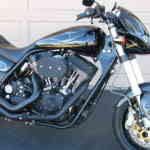
Are we to assume you got it all working like it should? I see 13.7 on the tank panel gauge. Nice job, looks great!