



Causes of engine pinging

Road Captain
Joined: Apr 2005
Posts: 535
Likes: 14
From: Highspire Pa

try looking for: SENSOR, MANIFOLD AIR PRESSURE (MAP) it is similar to the VOES but I guess better, maybe more accurate, I don't think Harley still uses the old style VOES like they did with the older evo engines.
Last edited by pajoe; Aug 19, 2010 at 04:30 PM.
Road Captain
Joined: Apr 2005
Posts: 535
Likes: 14
From: Highspire Pa
Jim,
I read Harley started using MAP sensors on carbed bikes along with a non-adjustable crankshaft position sensor to determine ignition timing when the Twin Cam engine was introduced but as you confirmed, the older evo style engines uses a VOES. I don't know anything about MAP sensors or twin cam engines but read the MAP sensors track the pressure as opposed to just being an on-off type vacuum switch. I guessed the 2000 softail deuce might have a twin cam engine when rodney123456 posted his comments about the VOES was not listed for his bike.
I read Harley started using MAP sensors on carbed bikes along with a non-adjustable crankshaft position sensor to determine ignition timing when the Twin Cam engine was introduced but as you confirmed, the older evo style engines uses a VOES. I don't know anything about MAP sensors or twin cam engines but read the MAP sensors track the pressure as opposed to just being an on-off type vacuum switch. I guessed the 2000 softail deuce might have a twin cam engine when rodney123456 posted his comments about the VOES was not listed for his bike.
Stellar HDF Member


Joined: May 2009
Posts: 2,856
Likes: 127
From: Middle of Kansas
pajoe; Well duh. I missed that it was a 2,000. I am good at that. Thanks for the headsup. Sounds like they made them more complicated. I guess all that stuff is great as long as it is working, but when it quits, its a nightmare. I even changed my old 84 Sporty to points and condenser when the module quit. That way I could fix it. Hard to make an old hard head like me learn new tricks. Its taken me 15 years to figure out how to make this puter thing do what I want some times. LOL
Road Captain
Joined: Apr 2005
Posts: 535
Likes: 14
From: Highspire Pa
Jim,
I do believe the newest Harley is the best Harley made, but I prefer to keep my old one. I know very little but find I have a hard time even remembering those few things I knew. It's a bitch growing old but the only other alternative that I know of seems even less desirable.
I do believe the newest Harley is the best Harley made, but I prefer to keep my old one. I know very little but find I have a hard time even remembering those few things I knew. It's a bitch growing old but the only other alternative that I know of seems even less desirable.

Tourer
Joined: Apr 2010
Posts: 293
Likes: 7
I recommend you research VOES and timing for yourself.
The info here is way wrong.
As in, to decrease the advance is not a default power loss at all, no such thing. There are many factors that contribute to that dynamic. It may be the case, or may not. There is currently no way of knowing in respect of your bike and the information supplied.
The voes works nothing like it has been described here.
It is nothing like a light switch at all. A light switch is turned on for use, and turned off when you are finished.
A voes is constantly changing between one mode and the other(you can say on and off if you like) during operation. So it is more like the opposite of a light switch(unless you believe that flicking the light on and off is somehow beneficial).
The timing curves cross more than once.
You will most likely need a setting of at least 6 inches of mercury on your voes. This will cause it to change curves sooner, not stop it from advancing as quickly.
Seriously, look up the manual.
The info here is way wrong.
As in, to decrease the advance is not a default power loss at all, no such thing. There are many factors that contribute to that dynamic. It may be the case, or may not. There is currently no way of knowing in respect of your bike and the information supplied.
The voes works nothing like it has been described here.
It is nothing like a light switch at all. A light switch is turned on for use, and turned off when you are finished.
A voes is constantly changing between one mode and the other(you can say on and off if you like) during operation. So it is more like the opposite of a light switch(unless you believe that flicking the light on and off is somehow beneficial).
The timing curves cross more than once.
You will most likely need a setting of at least 6 inches of mercury on your voes. This will cause it to change curves sooner, not stop it from advancing as quickly.
Seriously, look up the manual.
Road Captain
Joined: Apr 2005
Posts: 535
Likes: 14
From: Highspire Pa
The VOES does change states often but it does not flicker often unless there is an intermittent vacuum leak or if you get it just right where the throttle puts just enough vacuum, I can make it flicker on slow upgrades but I have to try to do it.. The VOES switch will open whenever the vacuum drops, this happens whenever you first roll on the throttle but after things stabilize the vacuum works back up and the VOES will come on again - it remains "On" or grounded most of the time. Whenever the VOES is grounded it will go to full advance at about 1500 rpms, if it is ungrounded it may go to full advance anywhere from 2500-3000 rpms. Programmable ignitions do allow you to change these settings .


If you observe the pictures above you will note the dotted line is when the VOES is grounded and it is at full advance about 1500 rpms and stays there until it hits the rev limiter, the darker line is the slower curve but even that curve is at full advance from about 2500 - 3000 rpms. Curve 1 which is for stock engines is about 2500, whereas Curve 4 which is the slowest curve for 127" engine etc is at full advance about 3000 rpms. The photo is from the Ultima programmable ignition manual

My wife made a not too good but short youtube video (480P is better) showing the LED indicator that I have wired in series with my VOES, whenever the VOES wire is grounded the LED is lit, As I roll on the throttle the indicator goes out as soon as I level off the indicator comes back on. Some guys wire in parallel but I don't like that setup because if the LED allows enough current to flow to ground the led will go out but the ignition will remain on the full advance at 1500 rpms curve. . I used three different ignition modules and they all worked well with a 12V LED indicator wired in series.
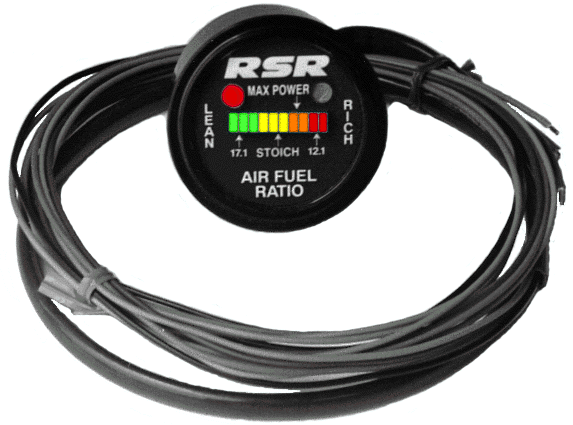
ON EDIT: The VOES led indicator is the round one in the upper left corner, under the "R" not the rectangular LEDS for the air-fuel ratio, they change more often than the VOES indicator. I do plan on having it tuned by a professional someday when I get around to it. I did have it on the dyno and my air/fuel ratio is included on the dyno report, on of the pictures at my signature, yes it is a little rich.
If you observe the pictures above you will note the dotted line is when the VOES is grounded and it is at full advance about 1500 rpms and stays there until it hits the rev limiter, the darker line is the slower curve but even that curve is at full advance from about 2500 - 3000 rpms. Curve 1 which is for stock engines is about 2500, whereas Curve 4 which is the slowest curve for 127" engine etc is at full advance about 3000 rpms. The photo is from the Ultima programmable ignition manual
My wife made a not too good but short youtube video (480P is better) showing the LED indicator that I have wired in series with my VOES, whenever the VOES wire is grounded the LED is lit, As I roll on the throttle the indicator goes out as soon as I level off the indicator comes back on. Some guys wire in parallel but I don't like that setup because if the LED allows enough current to flow to ground the led will go out but the ignition will remain on the full advance at 1500 rpms curve. . I used three different ignition modules and they all worked well with a 12V LED indicator wired in series.
ON EDIT: The VOES led indicator is the round one in the upper left corner, under the "R" not the rectangular LEDS for the air-fuel ratio, they change more often than the VOES indicator. I do plan on having it tuned by a professional someday when I get around to it. I did have it on the dyno and my air/fuel ratio is included on the dyno report, on of the pictures at my signature, yes it is a little rich.
Last edited by pajoe; Aug 20, 2010 at 03:40 PM. Reason: too many spelling errrors
Tourer
Joined: Apr 2010
Posts: 293
Likes: 7
You are getting closer.
But........
a voes is a good idea, and if it runs just fine without it, then you have done a terrible tuning job, and should not advise others that they do not need one.
The voes is in no way restricted to any rpm zone.
If a voes does not have any effect above 3500, and it does not affect maximum torque of hp, and it only has one adjustment(inches of mercury that it opens/closes at) then in what sense would it be better to not have one, than to have one poorly set-up(whatever that could mean)
as...........
it clearly would(in the worst case scenario) be the same as if it was not there anyhow?
You need to research a lot more before you try to instruct others. You are obviously not clear on your current understanding.
But........
a voes is a good idea, and if it runs just fine without it, then you have done a terrible tuning job, and should not advise others that they do not need one.
The voes is in no way restricted to any rpm zone.
If a voes does not have any effect above 3500, and it does not affect maximum torque of hp, and it only has one adjustment(inches of mercury that it opens/closes at) then in what sense would it be better to not have one, than to have one poorly set-up(whatever that could mean)
as...........
it clearly would(in the worst case scenario) be the same as if it was not there anyhow?
You need to research a lot more before you try to instruct others. You are obviously not clear on your current understanding.
HD Forum Stories
The Best of Harley-Davidson for Lifelong Riders

7 Surprising Harley-Davidson Products that Are Not Motorcycles
Verdad Gallardo
8 Best Harley-Davidson Motorcycles Ever
Pouria Savadkouei
10 Worst Harley-Davidson Motorcycles Ever
Pouria Savadkouei
Killer Custom's Jail Break Is The Breakout That Refused to Blend In
Verdad Gallardo
Crazy Bunderbike Build Looks Amazing, But Is It Impossible to Ride?
Verdad Gallardo
Harley-Davidson Reveals Super Cool Cafe Racer Concept
Verdad Gallardo
Engraved Rebellion: Inside Bundnerbike's Glam Rock II
Verdad Gallardo
10 Motorcycles You Should Never Buy
Joe Kucinski
10 Things Harley-Davidson Needs to Fix in 2026
Verdad Gallardo
Seasoned HDF Member


Joined: Aug 2008
Posts: 5,081
Likes: 2,159
From: Ohio
[QUOTE]
Nothing was ever mentioned as a power loss in a default mode, PaJoes attached info referanced default as the retarded mode.
Normally open switch closes at vacume, debating a light switch referance?
Touring section garbage
The voes works nothing like it has been described here.
It is nothing like a light switch at all. A light switch is turned on for use, and turned off when you are finished.
It is nothing like a light switch at all. A light switch is turned on for use, and turned off when you are finished.
A voes is constantly changing between one mode and the other(you can say on and off if you like) during operation. So it is more like the opposite of a light switch(unless you believe that flicking the light on and off is somehow beneficial).
Road Captain
Joined: Apr 2005
Posts: 535
Likes: 14
From: Highspire Pa
Irongear:
I do agree a VOES is a good idea, that is why I prefer to use one.
However, having a VOES that is set up to switch at too low a vacuum level can cause detonation. and that is what I meant by set up incorrectly. The harm done by severe detonation is worse than not having a VOES. Ultima does not recommend using a VOES on their big inch engines. I am led to believe Ultima had a lot of trouble in the early days with guys installing Ultima big inch engines but keeping their stock VOES causing detonation problems that were damaging engines.
The VOES does still open and close at various rpms, mine will be activated at 70 mph, but as you can see by the advance curves posted, once you get to full advance it doesn't matter if the VOES is closed or not you are still at full advance. Likewise maximum horsepower and torque on a dyno does not change if you add a VOES.
However, if you will be so kind as to explain how the VOES makes the timing go beyond "full advance" on anything other than perhaps a custom programmed curve, I will GLADLY admit I was incorrect stating that VOES only affects lower rpms; before the ignition module attains full advance. As I posted in my first sentence, I admit I am far from an expert
I apologize to anyone if they got the impression I think I am an expert.
I do agree a VOES is a good idea, that is why I prefer to use one.
However, having a VOES that is set up to switch at too low a vacuum level can cause detonation. and that is what I meant by set up incorrectly. The harm done by severe detonation is worse than not having a VOES. Ultima does not recommend using a VOES on their big inch engines. I am led to believe Ultima had a lot of trouble in the early days with guys installing Ultima big inch engines but keeping their stock VOES causing detonation problems that were damaging engines.
The VOES does still open and close at various rpms, mine will be activated at 70 mph, but as you can see by the advance curves posted, once you get to full advance it doesn't matter if the VOES is closed or not you are still at full advance. Likewise maximum horsepower and torque on a dyno does not change if you add a VOES.
However, if you will be so kind as to explain how the VOES makes the timing go beyond "full advance" on anything other than perhaps a custom programmed curve, I will GLADLY admit I was incorrect stating that VOES only affects lower rpms; before the ignition module attains full advance. As I posted in my first sentence, I admit I am far from an expert
I apologize to anyone if they got the impression I think I am an expert.