



How do you evaluate a Sert data file?

Tourer
Joined: Oct 2006
Posts: 422
Likes: 0
From:
 RE: How do you evaluate a Sert data file?
The bias table only effects closed loop operation or anytime the A/F table calls for 14.6. The propose of the bias table is to alter to A/F to something other than 14.6 by offsetting the point at which the O2 sensors switchfrom what theyconciders lean to rich.
If the bias voltage is set to 700mVolts anything higher would be rich anything lower would be lean and then add or subtract fuel with the O2 int.
If the bias voltage is set to 700mVolts anything higher would be rich anything lower would be lean and then add or subtract fuel with the O2 int.
Thread Starter
|
Road Master
Joined: Oct 2006
Posts: 894
Likes: 1
From: Northport, AL
RE: How do you evaluate a Sert data file?
Thanks for clearing that up. Is there any disadvantages to keeping the bias table maxed out? 14.2 A/F sounds closer to ideal than 14.6. Is the 14.6 A/F a setting to keep the EPA happy?
You guys should write a primer on this for us that want to learn about it. It would make a great "sticky".
You guys should write a primer on this for us that want to learn about it. It would make a great "sticky".

Banned
Joined: Jul 2006
Posts: 866
Likes: 1
From:
RE: How do you evaluate a Sert data file?
ORIGINAL: grandpawmoses
Thanks for clearing that up. Is there any disadvantages to keeping the bias table maxed out? 14.2 A/F sounds closer to ideal than 14.6. Is the 14.6 A/F a setting to keep the EPA happy?
You guys should write a primer on this for us that want to learn about it. It would make a great "sticky".
Thanks for clearing that up. Is there any disadvantages to keeping the bias table maxed out? 14.2 A/F sounds closer to ideal than 14.6. Is the 14.6 A/F a setting to keep the EPA happy?
You guys should write a primer on this for us that want to learn about it. It would make a great "sticky".
Tourer
Joined: Oct 2006
Posts: 422
Likes: 0
From:
RE: How do you evaluate a Sert data file?
ORIGINAL: grandpawmoses
Is there any disadvantages to keeping the bias table maxed out? 14.2 A/F sounds closer to ideal than 14.6. Is the 14.6 A/F a setting to keep the EPA happy?
Is there any disadvantages to keeping the bias table maxed out? 14.2 A/F sounds closer to ideal than 14.6. Is the 14.6 A/F a setting to keep the EPA happy?
Banned
Joined: Jul 2006
Posts: 866
Likes: 1
From:
RE: How do you evaluate a Sert data file?
ORIGINAL: cjuetten
Fuel milage may drop a bit.Its saferto MAXout andthen backthem off slowly watching closely for knock activity or any other lean indicators. At 14.2 you should not have an excessivly rich condition. The 14.6 is most likely EPA requirement. The 07 were designed to run lean but when you start seeing excessive knock activityyouneed torichened it up.
ORIGINAL: grandpawmoses
Is there any disadvantages to keeping the bias table maxed out? 14.2 A/F sounds closer to ideal than 14.6. Is the 14.6 A/F a setting to keep the EPA happy?
Is there any disadvantages to keeping the bias table maxed out? 14.2 A/F sounds closer to ideal than 14.6. Is the 14.6 A/F a setting to keep the EPA happy?
Tourer
Joined: Oct 2006
Posts: 422
Likes: 0
From:
RE: How do you evaluate a Sert data file?
I've recorded up to 9.25degrees knock retard@ 2375rpm steady speed (55 mph) with throttle at 15.5%.(this iscruising range and bike was in closed loop operation.AFR was 14.6 and O2 int at 104%).This is where my "Can of Marbles" or "Trany Noise" was coming from.Increasingthe O2 bias voltage has since reduce knock retard and pinging.
I stated that Fuel milage "May" drop. Yes, I was guessing here as a possible disadvantage.
Ihave gained a lot of great info from you and others and I'mlearning as I go. Unfortuantly its winter here so I'm not getting any real tuning done right now, but Iapprieciate any and all info I can get from those with moreexperance and warmerclimate.
I stated that Fuel milage "May" drop. Yes, I was guessing here as a possible disadvantage.
Ihave gained a lot of great info from you and others and I'mlearning as I go. Unfortuantly its winter here so I'm not getting any real tuning done right now, but Iapprieciate any and all info I can get from those with moreexperance and warmerclimate.

Road Master
Joined: Dec 2006
Posts: 1,058
Likes: 6
From: Omaha Nebraska
RE: How do you evaluate a Sert data file?
ORIGINAL: grandpawmoses
Thanks for clearing that up. Is there any disadvantages to keeping the bias table maxed out? 14.2 A/F sounds closer to ideal than 14.6. Is the 14.6 A/F a setting to keep the EPA happy?
You guys should write a primer on this for us that want to learn about it. It would make a great "sticky".
Thanks for clearing that up. Is there any disadvantages to keeping the bias table maxed out? 14.2 A/F sounds closer to ideal than 14.6. Is the 14.6 A/F a setting to keep the EPA happy?
You guys should write a primer on this for us that want to learn about it. It would make a great "sticky".
Having to use a bias table does not make sense to me,14.2 is more rich then you should have to be for most smooth operating,economical cruising. All narrow band 02 sensors are designed to operate in the slightly too rich 14.6 EPA friendly emission control range.A fewEMS systems in the past have attempted this narrow band biastrick but all that I know ofhave got away from this proceedure due towhat I've described in a previous post, the inconsistancies of a narrow band O2s anytime you deviate from the .45V crossover point for more rich or lean of the 14.6 stoich ratio.Possibly the HD EMS/software is more advanced then the rest of the EMS engineworld, but I'd bet against it or possibly the engine is under developed with inconsistancies causing us tohave to mis-tunethe EMS, I hope not. As a general rule, if you have to go to go from 14.6 to 14.2 to eliminate a problem, you are most likely going around the real problem, such as, if you are getting detonation,you either have too much timing advance, compression or bad fuel, whatever, I wouldtry backing the timing off in the offending RPM/load range rather then cover the problem up withricher A/F first.
HD Forum Stories
The Best of Harley-Davidson for Lifelong Riders

7 Surprising Harley-Davidson Products that Are Not Motorcycles
Verdad Gallardo
8 Best Harley-Davidson Motorcycles Ever
Pouria Savadkouei
10 Worst Harley-Davidson Motorcycles Ever
Pouria Savadkouei
Killer Custom's Jail Break Is The Breakout That Refused to Blend In
Verdad Gallardo
Crazy Bunderbike Build Looks Amazing, But Is It Impossible to Ride?
Verdad Gallardo
Harley-Davidson Reveals Super Cool Cafe Racer Concept
Verdad Gallardo
Engraved Rebellion: Inside Bundnerbike's Glam Rock II
Verdad Gallardo
10 Motorcycles You Should Never Buy
Joe Kucinski
10 Things Harley-Davidson Needs to Fix in 2026
Verdad Gallardo
Tourer
Joined: Oct 2006
Posts: 422
Likes: 0
From:
RE: How do you evaluate a Sert data file?
I'm stuck somewhere in the middle, based on previous exsperience and what seems to work with SERT. Here's some basic info onnarrow band O2sfor those that are curious.
Narrow Band
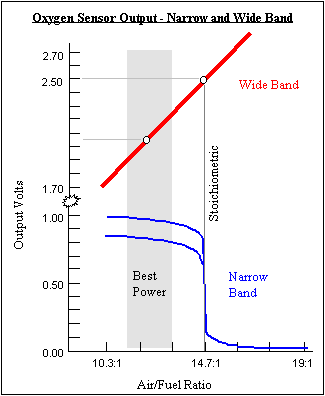
A Narrow Band Lambda Sensor generates a high voltage if it is in an atmosphere lacking oxygen. If the atmosphere has excess oxygen, a low voltage is generated. In use, a rich mixture gives a voltage of 0.8 – 1.0 volts. A lean mixture gives a voltage of 0.2 – 0.0 volts. The graph below taken from the Tech Edge web site shows the output more clearly. As you can see, there is very little variation on either side of rich or lean, but as it goes from rich to lean the voltage output changes from 0.8 volts to 0.2 volts almost instantly. Note the Lambda range at the bottom of the graph is 0.98 to 1.02 – the transition is very quick.

This means, in practical terms, that the Narrow Band Lambda Sensor is a yes/no type indicator. Yes the exhaust gas shows a rich mixture/no it doesn’t. Simple as that. It has no real use as an indication of mixture apart from rich or lean.
Narrow Band sensors have been around for some time and come in two types - heated and non heated. They can also have one to four wires. Initially, they were one wire – the output voltage, using the vehicle components as the ground path. Then they went to two wires for the signal with a dedicated ground wire, which gave more consistency and less noise to the output. When the first heated probes appeared they were made as 3 wire, being one signal, one heater, one ground, or 4 wire – one signal, signal earth, heater, and heater earth. These days 4 wire sensors are pretty much the standard.
The heater is to warm the sensor up. The sensors don’t work very well until they are hot, and with the emissions laws increasingly reducing the time after start up that a vehicle must start complying, the heater is needed to get the sensor working quickly.
Narrow Band
A Narrow Band Lambda Sensor generates a high voltage if it is in an atmosphere lacking oxygen. If the atmosphere has excess oxygen, a low voltage is generated. In use, a rich mixture gives a voltage of 0.8 – 1.0 volts. A lean mixture gives a voltage of 0.2 – 0.0 volts. The graph below taken from the Tech Edge web site shows the output more clearly. As you can see, there is very little variation on either side of rich or lean, but as it goes from rich to lean the voltage output changes from 0.8 volts to 0.2 volts almost instantly. Note the Lambda range at the bottom of the graph is 0.98 to 1.02 – the transition is very quick.
This means, in practical terms, that the Narrow Band Lambda Sensor is a yes/no type indicator. Yes the exhaust gas shows a rich mixture/no it doesn’t. Simple as that. It has no real use as an indication of mixture apart from rich or lean.
Narrow Band sensors have been around for some time and come in two types - heated and non heated. They can also have one to four wires. Initially, they were one wire – the output voltage, using the vehicle components as the ground path. Then they went to two wires for the signal with a dedicated ground wire, which gave more consistency and less noise to the output. When the first heated probes appeared they were made as 3 wire, being one signal, one heater, one ground, or 4 wire – one signal, signal earth, heater, and heater earth. These days 4 wire sensors are pretty much the standard.
The heater is to warm the sensor up. The sensors don’t work very well until they are hot, and with the emissions laws increasingly reducing the time after start up that a vehicle must start complying, the heater is needed to get the sensor working quickly.