When you click on links to various merchants on this site and make a purchase, this can result in this site earning a commission. Affiliate programs and affiliations include, but are not limited to, the eBay Partner Network.
The Shock's just got here... Plowing thru the instructions at the moment. On the first page it tells me to look at the " ressy " " Look at the brackets on the ressy, Re-drill one of them to mount on the smaller diameter of the ressy." Update ... Howard replied sorta with an opeing salvo of I'm a Dumb Bunny for not following his instructions... anyhow a " RESSY" is the external reservoir... That's the kinda stuff that throw ya for a loop on his instructions... He know in his head what he is telling you but there is a bit of a language barrier for us non techie non engineer types... It's clear in his head but the translation to the head of dumb bunnies like myself takes some elbow grease....
Last edited by TimLScheffer; Aug 22, 2016 at 02:02 PM.
Just getting it straigt in my head. I'm reading the manual and restating it according to Tim... :-) I will do the install sometime this week and git back to you folks...
" Compression Damping " the energy absorption speed when you hit a bump and the shock compresses or shortens as it compresses the oil or air. The Compression valve or damper controls the ease of or speed of compressing the fluid by making the orifices through which it flows bigger or smaller. This control or ajuster is on top of the shock or on the external reservoir. Playing with the compression damping makes the bike go from soft and botteming out, to harsh and hard. The idea is to tune it to road conditions and load. Finding a place where the rubber maintains the best constant contact with the road which improves handling... How you handle the bike has to do with the ajustment... Will you be diving into and accelerating into a corner or will you drift through it... There is pro's and con's ajusting either way... If you are digger diver you will have to make a tighter ride which will comprimise cruising shock absorbtion as opposed to forces applied digging diving stability... and vice versa...
" Rebound Damping " the rebound ajuster is on the bottom of the shock. It controls how fast the shock returns to extended length by the same method of regulating how fast the oil comes back into the shock tube as it uncompresses or extends. Playing with the rebound damping makes the bike lose and bouncy when easy or free flowing to hard and bumpy when not free flowing... You have to ajust that to your liking, road conditions and load with the external ajusters if you have them.
" Spring Pre-Load " The Spring Pre-Load has little to do with the damping processes. It is the hard coil spring. This Spring needs to be custom ordered for the weight of the bike and your bike and load. Ajusting it by compressing or uncompressing it set's the resting height of the bike. That's why it must be ordered to the specs of you, your weight, your passengers weight and gear.
So, when you set the Pre-Load it looks like the difference between the wheel hanging off the jack and with you sitting on it should be around one inch from a fixed point on the axle to a fixed point on the seat or frame. I need to check on that measurement and it's in milimeters not inches and I did a conversion in my head... I'm not that facile with metrics... Anyhow get back to ya when I figure that out better...
Last edited by TimLScheffer; Aug 16, 2016 at 06:21 PM.
So, when you set the Pre-Load it looks like the difference between the wheel hanging off the jack and with you sitting on it should be around one inch from a fixed point on the axle to a fixed point on the seat or frame. I need to check on that measurement and it's in milimeters not inches and I did a conversion in my head... I'm not that facile with metrics... Anyhow get back to ya when I figure that out better...
No not really, you want to set your sag at 1/3rd of the 'stroke' your specific shocks have. That number should be on your owners manual and in the email from MM.
That number should be on your owners manual and in the email from MM.
I concur... Like I said, I got to finish Cipherin... I barely know what a mm is... why don't they put this stuff in inches for us Metrically challenged Americans...
I sent you 4 different sets of directions that I authored in the e-Mails (aforementioned in post dated 08-15-2016 11:16 AM). It is imperative you read that e-Mail I sent to the e-Mail address you provided. Download the aforementioned installation directions contained in: "also include four (4) different installation instructions, (two [2].....obvious reasons. I am easily available to call anytime within reason."
At the same time please read the information in the body of that e-Mail. It contains:
" Invoice w/tracking #
Please read these included install instructions and ignore the ones in the box. Please buy the tools needed. Problems or having trouble, please call me any reasonable hour 7 days a week E.S.T. I want you to have no drama in getting a good ride.
A): Please read the conditions on the build sheet you signed. Phone #:
#0 Maintenance: My shocks will last a lifetime. The warrantee is a conditional 5 years (must be maintained). The shafts and threads must be cleaned regularly. Service Ask me
00: I wish you to call me & we will put the shocks on together. Please have shocks in hand & instructions already read & understood." (you do not have to call me if you do not want to, your choice).
Before you ever completed this sale, you were sent an invoice. On that invoice were your conditions of sale. I do this so I/we get the expected performance & results by following the agreed upon terms, that is part of what you paid me for. The information you are reading and printing is something I asked you to ignore. I have no real ego needs for this service, just to give you the best service I can.
I am the guy who originally developed your/these shocks along with the brackets. Someone at Ohlins changed my hole lay-out to what is is now from the factory. I can not do anything about this as I do not own Ohlins. All I can do is send you/my customers directions on how to fix the problem and be personally available via phone anytime within reason. That is what sets me apart, knowing what I am talking about.
PS: Look at the position of the Ressy/reservoir mounting straps:
Please ignore the fact the hose position which should be in front of the Ressy and the fact that the (I include & not Ohlins) protective clamp sleeves are not used by this client.
Got ya... I have not started yet on the installation. I am just reading all the information in the box to acclimate myself and i am thinking out loud here
PS: Look at the position of the Ressy/reservoir mounting straps:
Please ignore the fact the hose position which should be in front of the Ressy and the fact that the (I include & not Ohlins) protective clamp sleeves are not used by this client.
Howard,
I've never heard you discuss the position of the remote reservoir (Ressy) hose on your #6 rear shocks. I'm guessing the position of the hose is based on the particular model year of motorcycle and method of actually mounting the remote reservoir. Please clarify.
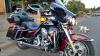
The Hardest Part is mounting the reservor. On a 14 Ultra Classic Limited the L bracket provided slides inbetween the inside of the fender and the bracket for the little face plate on the rear with the L facing in. I think this bracket comes from Ohlin. It is drilled wrong. Howard claims he gave em the spec and they changed it... I am curious as to why Howard does not make that correction for us by drilling another hole instead of making it a puzzle type headace for the installer... Mount the hose clamp brackets to the little holes and then you have to drill another hole to get the big holes to match up to the holes in the fender...
1. Sag Set Up
a. Your shocks are delivered by me with the Pre-Load collar set with only a few threads showing at the top. You are
the only one that can set your spring pre-load on your bike correctly.
b. Measure the total length of the shock in any method you wish with the wheel slightly off of the ground.
An easy way is to rotate the “Flats” of the shock mounting bolts. I recommend a caliper that is at least 14” long. A cheap solution is a Harbor Freight:
c. If you own a FLT this measurement is what you will get from 28 mm (1.1") of total sag if you weigh 204#. (next picture)
d. In this instance the total length from the outside flat ( of the bottom bolt in the swing arm to the) outside flat of the (top shock) bolt with the wheel off of the ground was 349 mm. (13.7" )
With the subject sitting on the bike with feet up on the boards and the jack removed, the total sag was 28 mm ( 1.1" ) as measuring from the same point, the shock length is 321 mm ( 12.6" ) .
This is a 220 mm ( 8.6 " ) X 25 N/m spring only. Write it down!
e. Have a friend steady the bike by the handlebars and the rider sits on the bike with the wheel on the ground if
measuring for single up. For two up both riders get on the bike with feet up on the pegs just like you are riding.
f. Look on my site and determine what your stroke is. ( ? ) ( where on your site? ) Divide the stroke by 1/3rd.
A #3~#3 looks like this: #3~#3: 329 +5mm (.2") /- 5 mm (.2") = low of 12 3⁄4”~13 9/64,
Stroke: 3 1/32"/ 77mm.
g. Depending where the height adjuster is adjusted to,
measure from your reference point (R-1). ( not quite clear on what R-1 is. I assume reference point 1, which would betop bolt hole on the frame? I did not see a pic with R-1 labeled. Perhaps it is on info on your site somewhere? )
h. Divide the stroke by 1/3rd (77mm) (3" ) 3 ÷ = 25.66 mm ( 1")
i. (R-1) - 1/3rd stroke = (R-3) target (with the above rider(s)
on the bike).
Please remember that over 500 miles your shocks will
break-in and have different ride characteristics than new.
Look at this spring pre-load collar in relation to the top
seal head, that bike that I personally measured both
initially and now. The spring pre-load collar was set similarly to the
above shock on the FLT. The length of the shock (with like height
adjuster length) is exactly the same. 1/3rd the stroke (rebound) is
inside of the shock.
n an effort to supplement the Öhlins Mounting Instructions I have created this pictorial from actual
experiences.
1. Nomenclature
I
2 | P a g e
2. Pull the shock out of the box and familiarize yourself with the parts shown above.
a. Legal Disclaimers to protect myself
i. It is advisable to have an Öhlins dealer install the shock absorber.
ii. When installing, consult your Vehicle Service Manual.
3. All models;
a. Remove Present Shock Absorbers.
b. The first steps is;
c. Measure & correct the swing arm and frame if it is out
of alignment commonly found on almost all Harley Davidsons.
( I understand that to mean, that when you bolt the shock up to the swing arm or bottom bolt of the shock, and swing the top of the shock up to the top bolt hole on the frame, then it should come flush with the the frame. If it does not come flush and there is a space, a spacer should be mounted to bridge that gap. If the gap is not rectified with a washer then the shock would not be riding true causing side loading of the shaft which would cause it to bend, warp or waller out the bushing it goes into.)
( A method of checking that would be to install a bolt in the bottom shock bolt hole in the swing arm. Then use a straight edge to sit on top of the bolt flush with the bottom mounting hole. With the straight edge on the bottom bolt flush against the bolt hole, the top of the straight edge should be flush with the top mounting hole. If it is not then you have to add spacers to bridge the gap. )
d. Thread in an appropriate ½” X 13” bolt into your
bottom shock mount
(2). Place the straight edge or caliper onto the
bottom bolt, using that bolt A) & bottom mounting bung (bolt hole) (2) as the
governing reference point and not the top mount/bolt (1). The top
end eye & cylinder of the shock is stationary and the shaft and the
piston must move exactly true inside the seal head bushing and
cylinder. There is no room for error. ( the top bolt hole on the frame is stationary and does not move) ( The bottom shock bolt hole is on the swing arm and goes up and down. )
e. Rotate the straight edge or caliper around the bolt
shaft until the edge is in line with the top mounting bung (bolt hole) (A) and if
there is a space (B) it must be filled exactly for your shock shaft &
piston to properly move up and down with the swing arm/tire.
f. Install the sleeve (converts metric to SAE if needed) in
the bottom eye (#2) than install the ½”x 13 x 2 ½” bolt and washer through the outside eye
than affix shock and bolt to the swing arm. Snug using your washer and ½”x 13 nut. No
washer (spacers) should be necessary unless the swing arm and frame is out of alignment
commonly found on almost all Harley Davidsons or clearance problems are caused by
aftermarket accessories.
g. Rotate shock upwards so the top bolt mounting hole in the frame aligns with the cylinder
head bolt hole.
h. Look from the rear forward at the space (if any) between the frame and the cylinder head
(#1).
i. Add the appropriate amount of space
j. Install the sleeve (converts metric to SAE) in the bottom eye
(#2) than install the ½”x 13 x 2 ½” bolt and washer through
the outside eye than affix shock and bolt to the swing arm.
Snug using your washer and ½”x 13 nut. No washer
(spacers) should be necessary unless the swing arm and
frame is out of alignment commonly found in 1986 ~ 2008
FLT’s or clearance problems are caused by aftermarket
accessories.
k. Rotate shock upwards so the top bolt mounting hole in the
frame aligns with the cylinder head bolt hole.
l. Look from the rear forward at the space (if any) between the
frame and the cylinder head (#1). m. Add the appropriate amount of spacer(s) to shim the shock
to eliminate the gap if needed. ( see attached pic ) Caution! Under no circumstances ever tighten the mounting bolt to close the gap
Last edited by TimLScheffer; Aug 22, 2016 at 08:10 PM.
I've read a lot of threads about these great shocks. But my question is this what happens if you and or your passenger gain or lose weight? Go from lite packing trips to heavy packing trips? What if your wife rides once or twice a season like mine does? I'll stick with my progressive shocks. Spend a lot of time talking to my dealer about this issue. He didn't recommend these.
If your parameters change the maing thing that changes is the pre-load springs... They set the resting height of your bike and load to maxamise the amout of travel left in your shocks. If you change too much it's not that big a deal to change out the springs to your new specs. The springs have no bearing on ride... they just set the starting point... Outside that you can there is ajustment for light heavy loads... and it's easy to do on the fly... Your dealer wants to sell you OEM... If your riding style is not aggressive and you ride the speed limit drifting through corners as opposed to throttling thru them, then the OEM is adequate but by no means perferable...
Howard, If you handle these shocks before you ship em to us, it would be aweful white of you to drill out the Resevor Bracket for us... That would be service. I am curious as to why you don't?
Last edited by TimLScheffer; Aug 22, 2016 at 08:00 PM.
Slideshow: From the troubled AMF years to modern misfires, these bikes earned reputations for reliability issues, questionable engineering, or disappointing performance.
Crazy Bunderbike Build Looks Amazing, But Is It Impossible to Ride?
Slideshow: The Swiss custom shop has taken a Harley Softail and stretched it into something so long and low that it looks closer to a rolling sculpture than a conventional motorcycle.
Engraved Rebellion: Inside Bundnerbike's Glam Rock II
Slideshow: A standard cruiser becomes an intricate metal canvas in the hands of a Swiss custom house known for pushing Harley-Davidson platforms far beyond their factory brief.
Slideshow: Harley-Davidson's challenges aren't abstract; they show up in dropping shipments, shrinking dealer traffic, and strategic decisions that aren't yet translating into growth.