




MPG - carb = 45.... fuel injection = 36...why?
Thread Starter
|
Stellar HDF Member
Joined: Jan 2013
Posts: 2,721
Likes: 103
From: St. Louis, MO
 MPG - carb = 45.... fuel injection = 36...why?
This might be better in the tech forum but it doesn't get many views and there are some sharp minds here so I want to get some advice.
My buddy lends me his 03 heritage softail (TC 88) when I come to town (good buddy huh). Only difference in our bikes besides the forks is his is a carb and mine is FI, and I run a windshield and his bike doesn't have one, I have long fishtail duals with lollipops and he has V&H long shots with baffles and it received a "stage 1" air cleaner, the pipes and jetting before he took delivery.
I have the stock tune in my FI bike. I do have a PC III tuner that I got from FuelMoto with their custom tune for my mods, but it just adds fuel, and I don't notice any performance difference with it, only 2 mpg lower fuel economy.
I get consistent 45 mpg on his bike, but only 36 on mine. Maybe 38 if I ride extra easy.
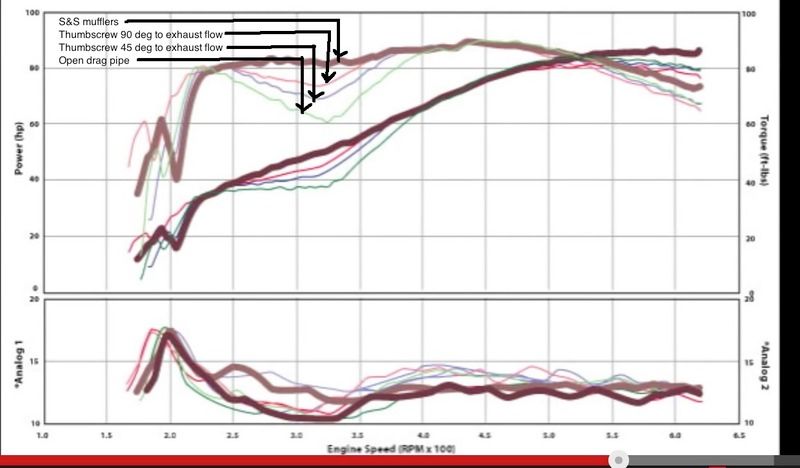
I will post up spark plug pictures and MPG logs later. I'm considering reducing fuel a bit from stock from 2000-3500 as that is the bog area from straight pipes as per this dyno sheet. The straight pipes reduce VE in this area due to reversion as discussed and proven here:
https://www.hdforums.com/forum/softa...confirmed.html
 [/URL]
Anyone else notice such a huge MPG increase with a carb? What MPG are you guys getting?
EDIT - FIGURED IT OUT. IT IS MY AVERAGE SPEED IN FL RIDING VS MO RIDING. SEE POST 36 FOR DETAILS. MY BIKE IS GETTING 43 MPG IN TWO LANE COUNTRY ROAD GROUP RIDING AT 50-60 MPH LIKE I DO IN MO, BUT I SELDOM DO THAT IN FL, MOST FL RIDING IS SOLO HIGHWAY RIDING AT 80-85 MPG.
My buddy lends me his 03 heritage softail (TC 88) when I come to town (good buddy huh). Only difference in our bikes besides the forks is his is a carb and mine is FI, and I run a windshield and his bike doesn't have one, I have long fishtail duals with lollipops and he has V&H long shots with baffles and it received a "stage 1" air cleaner, the pipes and jetting before he took delivery.
I have the stock tune in my FI bike. I do have a PC III tuner that I got from FuelMoto with their custom tune for my mods, but it just adds fuel, and I don't notice any performance difference with it, only 2 mpg lower fuel economy.
I get consistent 45 mpg on his bike, but only 36 on mine. Maybe 38 if I ride extra easy.
I will post up spark plug pictures and MPG logs later. I'm considering reducing fuel a bit from stock from 2000-3500 as that is the bog area from straight pipes as per this dyno sheet. The straight pipes reduce VE in this area due to reversion as discussed and proven here:
https://www.hdforums.com/forum/softa...confirmed.html
[/URL]Anyone else notice such a huge MPG increase with a carb? What MPG are you guys getting?
EDIT - FIGURED IT OUT. IT IS MY AVERAGE SPEED IN FL RIDING VS MO RIDING. SEE POST 36 FOR DETAILS. MY BIKE IS GETTING 43 MPG IN TWO LANE COUNTRY ROAD GROUP RIDING AT 50-60 MPH LIKE I DO IN MO, BUT I SELDOM DO THAT IN FL, MOST FL RIDING IS SOLO HIGHWAY RIDING AT 80-85 MPG.
Last edited by Joe_G; Mar 13, 2016 at 07:49 PM.

Outstanding HDF Member
Joined: Aug 2012
Posts: 3,217
Likes: 90
From: Detroit
Most of our riding is done in the "bog area" shown on your dyno sheet, and that's also the really rich area shown on your dyno sheet.
Carbs actually have some advantages when it comes to to semi-automatically adjusting fuel to airflow. Disadvantages too.
But fuel injection allows much more precise tuning. You could pull some fuel out of that rich cruising range, and probably wind up with better cruising economy than the carbed bike. Although 45 mpg (assuming freeways speeds averaging around 70) is pretty hard to beat, without venturing into the risky area of engine-destroying detonation.
Carbs actually have some advantages when it comes to to semi-automatically adjusting fuel to airflow. Disadvantages too.
But fuel injection allows much more precise tuning. You could pull some fuel out of that rich cruising range, and probably wind up with better cruising economy than the carbed bike. Although 45 mpg (assuming freeways speeds averaging around 70) is pretty hard to beat, without venturing into the risky area of engine-destroying detonation.
Last edited by Warp Factor; Aug 6, 2015 at 01:30 PM.
Thread Starter
|
Stellar HDF Member
Joined: Jan 2013
Posts: 2,721
Likes: 103
From: St. Louis, MO
I agree with you, my next step is to do my typical weekend rides a few times without a windshield and see how my mileage is.
I keep very detailed logs of mileage as you can see below so we'll have some data to work with.

I have been tuning Vettes for 8 years so I'm familiar with the process and I agree with you. You mention that the bog area is where I cruise (completely agree) and that it's rich in that area....now therein lies a question - I've always heard "Harleys are tuned lean from the factory".
That strikes me as odd - every car I've tuned is tuned rich from the factory - in open loop, however. Obviously in closed loop the car will be at 14.7. My TC 88 Harley is a speed density tune with no O2 sensors nor obviously any feedback loop. GM tunes rich in open loop as the add'l fuel is cooling and protects the pistons. Of course, the EPA mileage ratings are done in closed loop so fueling is optimized for mileage in closed loop.
What does Harley do? Tune rich at WOT/heavy load, and lean in part throttle cruise? That would make sense to me, as rich at WOT is safe, lean at part throttle low load is good for mileage.
I would like to know this answer before I start pulling fuel from my tune.
I keep very detailed logs of mileage as you can see below so we'll have some data to work with.

Most of our riding is done in the "bog area" shown on your dyno sheet, and that's also the really rich area shown on your dyno sheet.
Carbs actually have some advantages when it comes to to semi-automatically adjusting fuel to airflow.
But fuel injection allows much more precise tuning. You could pull some fuel out of that rich cruising range, and probably wind up with better cruising economy than the carbed bike.
Carbs actually have some advantages when it comes to to semi-automatically adjusting fuel to airflow.
But fuel injection allows much more precise tuning. You could pull some fuel out of that rich cruising range, and probably wind up with better cruising economy than the carbed bike.
That strikes me as odd - every car I've tuned is tuned rich from the factory - in open loop, however. Obviously in closed loop the car will be at 14.7. My TC 88 Harley is a speed density tune with no O2 sensors nor obviously any feedback loop. GM tunes rich in open loop as the add'l fuel is cooling and protects the pistons. Of course, the EPA mileage ratings are done in closed loop so fueling is optimized for mileage in closed loop.
What does Harley do? Tune rich at WOT/heavy load, and lean in part throttle cruise? That would make sense to me, as rich at WOT is safe, lean at part throttle low load is good for mileage.
I would like to know this answer before I start pulling fuel from my tune.
Outstanding HDF Member
Joined: Aug 2012
Posts: 3,217
Likes: 90
From: Detroit
I have been tuning Vettes for 8 years so I'm familiar with the process and I agree with you. You mention that the bog area is where I cruise (completely agree) and that it's rich in that area....now therein lies a question - I've always heard "Harleys are tuned lean from the factory".
That strikes me as odd - every car I've tuned is tuned rich from the factory - in open loop, however. Obviously in closed loop the car will be at 14.7. My TC 88 Harley is a speed density tune with no O2 sensors nor obviously any feedback loop. GM tunes rich in open loop as the add'l fuel is cooling and protects the pistons. Of course, the EPA mileage ratings are done in closed loop so fueling is optimized for mileage in closed loop.
What does Harley do? Tune rich at WOT/heavy load, and lean in part throttle cruise? That would make sense to me, as rich at WOT is safe, lean at part throttle low load is good for mileage.
I would like to know this answer before I start pulling fuel from my tune.
That strikes me as odd - every car I've tuned is tuned rich from the factory - in open loop, however. Obviously in closed loop the car will be at 14.7. My TC 88 Harley is a speed density tune with no O2 sensors nor obviously any feedback loop. GM tunes rich in open loop as the add'l fuel is cooling and protects the pistons. Of course, the EPA mileage ratings are done in closed loop so fueling is optimized for mileage in closed loop.
What does Harley do? Tune rich at WOT/heavy load, and lean in part throttle cruise? That would make sense to me, as rich at WOT is safe, lean at part throttle low load is good for mileage.
I would like to know this answer before I start pulling fuel from my tune.
EPA testing is kind of a weird thing. They do test on "cold starts", but they also don't test at 700 horsepower levels on cars, which fall outside of their testing range.
Thread Starter
|
Stellar HDF Member
Joined: Jan 2013
Posts: 2,721
Likes: 103
From: St. Louis, MO
You obviously know your stuff. Regarding Vettes, I have a supercharged C5, which can be pretty hard to tune well, because airflow exceeds the measurement range of the Mass Airflow Sensor.
EPA testing is kind of a weird thing. They do test on "cold starts", but they also don't test at 700 horsepower levels on cars, which fall outside of their testing range.
EPA testing is kind of a weird thing. They do test on "cold starts", but they also don't test at 700 horsepower levels on cars, which fall outside of their testing range.
Not to hijack my own thread, but can't you get a conversion harness from Lingenfelder for a ls3 style blade maf and convert your maf tables to read that with much improved headroom? I am kind of out of date on the c5 stuff but I thought that was possible.
Back on topic - I suspect the exhaust reversion is causing fairly significantly lower VE in the dip range, thus, with lower VE I'd need lower fueling per my estimation - lower VE means less fuel needed compared to stock.
BUT...in order to answer my question as to whether the stock Harley tune is lean or rich in the mid-range before I started pulling fuel, I got some canned tunes from PowerCommander and I got one from FuelMoto with my cable. When I see what they are doing, I figured I'd be able to judge the stock tune from Harley.
Here's what I found.
Here are some canned tunes from Power Commander:
Their tune for a stock bike:

Their tune for a set of VH Longshots with no baffle (closest they had to my setup)

My Fuel Moto tune:

Some observations I had, I'd love to hear anyone else's thoughts:
1. In every circumstance fuel is being added at the prime range of highway cruising/passing, 2000-4000 10-40% throttle.
2. Fuel moto adds 10% fuel at 0 throttle - this must be to eliminate the popping on decel, and I can tell you it works. The thumbscrews cut a lot of it, but not all of it with the stock tune. The Fuelmoto tune cut all of it with no thumbscrews.
3. The power commander map with open pipes adds even more fuel than Fuel Moto- 33% at 4k 20%! And they add a lot more at 100% throttle, Fuel Moto adds only a little.
4. Not shown, but in both tunes, power commander adds 3% and 4% timing at 80% and 100% throttle respectively. Fuel Moto kept timing stock.
I read over and over that "Harleys are tuned from the factory to run lean". This is contrary to how GM tunes, they tune very rich in open loop to provide the benefit of cooling fuel on the cylinders. Sacrifices a little power but saves warranty claims. Our bikes have only open loop. These maps would indicate that to be true that Harley tunes lean or at least that there's more power to be had with more fuel. What I don't know is if they are based on wideband dyno results.
Does anyone have a tune they could post? I'm curious if anyone who's had their bike dyno'd has actually reduced fueling from the stock setting.
As I review these canned tunes, I'm getting less inclined to take fuel out of my bike...
Thread Starter
|
Stellar HDF Member
Joined: Jan 2013
Posts: 2,721
Likes: 103
From: St. Louis, MO
Here are my plugs.
Before lollipops:

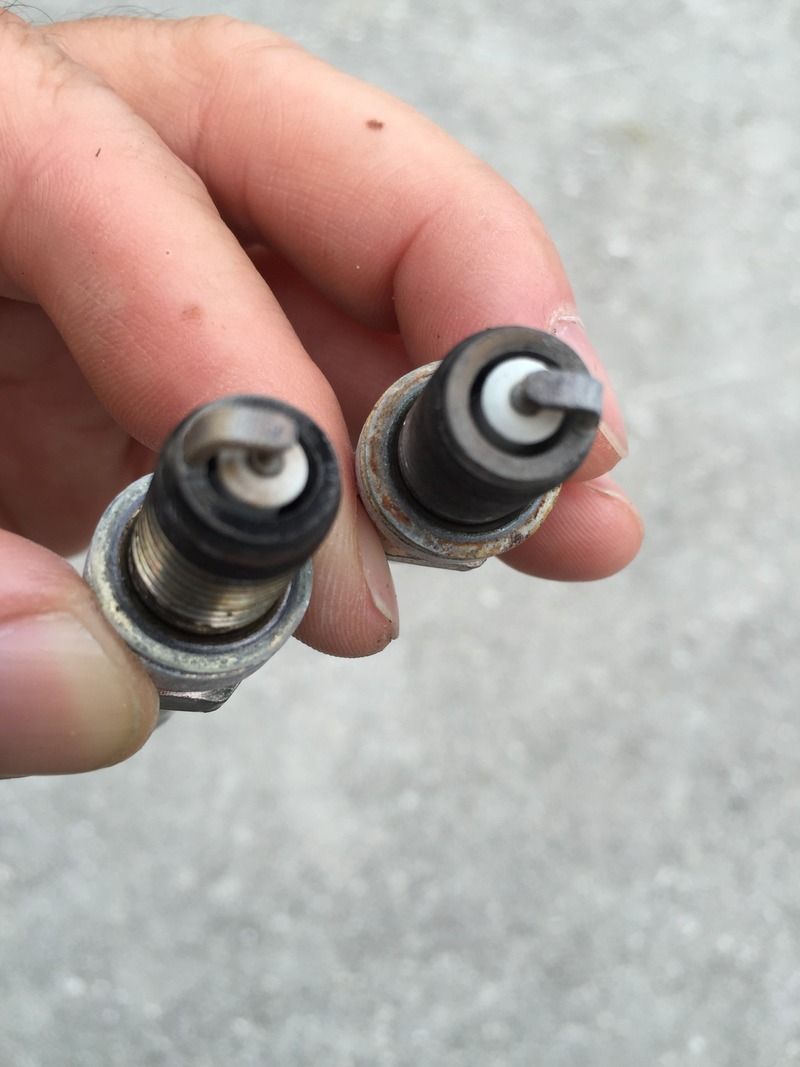
After lollipops, with 412 miles since lollipop install. This is mostly highway driving, 60-80 mph with a few runs a bit faster.... :-). This is all stock tune. I estimate, based on S&S dyno tests, that I gained about 15 rwtq 2000-3500 rpm from the lollipops (thumbscrews).

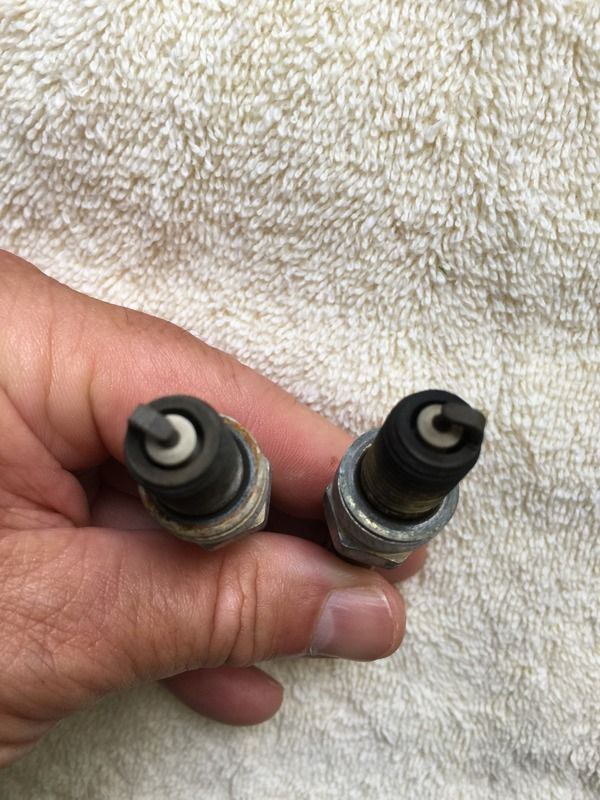
I have my opinion but I'd like others' opinions on my fueling before I start messing with it.
Before lollipops:


After lollipops, with 412 miles since lollipop install. This is mostly highway driving, 60-80 mph with a few runs a bit faster.... :-). This is all stock tune. I estimate, based on S&S dyno tests, that I gained about 15 rwtq 2000-3500 rpm from the lollipops (thumbscrews).


I have my opinion but I'd like others' opinions on my fueling before I start messing with it.
Trending Topics

Tourer
Joined: Jun 2015
Posts: 301
Likes: 2
From: 46835
By conventional plug read, the "after" plugs are pretty rich.. (like choke choke cough rich on the last photo)
The cad plating should be cooked 1 to 1.5 threads on a power tune.. (standard for racing). At 2+ threads, vaporized aluminum tends to come out the tailpipe.. (but the rotating mass gets lighter)
The other view you need to read (and virtually impossible to photograph) is down the porcelain inside the plug..
An accurate read also requires a "Full throttle" run with a clean cutoff.. IE go through the lights at the end of the track and kill it.. If you putt putt around after the pass, the read gets pretty sketchy.. is why dyno time is so great..
First picture right side plug is almost ideal without seeing the porcelain.. Also the heat in that strap is about right (half way to plug body)
Not sure how race car stuff might apply to the vtwin..
The cad plating should be cooked 1 to 1.5 threads on a power tune.. (standard for racing). At 2+ threads, vaporized aluminum tends to come out the tailpipe.. (but the rotating mass gets lighter)
The other view you need to read (and virtually impossible to photograph) is down the porcelain inside the plug..
An accurate read also requires a "Full throttle" run with a clean cutoff.. IE go through the lights at the end of the track and kill it.. If you putt putt around after the pass, the read gets pretty sketchy.. is why dyno time is so great..
First picture right side plug is almost ideal without seeing the porcelain.. Also the heat in that strap is about right (half way to plug body)
Not sure how race car stuff might apply to the vtwin..
Last edited by RandallJ; Aug 6, 2015 at 02:30 PM.
HD Forum Stories
The Best of Harley-Davidson for Lifelong Riders

7 Times Harley-Davidson Chucked Tradition Out the Window
Verdad Gallardo
7 Surprising Harley-Davidson Products that Are Not Motorcycles
Verdad Gallardo
8 Best Harley-Davidson Motorcycles Ever
Pouria Savadkouei
10 Worst Harley-Davidson Motorcycles Ever
Pouria Savadkouei
Killer Custom's Jail Break Is The Breakout That Refused to Blend In
Verdad Gallardo
Crazy Bunderbike Build Looks Amazing, But Is It Impossible to Ride?
Verdad Gallardo
Harley-Davidson Reveals Super Cool Cafe Racer Concept
Verdad Gallardo
Engraved Rebellion: Inside Bundnerbike's Glam Rock II
Verdad Gallardo
10 Motorcycles You Should Never Buy
Joe Kucinski
Seasoned HDF Member


Joined: Mar 2010
Posts: 38,626
Likes: 6,443
From: Honah Lee
Put your bike back stock and it will get 45 mpg interstate doing 65 mph. I got close to 50 mpg doing 55 last 200 mile trip. However, I can make it get 36 easily.
I am running open SE filter (has no effect on it at that speed) and 96 TC OEM take off pipes with 2 .312 drilled thru center baffle plug in both pipes. (sound just a tad above stock except for a little rasp) ECM was mapped for open Python shotguns but it had no engine brake and was way to loud for my taste.
My son's bike did the same thing yours is doing with a tuner. Felt like it had too much timing but I think that was caused by it being too rich. Made more noise and generated a lot of blazing heat. It did feel like it had more power.
However, a lower gear and twist of the wrist and I have more power. My plugs for 20K of driving. The ones on the left were right after a trip. The ones on the right are from a trip down south when we got caught in an ice storm and they sprayed liquid salt all over everything.
I am running open SE filter (has no effect on it at that speed) and 96 TC OEM take off pipes with 2 .312 drilled thru center baffle plug in both pipes. (sound just a tad above stock except for a little rasp) ECM was mapped for open Python shotguns but it had no engine brake and was way to loud for my taste.
My son's bike did the same thing yours is doing with a tuner. Felt like it had too much timing but I think that was caused by it being too rich. Made more noise and generated a lot of blazing heat. It did feel like it had more power.
However, a lower gear and twist of the wrist and I have more power. My plugs for 20K of driving. The ones on the left were right after a trip. The ones on the right are from a trip down south when we got caught in an ice storm and they sprayed liquid salt all over everything.
Last edited by Jackie Paper; Sep 14, 2018 at 11:11 AM.