


Don't lug yer motor...


Cruiser
Joined: Oct 2016
Posts: 134
Likes: 12
From: Texas

That depends. Some things are worth listening to, and others are not. I prefer opinions backed up with a technical explanation, over old wives tales.
Older internal combustion engines, without centrifugal advance or vacuum advance/retard, were prone to detonate at low rpms combined with high throttle openings. The detonation is what caused the damage.
Later, the situation improved a lot with the addition of automatic, mechanically actuated spark timing controls.
Now, with the more sophisticated electronic engine controls, detonation can be warded off by strategies from richening the fuel mixture, to reducing timing advance, all done automatically based on input from sensors, including engine temperature sensors, oxygen sensors, rpm sensors, and detonation sensors, processed by the computer. Detonation, on a stock computer-controlled engine, isn't really anything one needs to worry about anymore, unless there's some kind of malfunction in the engine, fuel system, or the control system.
Computer-controlled engines will often be pushing a car down the freeway at around 1500 rpm these days, and not only do they not self-destruct at those low rpms, but they're the longest-lasting engines we've ever had.
Older internal combustion engines, without centrifugal advance or vacuum advance/retard, were prone to detonate at low rpms combined with high throttle openings. The detonation is what caused the damage.
Later, the situation improved a lot with the addition of automatic, mechanically actuated spark timing controls.
Now, with the more sophisticated electronic engine controls, detonation can be warded off by strategies from richening the fuel mixture, to reducing timing advance, all done automatically based on input from sensors, including engine temperature sensors, oxygen sensors, rpm sensors, and detonation sensors, processed by the computer. Detonation, on a stock computer-controlled engine, isn't really anything one needs to worry about anymore, unless there's some kind of malfunction in the engine, fuel system, or the control system.
Computer-controlled engines will often be pushing a car down the freeway at around 1500 rpm these days, and not only do they not self-destruct at those low rpms, but they're the longest-lasting engines we've ever had.
You can do what you want with YOUR bike but try to hold back a little when giving advice that has damaging potential.
Cruiser
Joined: Oct 2016
Posts: 134
Likes: 12
From: Texas
A couple times I wouldn't worry about too much, if at all. The problem I see is alot of rookies trying lug these engines all the time. I guess they think it's cool. Little do they know.

Outstanding HDF Member
Joined: Aug 2012
Posts: 3,217
Likes: 90
From: Detroit
The damage to the flywheel is what needs to be considered. Loading these engines up below 2500 rpm's is a bad move. A properly tuned engine won't ping, if it does its occassional. Trying to compare a Harley engine to a cage engine is ridiculous. Anyone that's been around Harley's for more than a day will tell you same thing.

And no, Harley engines aren't that different from cage engines. The most obvious differences are visual. Some other differences are that they are air cooled, have fewer cylinders, have a forked connecting rod setup, and use a roller bearing bottom end as opposed to using plain bearing inserts. Basic principles of operation are quite similar. Go ahead and tell me why any of those things (or anything else) makes a Harley engine less tolerant of low rpm operation, if you even have any sort of minimal technical knowledge at all.

As for damage to the flywheel, I already explained in post #13 that torque loads on the flywheel are highest around 3500, at the torque peak (fancy that!), and other reciprocating and rotation loads only increase as rpms increase. So what about low rpm operation is causing this damage to the flywheel that you speak of?
Last edited by Warp Factor; Oct 20, 2016 at 02:11 PM.
Road Captain
Joined: Jan 2016
Posts: 518
Likes: 244
From: Tucson Arizona
 2010 Dyna SG
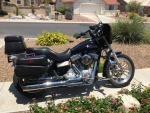
The torque curve for my 96 ci Twin cam (2010 Dyna SG), shows max torque coming as early as 2,500 and the curve remains static (flat), right up through about 4,300. It pulls like a tractor from 2,500 and a simple downshift really makes things happen in a hurry.
Being an old guy {almost 65}, who has never scraped a peg or even tried to pull a wheelie I find all of the get up and go I need between 2,500 and 4,000. The bike runs strong in this range regardless of gear selection.
At 2,700 in 6th I am rolling down the interstate at 77, 80 happens at 2,900 and faster than that just does not happen at all. Most of my riding is at something less than 3,000 though I never hesitate to roll it out to 4,000 as needed {besides it's a lot of fun}.
I get phenomenal mileage {50 riding solo - 46 - 48 2 up}. Since adding the FP3 Fuelpak tune {after adding the V&H Propipe 2 into 1 + the SEAC}, it runs cooler than before with no appreciable loss of mileage and no ping whatsoever. The dyno shows around 80 Hp and 102# of Torque and on a 675# bike that is plenty.
Works for me.
Being an old guy {almost 65}, who has never scraped a peg or even tried to pull a wheelie I find all of the get up and go I need between 2,500 and 4,000. The bike runs strong in this range regardless of gear selection.
At 2,700 in 6th I am rolling down the interstate at 77, 80 happens at 2,900 and faster than that just does not happen at all. Most of my riding is at something less than 3,000 though I never hesitate to roll it out to 4,000 as needed {besides it's a lot of fun}.
I get phenomenal mileage {50 riding solo - 46 - 48 2 up}. Since adding the FP3 Fuelpak tune {after adding the V&H Propipe 2 into 1 + the SEAC}, it runs cooler than before with no appreciable loss of mileage and no ping whatsoever. The dyno shows around 80 Hp and 102# of Torque and on a 675# bike that is plenty.
Works for me.

Thread Starter
|
Ultimate HDF Member

Joined: Jul 2014
Posts: 5,649
Likes: 430
From: MASS_hole
Hello! Me again.
I'll admit of lugging bikes in the past. Though rarely. The sound. Feel and overall pick up and inertia is dreadful in worst of cases.
Let's face it... YOU KNOW THAT CAN"T BE GOOD!
Some moters depending on engine mods will fair much better than stock tho.
For instance. Just modding yer drive gear ratio for two teeth in back and reducing the tranny pulley by two, will almost alter yer chances of ever luggin again at lower rpm.
Someone here can elaborate if they like
I'll admit of lugging bikes in the past. Though rarely. The sound. Feel and overall pick up and inertia is dreadful in worst of cases.
Let's face it... YOU KNOW THAT CAN"T BE GOOD!
Some moters depending on engine mods will fair much better than stock tho.
For instance. Just modding yer drive gear ratio for two teeth in back and reducing the tranny pulley by two, will almost alter yer chances of ever luggin again at lower rpm.
Someone here can elaborate if they like

Thread
Thread Starter
Forum
Replies
Last Post
hattitude
Milwaukee Eight (M8)
26
Jun 15, 2017 12:54 PM
spankustang
Exhaust System Topics
1
Mar 18, 2008 09:28 AM









