







I felt insulted !!!
Thread Starter
|
Road Warrior


Joined: May 2008
Posts: 1,368
Likes: 2,055
From: Paradise (almost, Florida )
 I felt insulted !!!
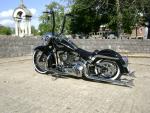
Neighbor came down this evening and walked in the garage and as he strolls up to my newly acquired 2005 Softail Springer Classic, he says, "wow, beautiful bike, I haven't seen you on this one." ( I own/buy/sell alot/often. ) So I reply, yeah, I just got it and I really like it. To which he replies, " sure is sweet, looks just like an old Indian." Aaarrgghhh !!! So I informed him that it is/was modeled after the 1948 Harley Springer. I was INSULTED !!!
But then, I got to wondering, honestly, who copied who? Or is it, who copied whom? Anybody know the history of these 2 beautiful bikes? I love old Indians too, but I do wonder who copied who/whom ? I sure like to convince myself that Indian copied Harley, but I really don't know. I know everyone has tried to copy Harley for the last decade or more, but back then???
But then, I got to wondering, honestly, who copied who? Or is it, who copied whom? Anybody know the history of these 2 beautiful bikes? I love old Indians too, but I do wonder who copied who/whom ? I sure like to convince myself that Indian copied Harley, but I really don't know. I know everyone has tried to copy Harley for the last decade or more, but back then???

Road Warrior
Joined: Mar 2007
Posts: 1,396
Likes: 146
From:
An Indian Chief and a 48 Panhead don't look alike! The Indian was a Flathead, had a three speed tranny, ran an exposed "v" belt to run the generator, had a girder front end, those unmistakably goofy valanced fenders, and had a plunger rear suspension.
The Harley had overhead valves, a four speed trans, ran a gear driven generator with the gear drive in the timing case, had a springer front end, which has a lot less unsprung weight, fenders designed to protect the rider but no goofy valances, and the classic rigid frame.
I'll never understand why people want to revive the Indian name. They went under in 1953 because a butt ugly, flathead, 3 speed motorcycle wouldn't cut it in the marketplace. People prefered Harleys and British bikes. They keep trying to revive the Indian name over and over and it keeps failing. They are not even a Harley knock off like the Japs make. They are a knockoff of bike that failed to compete with Harley Davidson because it was out dated even back in '53.
The Harley had overhead valves, a four speed trans, ran a gear driven generator with the gear drive in the timing case, had a springer front end, which has a lot less unsprung weight, fenders designed to protect the rider but no goofy valances, and the classic rigid frame.
I'll never understand why people want to revive the Indian name. They went under in 1953 because a butt ugly, flathead, 3 speed motorcycle wouldn't cut it in the marketplace. People prefered Harleys and British bikes. They keep trying to revive the Indian name over and over and it keeps failing. They are not even a Harley knock off like the Japs make. They are a knockoff of bike that failed to compete with Harley Davidson because it was out dated even back in '53.
Last edited by Northside; May 1, 2011 at 08:02 AM.

Banned
Joined: Feb 2009
Posts: 3,500
Likes: 1
an indian chief and a 48 panhead don't look alike! The indian was a flathead, had a three speed tranny, ran an exposed "v" belt to run the generator, had a girder front end, those unmistakably goofy valanced fenders, and had a plunger rear suspension.
The harley had overhead valves, a four speed trans, ran a gear driven generator with the gear drive in the timing case, had a springer front end, which has a lot less unsprung weight, fenders designed to protect the rider but no goofy valances, and the classic rigid frame.
I'll never understand why people want to revive the indian name. They went under in 1953 because a butt ugly, flathead, 3 speed motorcycle wouldn't cut it in the marketplace. People prefered harleys and british bikes. They keep trying to revive the indian name over and over and it keeps failing. They are not even a harley knock off like the japs make. They are a knockoff of bike that failed to compete with harley davidson because it was out dated even back in '53.
The harley had overhead valves, a four speed trans, ran a gear driven generator with the gear drive in the timing case, had a springer front end, which has a lot less unsprung weight, fenders designed to protect the rider but no goofy valances, and the classic rigid frame.
I'll never understand why people want to revive the indian name. They went under in 1953 because a butt ugly, flathead, 3 speed motorcycle wouldn't cut it in the marketplace. People prefered harleys and british bikes. They keep trying to revive the indian name over and over and it keeps failing. They are not even a harley knock off like the japs make. They are a knockoff of bike that failed to compete with harley davidson because it was out dated even back in '53.
well put sir
Trending Topics

Road Warrior
Joined: Jul 2007
Posts: 1,308
Likes: 2
From: WA - The State
I'll never understand why people want to revive the Indian name. They went under in 1953 because a butt ugly, flathead, 3 speed motorcycle wouldn't cut it in the marketplace. People prefered Harleys and British bikes. They keep trying to revive the Indian name over and over and it keeps failing. They are not even a Harley knock off like the Japs make. They are a knockoff of bike that failed to compete with Harley Davidson because it was out dated even back in '53.
HD Forum Stories
The Best of Harley-Davidson for Lifelong Riders

7 Surprising Harley-Davidson Products that Are Not Motorcycles
Verdad Gallardo
8 Best Harley-Davidson Motorcycles Ever
Pouria Savadkouei
10 Worst Harley-Davidson Motorcycles Ever
Pouria Savadkouei
Killer Custom's Jail Break Is The Breakout That Refused to Blend In
Verdad Gallardo
Crazy Bunderbike Build Looks Amazing, But Is It Impossible to Ride?
Verdad Gallardo
Harley-Davidson Reveals Super Cool Cafe Racer Concept
Verdad Gallardo
Engraved Rebellion: Inside Bundnerbike's Glam Rock II
Verdad Gallardo
10 Motorcycles You Should Never Buy
Joe Kucinski
10 Things Harley-Davidson Needs to Fix in 2026
Verdad Gallardo
Extreme HDF Member
Joined: Aug 2007
Posts: 17,625
Likes: 1,665
From: Blairsville GA
In reality Indian probably killed themselves by neglecting their dealer network during WWI. Both Indian and Harley were selling the majority of their production to the Army, but Harley made sure to keep a few bikes going to their dealers. Indian dealers died on the vine without product to sell and many closed or switched brands. The depression just about killed both brands, but both staggered out of that period and went to war production in 1942. Every company that could make anything, made and sold everything they could make in that period. As has been said earlier, the postwar period was a time of opportunity and challenge for both brands. Civilian production essentially resumed with the 1947 models (there were a handful of 46 models) and Harley was ready with a new engine in 1948. In 49 Harley added telescopic forks, and in 52 made foot shift standard. Indian was selling refried beans and had production costs that were out of hand. RIP Indian.

Elite HDF Member
Joined: Aug 2008
Posts: 4,933
Likes: 11
From: Kentucky
Well, there's a huge difference, so it just means he doesn't know anything about motorcycles and is trying to amke conversation. On the other hand, nothing insulting about looking like an old Indian - that's as cool as it gets.