





Winter storage oil change.

Road Warrior
Joined: May 2009
Posts: 1,493
Likes: 94
From: Belgium

Takes longer than 10-15 minutes to get bike up to operating temperature when idling. You do more harm than good, you will not burn off the condensation that way. When living in NYC, I would put bike in garage for the duration. No changing oil etc. Never a problem in the 12 years I had that one. Now, with all the electronics, I would disconnect the battery.

Elite HDF Member
Joined: Sep 2009
Posts: 4,473
Likes: 15
From: River City Western Canada
Absolutely NOT
 ...this is the worst thing you can do...talk about condensation build up
Stellar HDF Member


Joined: Feb 2010
Posts: 3,395
Likes: 266
From: Southern California
Hi all.
Winter storage in is approaching and I need some advice.
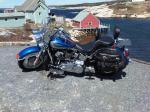
I will be storing my Heritage in my unheated garage for the winter. I know it is important to get the old oil removed for the winter and I will be changing it for storage.
I am also concerned with condensation forming in the engine as the temperature increases and decreases. This concerns me as well.
This is what I am thinking of doing. Change the oil and filter pre storage using cheap 20-50 recomended for V twins and a cheap black fiter.
Then post storage warming it up and changing it again using Mobil V Twin 20-50 and an HD chrome filter.
I should add this heritage was new july 15 2011. I have had the 1000 mile service done at the dealer ship. They recommended changing to synthetic oil on my second oil change(not sure why). I am thinking it will have about 4000 miles on it by the time it comes to storage time.
The pre storage oil change should only cost about $20(will be doing it myself). Do you guys think I am wasting my time and money doing the cheap pre storage change?
Or do I just do a synthetic change pre storage and not worry about the condensation?
Thanks in advance for the advice.
Winter storage in is approaching and I need some advice.
I will be storing my Heritage in my unheated garage for the winter. I know it is important to get the old oil removed for the winter and I will be changing it for storage.
I am also concerned with condensation forming in the engine as the temperature increases and decreases. This concerns me as well.
This is what I am thinking of doing. Change the oil and filter pre storage using cheap 20-50 recomended for V twins and a cheap black fiter.
Then post storage warming it up and changing it again using Mobil V Twin 20-50 and an HD chrome filter.
I should add this heritage was new july 15 2011. I have had the 1000 mile service done at the dealer ship. They recommended changing to synthetic oil on my second oil change(not sure why). I am thinking it will have about 4000 miles on it by the time it comes to storage time.
The pre storage oil change should only cost about $20(will be doing it myself). Do you guys think I am wasting my time and money doing the cheap pre storage change?
Or do I just do a synthetic change pre storage and not worry about the condensation?
Thanks in advance for the advice.
On another note: Get a good automatic battery tender to keep the battery charged for the winter, if you do not already have one. You do not need to remove the battery from the bike, the battery tender puts out enough to keep the battery charged and to supply the parasitic draw of the electronics on the bike. As long as it is on the tender it won't freeze until you get to well below -60 F and at lower temperatures the battery will actually last longer than if you bring it inside and keep it warm and toasty (batteries are not living animals or plants).
oil
go to a gas station bring your stabilizer with you put in the required amount fill the tank with gas. go home change the oil and filter do not start it. put the bike on blocks or a jack to keep the tires off the ground.put a battery tender on it to keep the battery peaked leave it until spring. before i fire it up in the spring i give each cylinder a shot of oil i use marvel. it will smoke for a minute or two and then your on your way. you will hear plenty of differences in the way people do this read them and decide which make sense or sounds right to you and go with it every one thinks there way is best you decide on yours
You need to be concerned with condensation on the exterior of the bike and spot rust. I stored a brand new "other brand" bike in an un heated shed a few years back without applying any exterior protectant or heat and the spot rusting in the spring was noticeable over most of the bike in particular the chrome. I live along the coast so temps fluxuate quite a bit. This is my first year with my Harley and I plan on storing it in a heater garage this winter.
I have read threads about guys who unhooked the battery. Then in the spring the bikes computer had to be re-tuned because the computer "forgot" it's program. I don't know how true this is but a battery tender costs 30 bucks here. Cheaper than the alternative. And starting the bike in the winter and not riding it is insane. The motor will not get hot enough to boil off the condensation and will cause more. Do not start the bike until spring. And the oil depending on mileage will form sulfuric acid. Its a by-product of combustion.Do you want sulfuric acid in your crankcase sitting in there for months on end.

Stage II
Joined: Jun 2009
Posts: 2
Likes: 0
From: Manlius NY / Matunuck Beach RI
I store my Classic and wife's 883 in an enclosed 7X12' trailer for the winter. We change the oil using synthetic oil with a new filter, Stabilize the fuel (full tank) and keep a battery tender on both bikes giving them a 24 hour charge each month. To prevent rust or condensation from forming we first clean and wax both bikes and then spray all metal and chrome parts with S100 rust prevention spray. I have installed three 36" Golden Rods (electronic dehumidifier developed for gun safes) and keep them running throughout the year. Each Golden Rod has the ability to cover 500 square feet, so with the trailer being approx. 504 square feet, having three rods running is a bit of an overkill, but it gives me peace of mind. Besides they only draw 20 watts each so its no worse than running a 60w bulb all day.
My question would be, is it necessary to also change the transmission and primary oil as well for storage, since they normally don't get changed with each 5000 mile oil change?
My question would be, is it necessary to also change the transmission and primary oil as well for storage, since they normally don't get changed with each 5000 mile oil change?
HD Forum Stories
The Best of Harley-Davidson for Lifelong Riders

7 Surprising Harley-Davidson Products that Are Not Motorcycles
Verdad Gallardo
8 Best Harley-Davidson Motorcycles Ever
Pouria Savadkouei
10 Worst Harley-Davidson Motorcycles Ever
Pouria Savadkouei
Killer Custom's Jail Break Is The Breakout That Refused to Blend In
Verdad Gallardo
Crazy Bunderbike Build Looks Amazing, But Is It Impossible to Ride?
Verdad Gallardo
Harley-Davidson Reveals Super Cool Cafe Racer Concept
Verdad Gallardo
Engraved Rebellion: Inside Bundnerbike's Glam Rock II
Verdad Gallardo
10 Motorcycles You Should Never Buy
Joe Kucinski
10 Things Harley-Davidson Needs to Fix in 2026
Verdad Gallardo
Seasoned HDF Member


Joined: Mar 2010
Posts: 38,592
Likes: 6,435
From: Honah Lee
Just my opinion but been doing my own work for 45+ years and been in numerious V8 and 4 Cyl motors for complete overhauls and both sides of my Harley. Keep cars forever or just pass them along to my kids. See my album Change the oil to Syn and do not worry about it. Remove battery and charge it monthly. Do not cover bike or if you do just as a dust shield like a thin cotton sheet. Do not trap moisture on chrome and Al. I would fill the gas tank full. Spring I would syphon off some and refill with fresh.

Road Captain
Joined: May 2010
Posts: 542
Likes: 5
From: New York
Battery tender, Gas stabilizer and I move the bike around every 2-4 weeks to avoid flat spots on the tires.
I change the oil when it needs it NOT before or after storage.
I use to do all that stuff but I have come to the conclusion that I buy a new bike every 5 or so years so whats the point ?
OMG I can't sleep tonite because I might have condensation in the cylinders....whatever.
I change the oil when it needs it NOT before or after storage.
I use to do all that stuff but I have come to the conclusion that I buy a new bike every 5 or so years so whats the point ?
OMG I can't sleep tonite because I might have condensation in the cylinders....whatever.