





Ape Hanger Riser Bushing Question....
Thread Starter
|
Cruiser
Joined: Apr 2012
Posts: 127
Likes: 3
From: Maine
 Ape Hanger Riser Bushing Question....
Running 16" apes on 2" risers. I feel like there is way too much play in my risers, especially at 75-80mph when im holding on tight. The riser tends to pullback, to the point where my mirrors are out of adjustment, and when i get to a stop, I end up pushing forward on the bars to get the riser back to where it should be. I am using rubber bushings right now, and I think that is 90% of my problem here, however my Indy swears that if I go with urethane my hands will vibrate so bad I will just end up changing back to the rubber. I need opinions from my fellow ape'd riders.... What are you using- Rubber or urethane? What are the pro's and cons of either? Thanks a bunch!!!

Grand HDF Member


Joined: Jun 2009
Posts: 4,010
Likes: 1,240
From: On the Front Range, CO
With 18'' of combined rise, you NEED poly bushings, for the exact reasons you describe.
I'm honestly quite surprised that your indy is trying to advise you against switching to poly bushings. There is a cost/benefit of everything. Running tall bars simply require poly bushings to be safe.
As a note, the B motors in our Softails get buzzy when riding at sustained highway speeds/high rpms. Not bad, but it's noticeable.
I'm running 16" apes on 2" risers. With my set up (Springer front end with no bushings at all) the combination is fine, and Of course I have no movement. On my Road Glide, I have 18" apes with poly bushings.
Make the switch - you will eliminate the movement and be much more pleased.
I'm honestly quite surprised that your indy is trying to advise you against switching to poly bushings. There is a cost/benefit of everything. Running tall bars simply require poly bushings to be safe.
As a note, the B motors in our Softails get buzzy when riding at sustained highway speeds/high rpms. Not bad, but it's noticeable.
I'm running 16" apes on 2" risers. With my set up (Springer front end with no bushings at all) the combination is fine, and Of course I have no movement. On my Road Glide, I have 18" apes with poly bushings.
Make the switch - you will eliminate the movement and be much more pleased.

Tourer
Joined: Oct 2013
Posts: 264
Likes: 15
From: Calmar, Alberta
For what they cost and the time to install give the poly bushings a shot. I put 12" mini apes and 4" risers on my FXDC, yeah, a dyna, I know... wrong section. I subsequently found the deflection in the bars from steering inputs to be unacceptable with the stock rubber bushings. I put some Ness poly bushings in (it's what they had on the shelf!) and found more vibration at idle but less at speed and way more precise steering inputs.

Elite HDF Member
Joined: Aug 2008
Posts: 4,133
Likes: 125
From: Japan
Running 16" apes on 2" risers. I feel like there is way too much play in my risers, especially at 75-80mph when im holding on tight. The riser tends to pullback, to the point where my mirrors are out of adjustment, and when i get to a stop, I end up pushing forward on the bars to get the riser back to where it should be. I am using rubber bushings right now, and I think that is 90% of my problem here, however my Indy swears that if I go with urethane my hands will vibrate so bad I will just end up changing back to the rubber. I need opinions from my fellow ape'd riders.... What are you using- Rubber or urethane? What are the pro's and cons of either? Thanks a bunch!!!
I have almost 20" total and still have some movement, even with poly bushings, but I knew enough to use them, mostly by reading ape install info on this forum. Perhaps you should point your Indy to this place or tell him to pull his head outta his @$$...
Cruiser
Joined: Mar 2012
Posts: 119
Likes: 1
From: Southern California
The increased length of your bars, equals leverage. Think.... skateboard trucks.
I found the stock rubber bushings, even with the stock height bar, to be to loose. A new set of poly bushings is less than $20. Less than half an hour to install yourself.
A little more vibration? Barely noticeable. You'll like the improvement. You can always change back.
I found the stock rubber bushings, even with the stock height bar, to be to loose. A new set of poly bushings is less than $20. Less than half an hour to install yourself.
A little more vibration? Barely noticeable. You'll like the improvement. You can always change back.
Trending Topics
Grand HDF Member
Joined: Jun 2009
Posts: 4,010
Likes: 1,240
From: On the Front Range, CO
Your Indy's a moron and doesn't know what the hell he's talking about. Find another one.
I have almost 20" total and still have some movement, even with poly bushings, but I knew enough to use them, mostly by reading ape install info on this forum. Perhaps you should point your Indy to this place or tell him to pull his head outta his @$$...
I have almost 20" total and still have some movement, even with poly bushings, but I knew enough to use them, mostly by reading ape install info on this forum. Perhaps you should point your Indy to this place or tell him to pull his head outta his @$$...
Bigjosh, your indy isn't someone I'd let turn a wrench on my bikes....
HD Forum Stories
The Best of Harley-Davidson for Lifelong Riders

Jason Momoa Is Turning Classic Harleys Into PHEVs
Verdad Gallardo
Harley-Davidson Fat Boy Becomes a Dark, Decepticon-Inspired Custom
Verdad Gallardo
6 Weirdest Harley-Davidsons Ever Sold to the Public
Verdad Gallardo
7 Times Harley-Davidson Chucked Tradition Out the Window
Verdad Gallardo
7 Surprising Harley-Davidson Products that Are Not Motorcycles
Verdad Gallardo
8 Best Harley-Davidson Motorcycles Ever
Pouria Savadkouei
10 Worst Harley-Davidson Motorcycles Ever
Pouria Savadkouei
Killer Custom's Jail Break Is The Breakout That Refused to Blend In
Verdad Gallardo
Crazy Bunderbike Build Looks Amazing, But Is It Impossible to Ride?
Verdad Gallardo
Stellar HDF Member


Joined: Oct 2009
Posts: 2,054
Likes: 26
From: Florida
What great timing on this thread!
We just installed "16 apes with "2 risers on my brother's Rocker-C and we noticed that we couldn't tighten the risers down enough to keep them from moving down at the top tree. My first assumption (besides the added leverage) was that his stock risers had a larger footprint which actually rested on the top clamp and prevented this wobble. The new risers foot is smaller in diameter than the cup washer that fits over the stock bushing so I figured we needed some sort of spacer between the risers and to clap to spread the tension over a larger area. However, after doing more research online and looking at other scoots with apes at the dealership I concluded that my initial thought was not the case and most of the bikes I saw had the same smaller riser foot sitting over the bushing. I concluded that we try some new poly bushings and picked up a set.
Haven't installed them yet but I have a feeling that this will do the trick. I will post our results as soon as we get everything put back together.
We just installed "16 apes with "2 risers on my brother's Rocker-C and we noticed that we couldn't tighten the risers down enough to keep them from moving down at the top tree. My first assumption (besides the added leverage) was that his stock risers had a larger footprint which actually rested on the top clamp and prevented this wobble. The new risers foot is smaller in diameter than the cup washer that fits over the stock bushing so I figured we needed some sort of spacer between the risers and to clap to spread the tension over a larger area. However, after doing more research online and looking at other scoots with apes at the dealership I concluded that my initial thought was not the case and most of the bikes I saw had the same smaller riser foot sitting over the bushing. I concluded that we try some new poly bushings and picked up a set.
Haven't installed them yet but I have a feeling that this will do the trick. I will post our results as soon as we get everything put back together.
Stellar HDF Member

Joined: May 2009
Posts: 2,856
Likes: 127
From: Middle of Kansas
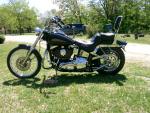
I replaced the rubber bushings with poly bushings on my 99 Softail Custom with the original buchorn bars. I can see no more vibration with them over the rubber, but much better handling and solid feel. I do have to say that my old rubber bushings were pretty worn out when I changed them.