When you click on links to various merchants on this site and make a purchase, this can result in this site earning a commission. Affiliate programs and affiliations include, but are not limited to, the eBay Partner Network.
The Evos are bulletproof and there are literally thousands of aftermarket parts and add ons.
The Ironhead has the cool factor but it’s going to need more attention.
You want to ride or wrench is what it comes down to.
If you want something to ride everyday buy the Evo.
You want to tinker buy the Ironhead.
Also the Evo Sportster's have hydraulic self adjusting tappets, an unmolested Evo motor doesn't leak oil and if maintained at the correct intervals they can do over 100,000 miles without any trouble at all.
The Ironheads are notorious for breaking down, leaking oil and generally requiring a lot of weekend maintenance. By the time the last Ironheads were produced in 1985, they were an ancient design manufactured using old worn out machine tools, that and poor owner maintenance contributed to their bad reputation for unreliability and oil leakage. You could always spot where an Ironhead had been parked up by the pool of oil it left on the ground.
A properly put together Ironhead motor is as good as any Evo, but with that classic looking motor, there are so many highly used and abused Ironheads out there, you pay your money and hope that you've bought a good one. With a private sale it'll be bought as seen, with no warranty or return option.
There's nothing wrong with the 1100 Evo Sportster's, they didn't sell well in the day due to the capacity being so close to the 883, the 1100 was only available in 1986 and 1987, the more popular 1200 version appeared in 1988.
There's nothing wrong with the 1100 Evo Sportster's, they didn't sell well in the day due to the capacity being so close to the 883, the 1100 was only available in 1986 and 1987, the more popular 1200 version appeared in 1988.
I wonder what the horsepower differences were between the 1100 and 1200?
The 1100 I saw at a dealer around the Tampa Florida area is $2500, it a similar blue, maybe 20,000 miles. I like the look of that Sporty. Are they good bikes or any known issue's?
Well, being an Evo, it's light years ahead of an Ironhead in terms of reliability and longevity.
However, it's a really early Evo, and like most products, it had it's issues. Over time, the Evo platform was refined and improved. Generally speaking, the later the bike, the more reliability improvements it has.
Now that said, there were also cost reductions along the way, some that we'd rather not have.
First thing you need to understand is that it's a 4-speed. 4-speeds were 1986-1990. Beginning in 1991 and extending through the end of the Evo Sportster for the 2022 model, they're all 5- speeds.
Probably the biggest common issue with 4-speeds is the alternator, which is built into the clutch basket. It's known to be troublesome, for the magnets coming loose. An aftermarket clutch basket with sealed magnets is available.
In addition to moving the alternator up to the front primary sprocket, 5-speeds also got the crankcase breathers moved to the heads. This helps reduce oil in the blow-by.
5-speeds also got a better oil pump setup. The 4-speeds have an oil pressure bypass that dumps excess oil into the cam box. Not only is the bypass problematic, sometimes causing a severe loss of oil pressure, but bypassing into the cam box also aggravates wet sumping, which is something that's been an issue on Sportsters for forever. 5-speed pumps can be fitting to 4-speeds, and the oil pressure bypass can be plugged, so this issue is solvable on a 4-speed. And the 5-speed pump has seen lots of improvements over the years, one of which was the addition of a scavenge side inlet in the cam box that came out in 1998, to help reduce wet sumping. Revisions again in 2000 and 2007 enhanced scavenging even more.
Also, 1986-1987 models came from the factory with a Keihin butterfly carb, which is a real POS. But it's not hard to retrofit a CV40 from a 1988-2006 model. Or better yet, an HSR42, although you may have raise the tank a tad to get clearance to the right side petcock.
Parts availability for 4-speeds is an issue, too. But there are repro parts available. V-Twin Mfg is the primary supplier. All their stuff comes from Taiwan. But overall the quality is good, in my experience.
Those are the main issues with owning a 4-speed. Even though it was a quantum leap from the Ironhead, it's still an old bike. You're talking nearly 40 years old at this point.
There are some advantages to the 4-speeds though. For example, they have replaceable tappet blocks, cam bearings on the case side (instead of bushings), and the 86-87 also has a splined pinion shaft. Stuff that was changed later to reduce cost.
Interesting, my 1991 FSM shows the 1200 at 68 hp (72 lb-ft), a bit of an improvement.
John
The 1200's did get more powerful, John, the XR1200 was the ultimate tyre shedding air cooled 1200 producing 90 hp @ 7000 rpm and 74 ft-lbs at 4000 rpm.
Last edited by Rob Roy's Revenge; Oct 6, 2024 at 12:57 PM.
If you buy an Ironhead that’s been taken care of and hasn’t been abused or chopped up, they can be very reliable. Of course, the newer the better your chances, but I’d avoid the 1985 and late 1984 models unless the alternator has been upgraded to fix their design problem. I bought my 1983 XLX (with 9000 miles on it) in 1990, and have put another 48,000 miles on it with very few problems. Yeah, you have to adjust the valves every so often, but it’s really easy to do. The ‘82-‘85 came with a set-and-forget electronic ignition, and mine’s still working fine. You have to adjust the primary and rear drive chains, but that’s the same with the early Evo Sportsters. The highway vibes aren’t bad if you go up a tooth or two on the front drive sprocket, and mine doesn’t leak oil (yes, there’s oil in it…lol). I live in Alabama and put an oil cooler on mine, which makes for a happy Ironhead. The Evo is probably a better machine, but the Ironhead was upgraded throughout its 29 years of production, so they weren’t exactly dinosaurs near the end of production. The early Evo Sportsters were basically the same as the late Ironhead except for the engine. All the body parts are interchangeable.
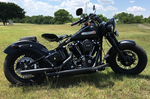
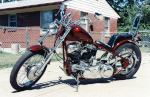
Anyway, for reference, here are a few photos of mine I took after returning from a ride yesterday. Ironheads are cool…
7 Surprising Harley-Davidson Products that Are Not Motorcycles
Slideshow: The bar-and-shield logo shows up on far more than motorcycles, some of the company's most unexpected products have nothing to do with riding.
Slideshow: From the troubled AMF years to modern misfires, these bikes earned reputations for reliability issues, questionable engineering, or disappointing performance.
Crazy Bunderbike Build Looks Amazing, But Is It Impossible to Ride?
Slideshow: The Swiss custom shop has taken a Harley Softail and stretched it into something so long and low that it looks closer to a rolling sculpture than a conventional motorcycle.
Engraved Rebellion: Inside Bundnerbike's Glam Rock II
Slideshow: A standard cruiser becomes an intricate metal canvas in the hands of a Swiss custom house known for pushing Harley-Davidson platforms far beyond their factory brief.
Slideshow: Harley-Davidson's challenges aren't abstract; they show up in dropping shipments, shrinking dealer traffic, and strategic decisions that aren't yet translating into growth.