



NPcN8w~~60_57.JPG)


Underslung Swingarm Design

Thread Starter
|
Road Master
Joined: Jan 2009
Posts: 804
Likes: 105
From: Charlotte, NC/Greenville, SC

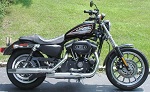
The reason for using a sprocket brake in my case is to clean up which ever side I can. With a sportster the drive side is on the right and there Is nothing that can be done about that. "Move the kickstand to the right side", you are joking, right?
Road Master
Joined: May 2012
Posts: 933
Likes: 10
From: St Louis, MO
Not joking. It's been done before.

Road Warrior

Joined: Oct 2012
Posts: 1,368
Likes: 41
From: In the foothills of southwestern NC - US of A
The round tubing I think will lead to unnecessary flexing, and the OP doesn't explain how he's going to get those bend radius' either. Weld together pipe fittings, or? IMHO rectangular tubing of sufficient wall thickness would be a better material choice for the sides than round tubing [with weld joints properly prepared/champhered before being welded together by a skilled craftsman for 100% penetration] to make up the desired shape, and to accurately position & attach the separate parts required to mount the axle, shock mounts, and swingarm pivot.
=8^)
Last edited by DrewBone; Jul 21, 2013 at 06:11 PM. Reason: fix spellink
Thread Starter
|
Road Master
Joined: Jan 2009
Posts: 804
Likes: 105
From: Charlotte, NC/Greenville, SC
That would be as strange as the Triumph I once had, brake and shifter on wrong sides. POed my friends that tried to ride it.
Thread Starter
|
Road Master
Joined: Jan 2009
Posts: 804
Likes: 105
From: Charlotte, NC/Greenville, SC
Yes, but look at the % of tubing present in both examples...round tubing only represents approx. 50% of the design in your first example and even less in the second; forged/cast parts make up the remainder of the swingarm[s] and are stronger by inherent design shape than "straight" tubing.
The round tubing I think will lead to unnecessary flexing, and the OP doesn't explain how he's going to get those bend radius' either. Weld together pipe fittings, or? IMHO rectangular tubing of sufficient wall thickness would be a better material choice for the sides than round tubing [with weld joints properly prepared/champhered before being welded together by a skilled craftsman for 100% penetration] to make up the desired shape, and to accurately position & attach the separate parts required to mount the axle, shock mounts, and swingarm pivot.
=8^)
The round tubing I think will lead to unnecessary flexing, and the OP doesn't explain how he's going to get those bend radius' either. Weld together pipe fittings, or? IMHO rectangular tubing of sufficient wall thickness would be a better material choice for the sides than round tubing [with weld joints properly prepared/champhered before being welded together by a skilled craftsman for 100% penetration] to make up the desired shape, and to accurately position & attach the separate parts required to mount the axle, shock mounts, and swingarm pivot.
=8^)
Last edited by motohaid; Jul 21, 2013 at 08:09 PM.
Thread Starter
|
Road Master
Joined: Jan 2009
Posts: 804
Likes: 105
From: Charlotte, NC/Greenville, SC
Certainly it can be done but please note that the earlier swing arms were short compared to the sketch of the OP. As I noted, stiffness is related to the length of the swing arm to the third power. Besides old Harleys were not exactly notable for good handling in turns - except for flat trackers 
In fact the swing arm in the photo posted may even be even shorter than a modern rectangular cross-section swing arm (perhaps due to smaller tire diameters ?). Just visually estimating the length, it seems about 25% shorter which would more than double the stiffness.
P.P.S. Looking again at the old swing arm design above I noticed that the length of the round tubing is only about half the length of the swingarm - beefy steel forgings at both ends make up the rest of the length. That's a typical design example of the fifties and sixties, as I recall and my two British thumpers of that era had similar swing arms. The short length of the tubing kept flexure to a minimum - probably three or four times the stiffness that I originally estimated.
Gussets MAY help with stress although stress really isn't a problem anyway providing that the tubing is of adequate diameter and wall thickness. The problem is flexing as related to handling. BUT gussets, unless they are applied properly to the appropriate areas, frequently INCREASE stress. (Do a search for "stress risers".)
Modern swing arms, or any old ones that I can recall, didn't use gussets in the design except for the axle fishtail; with the possible exception of horizontal gussets on the "U" section at the front of the swing arm.
As mentioned previously, if the intent is style rather than handling then it's strictly a matter of personal taste and the amount of risk the rider chooses to take. I simply point out the problem - not to create conflict but because the OP requested constructive comments.
P.S. These are probably good reasons why a configuration like the original sketch hasn't been successfully done before -
In fact the swing arm in the photo posted may even be even shorter than a modern rectangular cross-section swing arm (perhaps due to smaller tire diameters ?). Just visually estimating the length, it seems about 25% shorter which would more than double the stiffness.
P.P.S. Looking again at the old swing arm design above I noticed that the length of the round tubing is only about half the length of the swingarm - beefy steel forgings at both ends make up the rest of the length. That's a typical design example of the fifties and sixties, as I recall and my two British thumpers of that era had similar swing arms. The short length of the tubing kept flexure to a minimum - probably three or four times the stiffness that I originally estimated.
Gussets MAY help with stress although stress really isn't a problem anyway providing that the tubing is of adequate diameter and wall thickness. The problem is flexing as related to handling. BUT gussets, unless they are applied properly to the appropriate areas, frequently INCREASE stress. (Do a search for "stress risers".)
Modern swing arms, or any old ones that I can recall, didn't use gussets in the design except for the axle fishtail; with the possible exception of horizontal gussets on the "U" section at the front of the swing arm.
As mentioned previously, if the intent is style rather than handling then it's strictly a matter of personal taste and the amount of risk the rider chooses to take. I simply point out the problem - not to create conflict but because the OP requested constructive comments.
P.S. These are probably good reasons why a configuration like the original sketch hasn't been successfully done before -
I have a very concise write up about swingarms that I will post a link to when I find it. In this article the writer talks about gussets and trusses. I have seen a lot of swingarms designed with gussets or truss design.
Last edited by motohaid; Jul 21, 2013 at 08:29 PM.

Advanced
Joined: Jun 2013
Posts: 87
Likes: 0
From: eureka
Square or rect tubing is strongest along the "x" and "y" axis. I think round tubing of adaquate size and thickness would probably better resist flexing.
..... because there are metals with better properties at not much more cost. I would say Harley probably designs the swingarms using steel that is adaquate with a safety factor but not with the best properties to save $$.
.... have an engineer look at my design. I don't have all the forces I need to have it engineered correctly so any help from an engineer I can get will help and then beef it up to the 10th power!
..... because there are metals with better properties at not much more cost. I would say Harley probably designs the swingarms using steel that is adaquate with a safety factor but not with the best properties to save $$.
.... have an engineer look at my design. I don't have all the forces I need to have it engineered correctly so any help from an engineer I can get will help and then beef it up to the 10th power!
There are a few problems with the assumptions that you made above (I've redacted parts that aren't important to the engineering aspects of the discussion).
Regarding the relative bending resistance of round versus square tubing of equivalent dimensions square tubing is about 20% better and the axis (X or Y) makes little or no difference to flexing.
Rectangular tubing is more desirable than either because it can be made stiffer in the dimension that is subjected to maximum load.
Regarding the properties of the materials (within the elastic limit, which all materials MUST conform in this discussion), flexing/bending is related to a property called Young's Modulus or Modulus of Elasticity.
For weldable mild carbon steel, this value is constant at about 30 million pounds per square inch. What this means is that flexing/bending of steel members (unless the steel is Chinese-made, LOL) is constant and independent of the steel alloy selected and how much and who paid for it.
Insofar as mandrel-drawn and welded construction, there is no difference between the two since Young's Modulus is the same for carbon steel. Stress and failure should not enter into a discussion like this one - if that is a concern, you are in over your head.
You asked for comments, both positive and negative and that you want an engineer to look at the design. I've given you my opinion, what you do with the information is up to you.
I have zero desire for confrontation, as I mentioned earlier. I wish you luck and will leave this discussion with one last suggestion: do not rely on my opinion or anyone else whose qualifications are unknown. You get what you pay for !
Cheers
Road Warrior
Joined: Oct 2012
Posts: 1,368
Likes: 41
From: In the foothills of southwestern NC - US of A
In this line of aerospace work there is no room for error, yet there are many things that are welded. For instance, the hooks on the Navy planes that get catapulted off the deck of our aircraft carriers, and the tail hooks that catch them as they land full throttle. There is an unimaginable array of items that we take for granted on a daily basis that are welded, yet we don't ever think about any "catastrophic" results...unless of course we're talking about some garage welder with his almighty Harbor Frieght welding machine attempting to weld a trailer hitch on his bud's duelly to tow his $250,000 motorhome...then we'z talkin' catastrophy for sure!!
You mentioned the HD swingarm...have you noticed how many individual pieces make up this swingarm, and how much of it is welded? Is it doomed to failure because...OMG, it's welded? Hell no. Yet it's design began like anything else; it has a specific purpose. The engineers at HD said to themselves, "Ok, this is what we need, now how can we make it?" And they did. Then the beancounters said, "Ok, now that you've made it, how can we make it cheaper?"
The questions that followed I'm sure went something like this: [engineer #1, under his breath] "These ****ing beancounters always find a way, don't they?! Just how in the hell are we going to make this thing cheaper?" Engineer #2 says..."Well...let's look at the properties of this material, see how light we can go with it to endure any possible stress applied upon it, figure out some shapes, do some tests, then take it from there." Engineer #3, "M'kay, let's get started!"
When all was said and done the newly designed swingarm passed muster with engineering tests and ultimately with the beancounters and boom, into production it went. And just a wonderful symphony of steel it has proven to be too. I'd even venture to say that it's designed to handle at least twice any operating load, to protect their asses, and just for shitz'n giggles. And I say this from manufacturing experience, as our engineers ALWAYS designed most everything we ever made to handle at least twice it's rated capacity, whether it was a 10 ton overhead bridge crane, 26'x12'x4' .250" wall & .375" thick stainless steel chem mill tanks wrapped with 21" and 18" I-beams, to hangers for a platform suspending a 1 ton transformer...
I never knew this until you mentioned it, but is there a reason why "most" aftermarket swingarms are made from round tubing? Well, I couldn't answer that, but I could guess. All I know is there's gotta' be a reason why the MoCo choses to go another route, probably from experience I would imagine?!
In any event, I still think that for an overall smaller footprint, less weight and more rigidity, rectangular tubing and welding is the way to go for your project. I can't see you making those tight radius bends in your drawing with any kind of "usual" mandrel, it's just not possible. But you will see through it, just like anything else, as there will be design changes as you go, it's just part of the process!
Eagerly awaiting your final product!
=8^)
Last edited by DrewBone; Jul 21, 2013 at 09:14 PM. Reason: fix spellink, again!
HD Forum Stories
The Best of Harley-Davidson for Lifelong Riders

8 Best Harley-Davidson Motorcycles Ever
Pouria Savadkouei
10 Worst Harley-Davidson Motorcycles Ever
Pouria Savadkouei
Killer Custom's Jail Break Is The Breakout That Refused to Blend In
Verdad Gallardo
Crazy Bunderbike Build Looks Amazing, But Is It Impossible to Ride?
Verdad Gallardo
Harley-Davidson Reveals Super Cool Cafe Racer Concept
Verdad Gallardo
Engraved Rebellion: Inside Bundnerbike's Glam Rock II
Verdad Gallardo
10 Motorcycles You Should Never Buy
Joe Kucinski
10 Things Harley-Davidson Needs to Fix in 2026
Verdad Gallardo
Southpaw Super Glide: A Left-Hand-Drive 1979 Harley FXE Built to Fit the Rider
Verdad Gallardo
Thread Starter
|
Road Master
Joined: Jan 2009
Posts: 804
Likes: 105
From: Charlotte, NC/Greenville, SC
Hi, motohaid, I'm an engineer.
There are a few problems with the assumptions that you made above (I've redacted parts that aren't important to the engineering aspects of the discussion).
Regarding the relative bending resistance of round versus square tubing of equivalent dimensions square tubing is about 20% better and the axis (X or Y) makes little or no difference to flexing.
Rectangular tubing is more desirable than either because it can be made stiffer in the dimension that is subjected to maximum load.
Regarding the properties of the materials (within the elastic limit, which all materials MUST conform in this discussion), flexing/bending is related to a property called Young's Modulus or Modulus of Elasticity.
For weldable mild carbon steel, this value is constant at about 30 million pounds per square inch. What this means is that flexing/bending of steel members (unless the steel is Chinese-made, LOL) is constant and independent of the steel alloy selected and how much and who paid for it.
Insofar as mandrel-drawn and welded construction, there is no difference between the two since Young's Modulus is the same for carbon steel. Stress and failure should not enter into a discussion like this one - if that is a concern, you are in over your head.
You asked for comments, both positive and negative and that you want an engineer to look at the design. I've given you my opinion, what you do with the information is up to you.
I have zero desire for confrontation, as I mentioned earlier. I wish you luck and will leave this discussion with one last suggestion: do not rely on my opinion or anyone else whose qualifications are unknown. You get what you pay for !
Cheers
There are a few problems with the assumptions that you made above (I've redacted parts that aren't important to the engineering aspects of the discussion).
Regarding the relative bending resistance of round versus square tubing of equivalent dimensions square tubing is about 20% better and the axis (X or Y) makes little or no difference to flexing.
Rectangular tubing is more desirable than either because it can be made stiffer in the dimension that is subjected to maximum load.
Regarding the properties of the materials (within the elastic limit, which all materials MUST conform in this discussion), flexing/bending is related to a property called Young's Modulus or Modulus of Elasticity.
For weldable mild carbon steel, this value is constant at about 30 million pounds per square inch. What this means is that flexing/bending of steel members (unless the steel is Chinese-made, LOL) is constant and independent of the steel alloy selected and how much and who paid for it.
Insofar as mandrel-drawn and welded construction, there is no difference between the two since Young's Modulus is the same for carbon steel. Stress and failure should not enter into a discussion like this one - if that is a concern, you are in over your head.
You asked for comments, both positive and negative and that you want an engineer to look at the design. I've given you my opinion, what you do with the information is up to you.
I have zero desire for confrontation, as I mentioned earlier. I wish you luck and will leave this discussion with one last suggestion: do not rely on my opinion or anyone else whose qualifications are unknown. You get what you pay for !
Cheers
Advanced
Joined: Jun 2013
Posts: 87
Likes: 0
From: eureka
I was bowing out of this discussion until I saw the post by DrewBone - a good summary from an experienced journeyman welder !
motohaid, I didn't feel that you were confrontational - I was concerned that I may have been considered confrontational. Written stuff doesn't come across that well and my writing tends to be - well, formal
Cheers, best wishes, success in your project and be safe !
motohaid, I didn't feel that you were confrontational - I was concerned that I may have been considered confrontational. Written stuff doesn't come across that well and my writing tends to be - well, formal
Cheers, best wishes, success in your project and be safe !