When you click on links to various merchants on this site and make a purchase, this can result in this site earning a commission. Affiliate programs and affiliations include, but are not limited to, the eBay Partner Network.
“Classic-car owners sometimes ask if they need to add lead substitute to their gasoline. For decades, Tetraethyllead was added to gasoline to reduce engine knock and help prevent valve-seat recession.”
I ran it for several years and 30K+ more miles with no issues.... That bike ran like a beast.... I miss it...!
What year bike? It looks like 1980s. Correct me if I'm wrong but didn't the late Shovels get hardened valve seats for unleaded gas? I think maybe '82- '84.
“Classic-car owners sometimes ask if they need to add lead substitute to their gasoline. For decades, Tetraethyllead was added to gasoline to reduce engine knock and help prevent valve-seat recession.”
I am absolutely not trying to start any kind of argument, so please consider this just a historical discussion. For many decades, Lead was called a lubricant by many publications and general discussion with mechanics ( be it technically incorrect or not ) So to simplify to the average person and mechanic, it was often said to lubricate. Yes, valve seat recession was secondary to the original purpose of lead in the fuels. That is why I simply agreed that it was fair to say it's not a lubricant. We can discuss the process, but some of you seem to know the metallurgical process that occurs of when the valve is banging on the seat at combustion temperatures, however some do not. So for valve recession, lead coated the valve and seat to resist transfer of particles and slow the deterioration of them. But historically it was described differently to most. Of course the very knowledgeable knew more of the details. If you look around in books, or on the internet God forbid, you will often find things like:
The 'seat' and 'valve' protection effects were something noticed later on, after WWII [i think]. Tetra ethyl lead leaves a microscopic layer of lead on the valve and seat; some folks call this cushioning. It was generally originally accepted that this effect, a 'lubricating', if you will, prevents microscopic welding of seat and valve, or at least reduced metal to metal microscopic contact, sort of how oil works.
Lead is, at very high temperatures, a LUBRICANT, AND A TERRIFIC CONDUCTOR OF HEAT. The conjecture was that a small amount of lead makes the seat and valve much less likely to weld at microscopic scattered points, and that the valve head heat is more readily transferred to the seat. Lead was thought to generally totally prevent the welding.
Does it make it right or correct, no, but sometimes old habits are hard to brake. Please forgive my incorrect description.
Jeff
Last edited by Changing Gears 4ever!; Dec 3, 2022 at 07:11 PM.
I got tired of using the lead additive in the late 80s, and had the work done. I don't remember exactly what was done, I'm thinking valves and seats, maybe guides.
I still ride that bike, a '66 FLH, don't have a clue how many miles on the conversion as it was a couple speedometers ago. I do know I put 2500 miles on this summer.
What year bike? It looks like 1980s. Correct me if I'm wrong but didn't the late Shovels get hardened valve seats for unleaded gas? I think maybe '82- '84.
You are correct, but I forget the exact year... I believe that is what Ventura HD put in my bike when it ate the valve. Apparently the shop that did my head work either left the old style in the heads, or used the old style when the replaced the OEM ones.... Been awhile so I can't remember all the details...
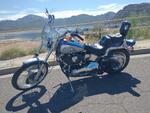
The one in the pick was my 1980 FXS. It replaced a 1978 FXS that got stolen. I loved then both...!
I rode my 1976 FXE Shovelhead all around the country using unleaded premium fuel without any problems at least through the late 90's. East coast, West coast, Sturgis and all around Texas including many summer months when the temp was near or above 100 degrees. And no, I did not ride like an old lady.
The only problem I had with the engine came from a cast piston fitted too tight and scored after a top end rebuild, on a summer run in Texas. The heads / valves and guides were fine.
I ran Manley stainless steel valves with nickle bronze guides, but never changed the factory valve seats. I think part of the problem some have had could be related to timing and carb jetting, that led to the engine overheating enough to have a negative effect on the valves etc. Or the fuel they got out of the pump may have not been the advertised octane rating, contributing to the pinging / overheating problems. Just my 2 cents.
I rode my 1976 FXE Shovelhead all around the country using unleaded premium fuel without any problems at least through the late 90's. East coast, West coast, Sturgis and all around Texas including many summer months when the temp was near or above 100 degrees. And no, I did not ride like an old lady.
The only problem I had with the engine came from a cast piston fitted too tight and scored after a top end rebuild, on a summer run in Texas. The heads / valves and guides were fine.
I ran Manley stainless steel valves with nickle bronze guides, but never changed the factory valve seats. I think part of the problem some have had could be related to timing and carb jetting, that led to the engine overheating enough to have a negative effect on the valves etc. Or the fuel they got out of the pump may have not been the advertised octane rating, contributing to the pinging / overheating problems. Just my 2 cents.
Paul
I had many friends that didn't change a thing, and ran the unleaded gas with no problem. I heard bad things would happen, but can't recall anyone having a problem. There were many shops that made the conversion, maybe they started the stories.
Heads were cheap back then at swap meets, I bought a pair, and had the conversion done, so if anything went wrong, I could bolt my old ones back on. I just didn't feel lucky, and wanted to cover all the bases.
7 Surprising Harley-Davidson Products that Are Not Motorcycles
Slideshow: The bar-and-shield logo shows up on far more than motorcycles, some of the company's most unexpected products have nothing to do with riding.
Slideshow: From the troubled AMF years to modern misfires, these bikes earned reputations for reliability issues, questionable engineering, or disappointing performance.
Crazy Bunderbike Build Looks Amazing, But Is It Impossible to Ride?
Slideshow: The Swiss custom shop has taken a Harley Softail and stretched it into something so long and low that it looks closer to a rolling sculpture than a conventional motorcycle.
Engraved Rebellion: Inside Bundnerbike's Glam Rock II
Slideshow: A standard cruiser becomes an intricate metal canvas in the hands of a Swiss custom house known for pushing Harley-Davidson platforms far beyond their factory brief.