




Compensator function?

Thread Starter
|
Stellar HDF Member


Joined: Dec 2005
Posts: 2,598
Likes: 52
From: South Jersey
 Compensator function?
Excuse my ignorance, I'm not that good of a wrench. I just bought this 2010 EG Classic with low mileage. It now has 1200 miles on it. My previous bike was a 2006, before compensator problems became an issue.
When I start it up I get the dreaded clank just about every startup. The previous owner said it did it from new. I asked the dealer if this was a problem and they said its normal, just ride it although it certainly doesn't doesn't seem normal to me.
Today I noticed a noise from my primary, sounded like the chain was hitting the case every so often but when it got up to operating temp it stopped making that noise. Also when I started it cold today it make a loud clank then some other knock I never heard before and the bike didn't start. Hit the button again and it fired right up.
Is my compensator bad already with such low mileage and what does the compensator actually do?
Should I think about replacing it at a cost of $670 at my dealer?
That clank makes me cringe!
When I start it up I get the dreaded clank just about every startup. The previous owner said it did it from new. I asked the dealer if this was a problem and they said its normal, just ride it although it certainly doesn't doesn't seem normal to me.
Today I noticed a noise from my primary, sounded like the chain was hitting the case every so often but when it got up to operating temp it stopped making that noise. Also when I started it cold today it make a loud clank then some other knock I never heard before and the bike didn't start. Hit the button again and it fired right up.
Is my compensator bad already with such low mileage and what does the compensator actually do?
Should I think about replacing it at a cost of $670 at my dealer?
That clank makes me cringe!
Last edited by Streetrunner; Jun 14, 2014 at 10:49 PM. Reason: Addition

Ultimate HDF Member
Joined: Dec 2006
Posts: 5,878
Likes: 17
From: The Desert SouthWest
My compensator has been the ONLY problem I've ever had with this bike. This bike is now on it's 4th compensator in 107,000 miles. Supposedly this is the "latest greatest Upgrade" to it - we shall see.
The '09 and newer models have had compensator problems - at least the Touring models, not sure about the Dynas, etc. The compensator has been "upgraded" several times over the last few years.
When it goes bad you hear a clunk at start-up and particularly at shut-down. It comes from the shift lever area on the left side. Take it to another dealer or shop and have them listen to it. It's easy to pick up on once you know the sound.
What's it's function? I've had it explained to me 2 or 3 times and I'm still not sure what it does, lol. Someone else can chime in with that hopefully. Whatever they did in '09 was an epic fail though, as prior to '09 you never even heard about such problems.
Do the newest models have these problems or were they remedied?
The '09 and newer models have had compensator problems - at least the Touring models, not sure about the Dynas, etc. The compensator has been "upgraded" several times over the last few years.
When it goes bad you hear a clunk at start-up and particularly at shut-down. It comes from the shift lever area on the left side. Take it to another dealer or shop and have them listen to it. It's easy to pick up on once you know the sound.
What's it's function? I've had it explained to me 2 or 3 times and I'm still not sure what it does, lol. Someone else can chime in with that hopefully. Whatever they did in '09 was an epic fail though, as prior to '09 you never even heard about such problems.
Do the newest models have these problems or were they remedied?
Last edited by Arizona; Jun 14, 2014 at 11:23 PM.
Outstanding HDF Member
Joined: Mar 2009
Posts: 2,216
Likes: 102
From: Central Illinois
Since the v-twin engine fires unevenly, it also sends pulses to the primary chain unevenly. To prevent constant shocks going through the chain, transmission gears and the rest of the driveline, the compensator is basically spring loaded so the engine sprocket is "cushioned" , meaning its not solidly mounted to the crankshaft but can rotate in both directions a small amount with heavy springs providing the cushion. This softens the pulses and reduces shock stresses to the rest of the driveline.
This is a photo of the inside of my primary with the 2014 compensator. The compensator is the smaller gear on the left, with the 3 spokes. The ramped part behind it is pushing against heavy springs and when the spokes from the gear bear on the ramps, the ramps will push inward against the springs providing the cushion. The clutch is the large gear on the right and the auto chain adjuster is the middle part at the bottom of the primary chain.
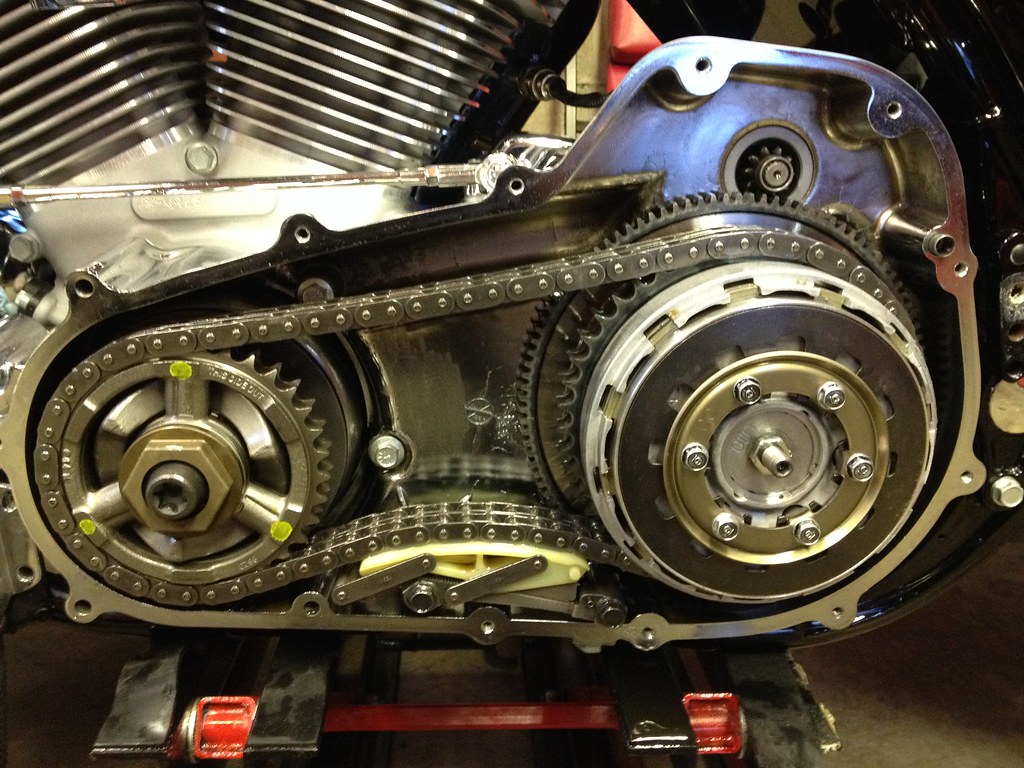
This is a photo of the inside of my primary with the 2014 compensator. The compensator is the smaller gear on the left, with the 3 spokes. The ramped part behind it is pushing against heavy springs and when the spokes from the gear bear on the ramps, the ramps will push inward against the springs providing the cushion. The clutch is the large gear on the right and the auto chain adjuster is the middle part at the bottom of the primary chain.

Outstanding HDF Member
Joined: Aug 2008
Posts: 2,090
Likes: 7
When the dampening Springs have lost enough tension to allow contact between the ramps, the noise will be unbearable. You will seriously think your engine is about to grenade. This startup clank is your warning that your compensator is becoming unhappy, and it wants to be changed. There are several threads out there about shimming the spring to increase dampening pressure. As stated the purpose is to smooth out the pulses of the engine. Someone tried running one without the comp and it slowly destroyed the primary components and tranny before he decided to reinstall the comp.

Seasoned HDF Member


Joined: Mar 2010
Posts: 38,695
Likes: 6,474
From: Honah Lee
My thoughts but conditions vary. The comp is there to smooth the ride so you do not fill the uneven firing. It does protect somewhat. However, since more and more people flog these bikes like sport bike, it was necessary for Harley to put the cush drive in the rear sprocket for protection to the drive train. The bang you hear is probably a weak battery. However ever now and then, they will all bang depending on where the motor stops. The primary can also make some rough sounding noise especially if you start listening to it. Whatever you do, when you start it, hold down on the start button just a millisecond longer then a car till it is running. If you let off before it has caught and hit it again and get a another spray of fuel, it will bang more. Also, not telling you to do this since book says not to, I leave mine in gear. When I get on, I pull the clutch in and using the back of the seat, push my bike back about 6". You will fill the clutch drag brake free as the oil stuck disks become unstuck from oil film. Then I start in gear with little forward lug. I eliminate any starter bang since the little extra resistance prevents the compensator from unloading so quickly. I also eliminate the clack going in first. That works. As a finial thought, that bang and the clack going in first hurts nothing. However, sounds like crap.

Elite HDF Member
Joined: Sep 2007
Posts: 4,928
Likes: 69
From: Near Myrtle Beach, SC
A few years ago, I tore-out a perfectly good stock 2010 Ultra compensator and replaced it with the SE version based on the concern that something "might" happen to the stock version. (parts cost was less than $250 plus a new primary gasket which I probably didn't need either) The SE version spring pack is much more robust, as were some of the other components, but I was having no trouble with the stocker at the time.
Later, I replaced the chain's auto-tensioning device ultimately with a Baker Drivetrain manually adjustable tensioner. (after trying the Hayden unit for a while...way too tight IMO). The Baker is a well built unit and I am totally happy with it's performance after several thousand miles.
I don't get any bangs or wierd noises from the primary, other than normal primary noise. I never did. It's going to make noise. It's a Harley, and this V-twin tractor engine between your legs will make noise. There are lots of moving parts, metal parts, that rub and make noise. First gear thunk is normal. Nothing to worry about.
That chain spinning around in your primary will make some racket. The kind of lube you use in there can make a difference in noise dampening to a degree. But in the end, noises from the primary are not going to leave you stranded unless something starts breaking-up and little pieces of steel go here and there. Keeping your primary fluid changed regularly will show you what is going on in that regard. Best to do all this yourself so you can see and take action.
I always start my bike in neutral. Lots less stress on the starter gears and starter clutch, and it pulls less cranking amps from the battery due to the reduced friction/resistance of overcoming clutch plate drag. I leave it in gear on the jiffy stand all the time. That way it can only roll so far if the jiffy tab breaks-off. O crap, I just realized, I'm off topic. Dang.

Trending Topics

Cruiser
Joined: Jan 2013
Posts: 245
Likes: 3
From: Fla-
HD Forum Stories
The Best of Harley-Davidson for Lifelong Riders

Jason Momoa Is Turning Classic Harleys Into PHEVs
Verdad Gallardo
Harley-Davidson Fat Boy Becomes a Dark, Decepticon-Inspired Custom
Verdad Gallardo
6 Weirdest Harley-Davidsons Ever Sold to the Public
Verdad Gallardo
7 Times Harley-Davidson Chucked Tradition Out the Window
Verdad Gallardo
7 Surprising Harley-Davidson Products that Are Not Motorcycles
Verdad Gallardo
8 Best Harley-Davidson Motorcycles Ever
Pouria Savadkouei
10 Worst Harley-Davidson Motorcycles Ever
Pouria Savadkouei
Killer Custom's Jail Break Is The Breakout That Refused to Blend In
Verdad Gallardo
Crazy Bunderbike Build Looks Amazing, But Is It Impossible to Ride?
Verdad Gallardo
Seasoned HDF Member
Joined: Mar 2010
Posts: 38,695
Likes: 6,474
From: Honah Lee
Hear you Joe, lot of abuse goes on in the primary and transmission. Why I change the oil when I do the engine oil. I doubt there is enough strain on the starter to reduce it's life if you brake the disk free like I say in my above post 6. However, pushing my bike back is probably a whole lot easier then yours!? HA 


