



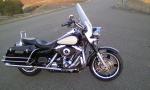

Swingarm alignment...

Thread Starter
|
Road Warrior


Joined: Dec 2006
Posts: 1,573
Likes: 138
From: StL, MO. USA

I pulled the swingarm yesterday and tried to check it against my old one to try and determine if it was bent. Both parts have very similar characteristics...so...they are either both right, or both bent.
I reinstalled and made sure (just like last time) that all torque specs are correct. I need to make sure the rear wheel/belt tension is right...and then, weather allowing, do a test ride.

Club Member
Joined: Jun 2007
Posts: 45,429
Likes: 2,898
From: Bedford UK
You have a very high spec build there! I'm working towards a similar spec myself, with a few additions. The only thing I can see missing is a rear stabiliser, actually the first thing I added to my own bike. In view of the other things you've done, if you don't have one use a True-Track.
As for the levels. the only suggestion I have is vertical alignment of the engine in the frame, however I wouldn't put too much confidence in precise accuracy of the build of the frame. It may well be that with everything at it's optimum, the seat rails for example are not actually level.
As for the levels. the only suggestion I have is vertical alignment of the engine in the frame, however I wouldn't put too much confidence in precise accuracy of the build of the frame. It may well be that with everything at it's optimum, the seat rails for example are not actually level.

Road Captain
Joined: Aug 2011
Posts: 575
Likes: 4
From: SouthWestern Ontario
This is what I would be checking as well. With everything else you have listed as being done, the alignment of the rear wheel in relation to the front wheel should be checked. You could use the 8' florescent tube method, holding it across both rear and front wheels or take it to someone with the laser alignment tools. I would also install one of the stabilizers on the market. Good luck!
Thread Starter
|
Road Warrior
Joined: Dec 2006
Posts: 1,573
Likes: 138
From: StL, MO. USA
To answer the stabilizer question... I am running a Smooth Rider stabilizer.
I need to find an easy way to use a straight-edge to verify front/rear wheel alignment.
- the 8' fluorescent bulb is a great idea...except ther is no room to do so because my exhaust & lower fairing is in the way. Also, since I am running a single-sided brake up front now, I have to work from both sides of the bike.
Kinda sucks
I need to find an easy way to use a straight-edge to verify front/rear wheel alignment.
- the 8' fluorescent bulb is a great idea...except ther is no room to do so because my exhaust & lower fairing is in the way. Also, since I am running a single-sided brake up front now, I have to work from both sides of the bike.
Kinda sucks

Seasoned HDF Member

Joined: Jan 2006
Posts: 11,477
Likes: 3,006
From: Charleston, SC
To answer the stabilizer question... I am running a Smooth Rider stabilizer.
I need to find an easy way to use a straight-edge to verify front/rear wheel alignment.
- the 8' fluorescent bulb is a great idea...except ther is no room to do so because my exhaust & lower fairing is in the way. Also, since I am running a single-sided brake up front now, I have to work from both sides of the bike.
Kinda sucks
I need to find an easy way to use a straight-edge to verify front/rear wheel alignment.
- the 8' fluorescent bulb is a great idea...except ther is no room to do so because my exhaust & lower fairing is in the way. Also, since I am running a single-sided brake up front now, I have to work from both sides of the bike.
Kinda sucks
Note: Not all touring bikes from all years are completely inline tire wise.
Some bikes have the rear kicked off to one side a few mm or more depending on how much offset was needed to put a belt inline with the rear tire pulley. Came that way from the Factory.
The important thing is to make sure both are running straight in relation to each other.
Road Captain
Joined: Aug 2011
Posts: 575
Likes: 4
From: SouthWestern Ontario
There is another method that I have used to check for parallel tracking:
-Position the bike in an exact upright position, using plumb bobs originating on the upper sidewall of each tire. (I did this with the bike on the lift using shims.)
-Draw a line on the floor, perfectly parallel with the contact points of the plumb bobs, extending 2' beyond the length of the bike on each end.
-Now you can use a shorter straightedge with a plumb bob hanging from each end, to span both front and rear wheels individually, to scribe/draw a directional line for each wheel and gauge the difference in tracking between both wheels.
Its a bit of setup and kind of caveman style but does work. This method will allow you to see both horizontal and vertical planes of each wheel allowing you to make corrections.
When I set mine up after building the modified swingarm, I used a combination of a laser, plumb bobs and straight edges using this method. My bike tracks and takes the sweepers like its on rails at any reasonable speed I've gone. Hope this helps, Good Luck!
-Position the bike in an exact upright position, using plumb bobs originating on the upper sidewall of each tire. (I did this with the bike on the lift using shims.)
-Draw a line on the floor, perfectly parallel with the contact points of the plumb bobs, extending 2' beyond the length of the bike on each end.
-Now you can use a shorter straightedge with a plumb bob hanging from each end, to span both front and rear wheels individually, to scribe/draw a directional line for each wheel and gauge the difference in tracking between both wheels.
Its a bit of setup and kind of caveman style but does work. This method will allow you to see both horizontal and vertical planes of each wheel allowing you to make corrections.
When I set mine up after building the modified swingarm, I used a combination of a laser, plumb bobs and straight edges using this method. My bike tracks and takes the sweepers like its on rails at any reasonable speed I've gone. Hope this helps, Good Luck!
Last edited by Recycled; Aug 18, 2014 at 12:50 AM. Reason: added coherent thought
HD Forum Stories
The Best of Harley-Davidson for Lifelong Riders

Harley-Davidson Fat Boy Becomes a Dark, Decepticon-Inspired Custom
Verdad Gallardo
6 Weirdest Harley-Davidsons Ever Sold to the Public
Verdad Gallardo
7 Times Harley-Davidson Chucked Tradition Out the Window
Verdad Gallardo
7 Surprising Harley-Davidson Products that Are Not Motorcycles
Verdad Gallardo
8 Best Harley-Davidson Motorcycles Ever
Pouria Savadkouei
10 Worst Harley-Davidson Motorcycles Ever
Pouria Savadkouei
Killer Custom's Jail Break Is The Breakout That Refused to Blend In
Verdad Gallardo
Crazy Bunderbike Build Looks Amazing, But Is It Impossible to Ride?
Verdad Gallardo
Harley-Davidson Reveals Super Cool Cafe Racer Concept
Verdad Gallardo
Road Captain
Joined: May 2014
Posts: 610
Likes: 62
From: White Bear Lake, MN
Reading with some curiosity here...sounds like you have done a lot of work to make the bike handle as well as possible.
In the first post, you reference that the issue is related to grooved or uneven pavement, yes? A couple of questions that might help focus in:
1. Does the bike handle to your satisfaction on other surfaces, like gravel, smooth pavement, chip seal, crowned two-lanes, etc...?
2. Assume that you have just resolved the issue--what does grooved or uneven pavement feel like to you now?
My experiences on grooved, uneven, and freshly chewed up (ready for resurfacing) roads have been all kinds of different over the years, depending on bike, tires, suspension, and other factors. Grate metal bridges are the worst, and when they're wet, even worse.
The thing I have found to work best is to loosen up my hands, and like a horse, let it have it's head. Not sure how loose yours is feeling, that's why I asked the questions above, to try and get a better sense of your feeling and expectations.
All the best,
Shane
In the first post, you reference that the issue is related to grooved or uneven pavement, yes? A couple of questions that might help focus in:
1. Does the bike handle to your satisfaction on other surfaces, like gravel, smooth pavement, chip seal, crowned two-lanes, etc...?
2. Assume that you have just resolved the issue--what does grooved or uneven pavement feel like to you now?
My experiences on grooved, uneven, and freshly chewed up (ready for resurfacing) roads have been all kinds of different over the years, depending on bike, tires, suspension, and other factors. Grate metal bridges are the worst, and when they're wet, even worse.
The thing I have found to work best is to loosen up my hands, and like a horse, let it have it's head. Not sure how loose yours is feeling, that's why I asked the questions above, to try and get a better sense of your feeling and expectations.
All the best,
Shane
Club Member
Joined: Jun 2007
Posts: 45,429
Likes: 2,898
From: Bedford UK

Note: Not all touring bikes from all years are completely inline tire wise.
Some bikes have the rear kicked off to one side a few mm or more depending on how much offset was needed to put a belt inline with the rear tire pulley. Came that way from the Factory.
The important thing is to make sure both are running straight in relation to each other.
Some bikes have the rear kicked off to one side a few mm or more depending on how much offset was needed to put a belt inline with the rear tire pulley. Came that way from the Factory.
The important thing is to make sure both are running straight in relation to each other.
Last edited by grbrown; Aug 18, 2014 at 08:23 AM. Reason: Clarification.