





rack and pull engine alignment

HDF Community Team


Joined: Sep 2013
Posts: 2,373
Likes: 2,345
From: Wisconsin


Excellent presentation in your wheel alignment thread. I couldn't tell from the pictures what frame you had (perhaps easy for some, but not me). How does this work with the "new" frames (09 and newer) and with the cam adjusters, not the nut and bolt style? I can easily see vertical adjustments with an adjustable top link but the left-right adjustments are not as obvious as they were on the older frames and small wheel only left-right adjustments with the cams would seem to require a bit of grinding on one cam or the other.
No need to ever grind on the cams. One cam is locked to the axle and one is not.
Seasoned HDF Member
Joined: Dec 2005
Posts: 19,900
Likes: 8,006
From: poway
The problem with the guy's theory is that the mounts themselves may not be straight.. When aligning wheel vertical with levels. The left top shock mount on my EGC was off by about 1/8 inch.. When they weldied the frame, it shifted in the fixture..

Grand HDF Member


Joined: Jan 2012
Posts: 4,458
Likes: 2,877
From: Oklahoma
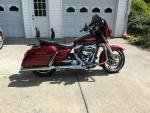
I was showing my softail. The frame type and adjuster type does not matter. Just use the left and right axle adjusters (cam or screw type) to align the rear wheel and properly tension the belt at the same time.
No need to ever grind on the cams. One cam is locked to the axle and one is not.
No need to ever grind on the cams. One cam is locked to the axle and one is not.
HDF Community Team
Joined: Sep 2013
Posts: 2,373
Likes: 2,345
From: Wisconsin
One cam is a welded part of the end of the axle, the other is keyed so that it must move with the axle when tensioning the belt. In mine I would guess that there is less than one degree of axle rotation before the keyed side follows the axle rotation adjustment. The design assumes that the swing arm and the lugs welded to it are true. From a practical standpoint, there is no independent movement of one cam relative to the other. My only Harleys have both been Road Kings so the cam system is all I have worked with. The system on the Soft Tails has always impressed me as superior as it is more adjustable.
Grand HDF Member
Joined: Jan 2012
Posts: 4,458
Likes: 2,877
From: Oklahoma
My machine rides pretty well now but I plan on getting the square tubes and angle iron to check it out. If you have any ideas after your first adjustment, please let me...or everyone know. "Massaging" any play on the loose side would only allow a very small correction and seems rather labor intensive to combine wheel alignment with belt tension. With any luck it would only need to be done once per tire change but still seems more difficult than the screw jack arrangement.

Road Master


Joined: Feb 2019
Posts: 1,144
Likes: 950
From: Port Saint Lucie, FL
@Hulkss and @btsom Does anybody on these HD forums ever use or been introduced to "The String Method" of motorcycle wheel alignment?
Also? It appears to me the goal is to align the wheels and then align the final drive unto the wheels and I presume this is where that S&S adjustable length heim link comes into play but I don't see where unless we have the ability to loosen the motor mounts to allow the engine/trans to reclock/reposition themselves accordingly because I sure wouldn't want constant tension getting induced into my primary drive bearings where at the end of the day? While wheel alignment is important (a solid 9 on my 10 scale) the rest is hyperbole seeing how the touring models have rubber mounted engines with one counterbalancer (as opposed to the softails solid mounted engines with 2 counterbalancers) where the touring engines jump around like Shakira's hips on coke! LOL!
Also? It appears to me the goal is to align the wheels and then align the final drive unto the wheels and I presume this is where that S&S adjustable length heim link comes into play but I don't see where unless we have the ability to loosen the motor mounts to allow the engine/trans to reclock/reposition themselves accordingly because I sure wouldn't want constant tension getting induced into my primary drive bearings where at the end of the day? While wheel alignment is important (a solid 9 on my 10 scale) the rest is hyperbole seeing how the touring models have rubber mounted engines with one counterbalancer (as opposed to the softails solid mounted engines with 2 counterbalancers) where the touring engines jump around like Shakira's hips on coke! LOL!
Road Warrior


Joined: Dec 2005
Posts: 1,276
Likes: 1,077
From: SE SC
I throw a leg over. Head down the street doing 40-50mph on a straight road with cruise on. I take both hands of the bars and if I go straight, the bikes aligned enough for me.
I've ridden a few "crooked" bikes....none bad enough to make me worry about it.
I've ridden a few "crooked" bikes....none bad enough to make me worry about it.
Grand HDF Member
Joined: Jan 2012
Posts: 4,458
Likes: 2,877
From: Oklahoma
I guess both of my Harleys have been a bit crooked. They both would drift to the left when hands off. I played with the 08 RK as it had more adjustability then the 23 but never trimmed out the pull. Loading everything heavy that I always carry into the right saddlebag eliminated most of the left drift. I could find no alignment section in the FSM, hope I didn't just miss it. The new frames (09 and newer) do not seem to allow for left-right adjustment and an adjustable top link must be added for vertical adjustment.
HD Forum Stories
The Best of Harley-Davidson for Lifelong Riders

7 Surprising Harley-Davidson Products that Are Not Motorcycles
Verdad Gallardo
8 Best Harley-Davidson Motorcycles Ever
Pouria Savadkouei
10 Worst Harley-Davidson Motorcycles Ever
Pouria Savadkouei
Killer Custom's Jail Break Is The Breakout That Refused to Blend In
Verdad Gallardo
Crazy Bunderbike Build Looks Amazing, But Is It Impossible to Ride?
Verdad Gallardo
Harley-Davidson Reveals Super Cool Cafe Racer Concept
Verdad Gallardo
Engraved Rebellion: Inside Bundnerbike's Glam Rock II
Verdad Gallardo
10 Motorcycles You Should Never Buy
Joe Kucinski
10 Things Harley-Davidson Needs to Fix in 2026
Verdad Gallardo
HDF Community Team
Joined: Sep 2013
Posts: 2,373
Likes: 2,345
From: Wisconsin
HDF Community Team
Joined: May 2022
Posts: 506
Likes: 241
From: CA
The string method also isn't particularly precise in that the F/R tires are different width, and besides it measures offset between where the tread starts, not at the rim. So a lot of eyeballing or ad hoc measurement techniques get used, never mind that tires aren't that precise to begin with either.
But the reality is if the tracking offset is small it makes zero difference, it's not noticeable when riding and difficult to try to measure. Perhaps in a race setting it's worth removing the tires and apply wheel spacers to where the two rims are perfectly lined up and weight evenly trimmed. For everyday riding though, not worth the bother. Unlike cars, MCs will always ride in a straight line as long as the weight is centered over the wheels.