


First Harley and First Post!


Extreme HDF Member
Joined: Jun 2014
Posts: 11,448
Likes: 2,299
From: NW Ohio

All modern gasoline engines use a similar system. On a car it's generally referred to as PCV, or positive crankcase ventilation. If properly executed it can actually help seal the piston rings and fractionally increase power. I've never seen it properly executed on a production vehicle.
A properly designed and installed port on the exhaust pipe can create a vacuum and actively pull these crankcase gasses out into the exhaust stream. This way they aren't depositing on the valves, heads, or pistons.
Next best option is just to vent to atmosphere. All my cars have the EPA mnadated EGR and PCV systems disabled.
A properly designed and installed port on the exhaust pipe can create a vacuum and actively pull these crankcase gasses out into the exhaust stream. This way they aren't depositing on the valves, heads, or pistons.
Next best option is just to vent to atmosphere. All my cars have the EPA mnadated EGR and PCV systems disabled.

Tourer
Joined: Feb 2016
Posts: 309
Likes: 39
From: Southlake Texas
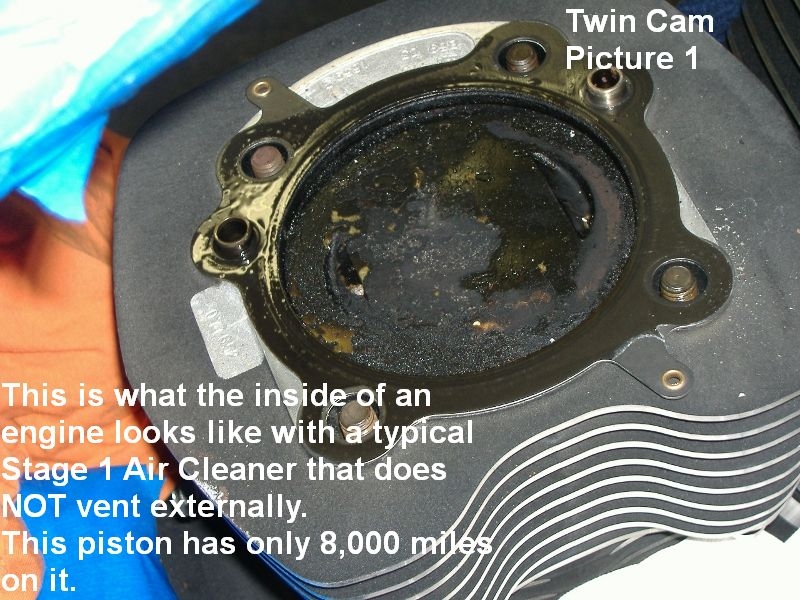
I'm afraid that's exactly how it works. The EPA requires head crankcase gasses to be vented back in to the A/C. Most current A/C offerings are EPA compliant meaning those gasses exit the head and travel back in to the A/C. The gas will carry a bit of oil which saturates your A/C filter and finds it way in to the intake and will garbage up your pistons and heads with oily residue. Not the best thing for any performance or longevity, stuffing hot oily gas back in, eh?
You can externally vent those gasses; the bike will be happier if you do. This is my Wide Glide running DK Custom breather bolts; this is one option you can consider. You can see the bolt in the center of the image. The crankcase gas exits the breather bolt and is vented to atmosphere, keeping the A/C, throttle body/intake, heads, and pistons clean.

I pilfered these images from DK Custom, you can see the differences. I wouldn't ever run an HD without external venting of the crankcase gasses...

You can externally vent those gasses; the bike will be happier if you do. This is my Wide Glide running DK Custom breather bolts; this is one option you can consider. You can see the bolt in the center of the image. The crankcase gas exits the breather bolt and is vented to atmosphere, keeping the A/C, throttle body/intake, heads, and pistons clean.
I pilfered these images from DK Custom, you can see the differences. I wouldn't ever run an HD without external venting of the crankcase gasses...

Extreme HDF Member
Joined: Feb 2015
Posts: 10,907
Likes: 8,758
From: Galt's Gulch - MI
Not really, it's never been any issue on any bike before. I've had several 88" Dyna's and never have any issues with any sort of significant carryover... This 103" is a bit different; there's something about these 103's; some will puke no matter what, and some don't vent oil at all.
I've played with oil viscosity; I've found the 10W-60 LiquiMoly will cough out all sorts of nasty; within 100 miles soaking the air filter and dripping on the cam cover. 20W-50 isn't much better. But, I do have to say, I've never seen a bike like this new 103" when it comes to carryover. An 88"? Never a problem. This 103" beast is a puking fool, no matter the oil level. The only thing that keeps it to a bare minimum is SAE 50 VR1 oil and a middle of the stick cold oil level. Trask Mystfree breathers and opening up the rocker support oil drain holes are next for this critter. I swear, I wonder about crank runout on this bike...
I've played with oil viscosity; I've found the 10W-60 LiquiMoly will cough out all sorts of nasty; within 100 miles soaking the air filter and dripping on the cam cover. 20W-50 isn't much better. But, I do have to say, I've never seen a bike like this new 103" when it comes to carryover. An 88"? Never a problem. This 103" beast is a puking fool, no matter the oil level. The only thing that keeps it to a bare minimum is SAE 50 VR1 oil and a middle of the stick cold oil level. Trask Mystfree breathers and opening up the rocker support oil drain holes are next for this critter. I swear, I wonder about crank runout on this bike...


Seasoned HDF Member


Joined: Jun 2014
Posts: 5,472
Likes: 6,342
From: pacific northwest
All modern gasoline engines use a similar system. On a car it's generally referred to as PCV, or positive crankcase ventilation. If properly executed it can actually help seal the piston rings and fractionally increase power. I've never seen it properly executed on a production vehicle.
A properly designed and installed port on the exhaust pipe can create a vacuum and actively pull these crankcase gasses out into the exhaust stream. This way they aren't depositing on the valves, heads, or pistons.
Next best option is just to vent to atmosphere. All my cars have the EPA mnadated EGR and PCV systems disabled.
A properly designed and installed port on the exhaust pipe can create a vacuum and actively pull these crankcase gasses out into the exhaust stream. This way they aren't depositing on the valves, heads, or pistons.
Next best option is just to vent to atmosphere. All my cars have the EPA mnadated EGR and PCV systems disabled.


Thread
Thread Starter
Forum
Replies
Last Post
GingerSmurf02
General Harley Davidson Chat
12
Feb 9, 2014 12:05 AM









