When you click on links to various merchants on this site and make a purchase, this can result in this site earning a commission. Affiliate programs and affiliations include, but are not limited to, the eBay Partner Network.
Engine Mechanical TopicsDiscussion for motor builds, cams, head work, stripped bolts and other engine related issues. The good and the bad. If it goes round and around or up and down, post it here.
There was much press concerning how MOCO had tested these engines and really put them thru the wringer. I can't believe they had no bearing or tensioner issues during all this supposed testing. I have another theory. The original motors they tested had a roller bearing in the rear and smoother chains. Somebody at Harley decided they could save a $1 with a cheaper bearing....and that's what they rolled out. These things were falling apart in serious numbers as soon as they hit the market. It's something we will likely never know, but if they had put the miles on these motors during testing they say they did.....it's hard to believe they did not discover they had a serious weakness. Me thinks something happened between "testing" and "roll-out".
We have a winner. The bikes were rock-solid in test form but the bean counters saw they could save .50 a unit with the ball bearing and there you have it. The TC engine post-2002, and especially 2007 and later were an exercise in what is called "value engineering" I don't want to offend anyone who loves their 07 and up bike, but I could name dozens of cost-cutting measures implemented for 07-up that resulted in millions in warranty claims and pissed-off customers. All I can say is marketing is a very powerful tool in todays world.
Ole Donny's eating some of his words now. Did any one of you out there remember his stories on synthetic oil's when they came out for bikes in the 80's (spinning bearing's etc All in American Iron.
Amusing is an understatement. Many of us swallowed the entire line of BS coming out of "whereever" about this new TC mil. Having had two fail and spending a grand to make the last one I owned not fail, I sold it ASAP and went bck to the EVO. I can assure you that I have not had the first tensioner shoe, or rear cam bearing fail since I've had this EVO.
I have read somewhere! the differences between builds of the 2002 vs 2003.
such as dephi fuel injection replace by ? and timken bearings replaced by? crankshaft difference as well. do you have any information on this topic?
This is a picture of a stock tensioner at 34,000 miles, its about one third worn on the outside of the cam plate. Couldn't see much of the inside one but I am sure it is no better. I am going to upgrade to the SE cam plate for hydraulic tensioners with higher flow oil pump. While it is all opened up SE 255 cams will be also installed. Its estimated at $1300 to be done at my HD dealer which also includes adj. pushrods, bearings, ect. To me its worth the investment not to worry about the spring tensioner issue anymore.
Reprinted with permission of Donny Petersen, Heavy Duty Cycles, Toronto, Ontario.
DONNY PETERSENS
SPECIAL ENGINE FEATURE
FATHEAD TWINCAM88
Twin Cam 88 + 88B "Fathead"
Where should I start? Well how about first describing this engine, 4 ½ years in the making, as a bulletproof platform for the future. Designed with durability and reliability in mind, the engineers are expecting a minimum 100,000 miles before rebuild. I’m writing this in March and as of this date they already have a Fathead with this magic mileage and it doesn’t need a rebuild.
Yeah I know of all the mythical Evos that have supposedly logged on the magic 100 grand but lemme tell you that for every rider that’s actually done that there are many more exaggerating their motorcycles prowess.
The Fathead is gonna consistently do 100 grand without blinking. In fact there are parts in that baby that will not need replacing for a few hundred thousand miles like the pinion bearing that rivals those used in top fuel dragsters. This engine is overengineered. It is a superlative effort in engine design that I’ve never seen or hope to have seen in my 30 years of working on the V-Twin.It’s a platform for many modifications that are going to be extremely reliable. It is obvious to me that screaming Eagle is going to attempt to take charge and control this engines' destiny in the hiperformance arena.
Again, by March 98, the Factory has logged 2 million miles in testing with 12,600 hours on the Dyno.
You see! This engine has been developed to run stock forever and almost forever with Harley Davidson designed Hi-performance components. This is why it’s called a platform. If your heart desires this staging area for more power it will be available, reliable, fast and durable. For more info on this aspect see "Hopping up the Fathead" elsewhere in this issue.
Skeptical as all get out, I entered the room, which was full of engineers, product marketing people and William Davidson himself. The raw emotion emanating from Bill Davidson was readily apparent as Dr. Marty Rosenblum the Factory historian watched Harley history in the making.
I had my list of Evo deficiencies such as cracking cases, leaking base gaskets, oily venting, pulling case studs…need I go on. What had they done to fix these inadequacies in the greatest engine produced by the Factory up until 1999?
Wow!
Approximately 460 component parts of the new Fathead engine were laid out in front of me on a large table for my perusal. To my right, sat a fully assembled engine in its entire splendor. To my left was a 1999 Dyna twin cam 88 cubic inch Fathead motorcycle. Talk about Harley heaven. Only about 15 of the parts are the same as those used in the Evo. It took me three minutes to throw every criticism I was about to launch out the window. For this story see "Ya’ll ain’t Gitting in der boy. Dats were de secret stuff is." elsewhere in this issue.
What followed was three days of intensive training from 6:30 am to 11 p.m. at night on the new motor. The teachers were Bill Davidson, engineers"Skip" Metz, and"Koby" Kobylarz with "Spike" Kieffer giving the overview. Steve, "who bleeds Harley oil when cut" Piehl ran shotgun. "Mr. Clean", Kenny Sutton, the VP in charge of building the Fathead showed us late at night how he was going to actually build the engines in the Pilgrim Rd. 400,000 sq. ft. plant demonstrating all the quality control features. Jerry "Mr. Smooth" Wilke VP of HD and President and CEO of Buell ably demonstrated through his every action why Harley is successful and is going to remain so. Not a big Buell fan because of its departure from traditional Harley styling, Jerry’s enthusiasm and instruction soon converted me to being a big fan. And I’ll tell ya somethin’. For anyone to do that ya gotta be smooth.
Then the Factory Race Team head honchos Steve Scheibe and Art Gomper taught us about the VR1000 in a secret f
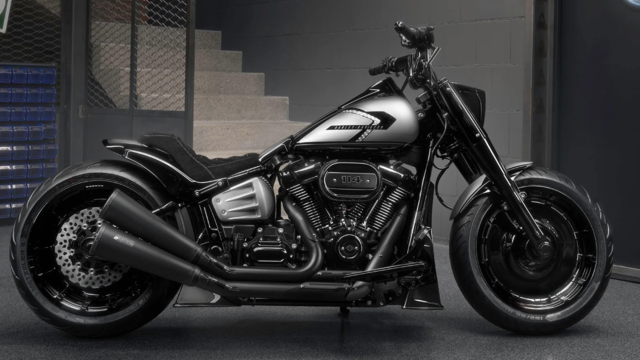
Harley-Davidson Fat Boy Becomes a Dark, Decepticon-Inspired Custom
Slideshow: Killer Custom's latest build relies on styling changes rather than performance upgrades, giving the cruiser an entirely different personality.
7 Surprising Harley-Davidson Products that Are Not Motorcycles
Slideshow: The bar-and-shield logo shows up on far more than motorcycles, some of the company's most unexpected products have nothing to do with riding.
Slideshow: From the troubled AMF years to modern misfires, these bikes earned reputations for reliability issues, questionable engineering, or disappointing performance.
Crazy Bunderbike Build Looks Amazing, But Is It Impossible to Ride?
Slideshow: The Swiss custom shop has taken a Harley Softail and stretched it into something so long and low that it looks closer to a rolling sculpture than a conventional motorcycle.
Engraved Rebellion: Inside Bundnerbike's Glam Rock II
Slideshow: A standard cruiser becomes an intricate metal canvas in the hands of a Swiss custom house known for pushing Harley-Davidson platforms far beyond their factory brief.



 All in American Iron.