When you click on links to various merchants on this site and make a purchase, this can result in this site earning a commission. Affiliate programs and affiliations include, but are not limited to, the eBay Partner Network.
So I was looking at the factory manual, and then at the PDF manual I have as well, and they show this same setup for the main circuit. It doesn't seem right, so I'm hoping someone can shed some light here.
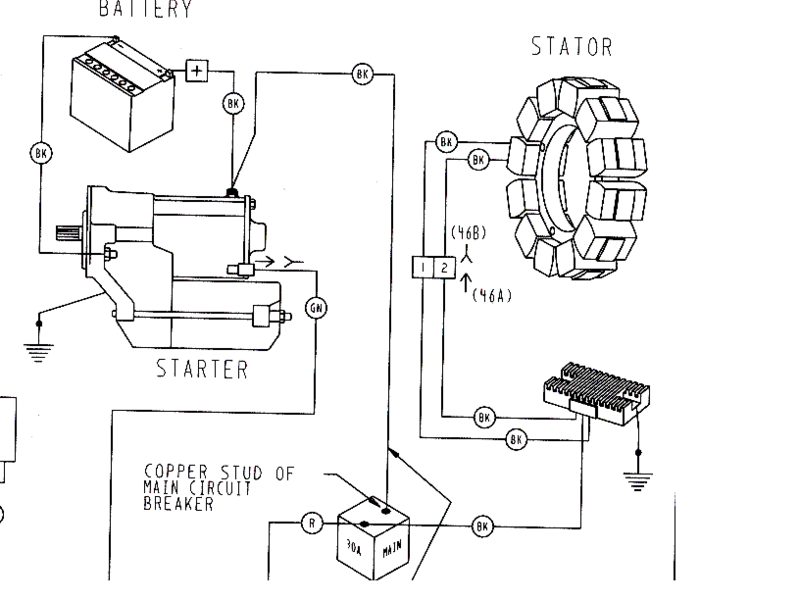
In the photo below, I feel like there should be a lead going from the battery (or the constant hot post of the solenoid) to the "input" side of the main circuit breaker (the same post that the output from the voltage regulator connects to).
Otherwise, how does the starter relay get power when the bike is not running - i.e. to operate the starter?
I'm at work and can't check for certain, but I'm pretty sure my bike has TWO wires connected to the "hot" leg of the main breaker. One comes from the voltage regulator, and one comes from the battery via the positive lug on the starter solenoid.
This would have to be or else there would be no power to the starter relay, ignition or anything else, and the alternator would not be able to charge the battery.
Last edited by Uncle G.; Jan 31, 2017 at 08:50 AM.
I don't think that schematic is correct. Mine (FSM) clearly shows a wire from what would be the right "B" on the starter solenoid to the main breaker.
Like Dr. Hess, my '96 Softail FSM shows a black wire from the battery + terminal to the starter/solenoid terminal, and a second black wire from that same terminal to the input (copper) stud of the main circuit breaker.
Last edited by yellowstone kelly; Jan 31, 2017 at 09:35 PM.
By any chance is there a metal strip that connects the copper stud of the main breaker to the positive terminal of the battery? I've seen that used on my 1978FXE. From the diagram in post #3 there isn't any way for power to be supplied to the main breaker.
On my '94 Softail there's a wire from the main breaker to the positive stud on the starter motor. It's just a short distance from one to the other so it's easy to miss unless you're looking for it.
I looked at all the wiring diagrams in this manual and the only diagram that doesn't show a 'buss bar' from the battery to the main circuit breaker is the diagram for the 1984 FXST. I guess it could be a mistake that it was omitted in the diagram. I included a diagram from another model just for illustration purposes.
OP: Tell us the model and year of the bike in question...
I just noticed in one of my old early Softail FSM wiring diagrams that the copper strip that connects the battery positive post to the main breaker is not shown, just like the pic posted by OP.
The electricity must get to the main breaker by magic...
That PDF wiring diagram is garbage...
Last edited by Dan89FLSTC; Feb 1, 2017 at 08:18 PM.
Slideshow: Jason Momoa's latest restoration project blends 1920s Harley-Davidsons with modern electric technology, creating some of the most unusual hybrid motorcycles ever built.
Harley-Davidson Fat Boy Becomes a Dark, Decepticon-Inspired Custom
Slideshow: Killer Custom's latest build relies on styling changes rather than performance upgrades, giving the cruiser an entirely different personality.
7 Surprising Harley-Davidson Products that Are Not Motorcycles
Slideshow: The bar-and-shield logo shows up on far more than motorcycles, some of the company's most unexpected products have nothing to do with riding.
Slideshow: From the troubled AMF years to modern misfires, these bikes earned reputations for reliability issues, questionable engineering, or disappointing performance.
Crazy Bunderbike Build Looks Amazing, But Is It Impossible to Ride?
Slideshow: The Swiss custom shop has taken a Harley Softail and stretched it into something so long and low that it looks closer to a rolling sculpture than a conventional motorcycle.







 Softail Wiring Question