



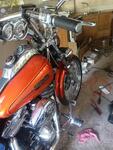




Question for you engine rebuilding guys

Thread Starter
|
Outstanding HDF Member
Joined: Sep 2011
Posts: 2,979
Likes: 1,165
From: No where near you, OH
 Question for you engine rebuilding guys
As some of you may remember a couple of years or so ago I attempted my first top end engine rebuild. It failed and I'm pretty sure why it failed. I have the factory service manual and followed the instructions for disassembly and reassembly exactly like the manual said. I overtorqued the cylinder stud nuts during assembly which pulled the threads out of the right front stud. Thought I fixed it by putting in a thread insert after tearing down the front cylinder again. It all torqued down to spec but leaks worse than a sloppy ***** because by overtorquing everything I believe I compromised the base and head gaskets. Now to the question. I obviously have to tear it down again for new gaskets but getting to the front cylinder stud hole in the block is it advisable to put in a helicoil in there instead of the thread insert and if so should I just pull the engine and send the block to a machine shop to fix my f'd up hole?

Seasoned HDF Member


Joined: Apr 2011
Posts: 6,185
Likes: 2,134
From: W. Texas
I'm not an engine builder on bikes
To throw this out my first thought would be.
To establish if the studs can hold to the torque
Did you not replace the gaskets when you did the front cyl to install the thread insert??
What kind of thread insert did you use?
Your post runs all together try some paragraphs for easier reading
WP
To throw this out my first thought would be.
To establish if the studs can hold to the torque
Did you not replace the gaskets when you did the front cyl to install the thread insert??
What kind of thread insert did you use?
Your post runs all together try some paragraphs for easier reading
WP
Thread Starter
|
Outstanding HDF Member
Joined: Sep 2011
Posts: 2,979
Likes: 1,165
From: No where near you, OH
Ok I'll try to sound like I'm not rambling. I used a helicoil thread insert. I don't believe I replaced the gaskets because the thought that I compromised those gaskets didn't occur to me until afterwards when all the oil leaks appeared while the engine was running.
. The front and rear cylinders are both leaking at the same rate which brought me to believe that I screwed up the gaskets by overtorquing them.
. Because I have to replace all the gaskets anyway from the base gaskets up I need to find out if I should just pull the engine and have the threads repaired at a machine shop.
My faith in a thread insert isn't that great in this application which is the reason for this question.
.
. The front and rear cylinders are both leaking at the same rate which brought me to believe that I screwed up the gaskets by overtorquing them.
. Because I have to replace all the gaskets anyway from the base gaskets up I need to find out if I should just pull the engine and have the threads repaired at a machine shop.
My faith in a thread insert isn't that great in this application which is the reason for this question.
.

Grand HDF Member


Joined: Aug 2008
Posts: 3,601
Likes: 9,921
From: Florida's gorgeous East coast
On my '85...there have been threads that needed to be repaired/replaced in her 36 year/309,000 mi lifetime. Because I've lived in a lot of places during all those years years, I've used 2 different machine shops, and a couple of independents as well. FWIW: they have all used Time-serts for those jobs. No Heli-coils.
Seasoned HDF Member
Joined: Apr 2011
Posts: 6,185
Likes: 2,134
From: W. Texas
Does this look like what you used ?
Or was it like this
There is a method for when you get it apart to ck the studs
. I'll try too find something for ya or I'm sure someone will chime.
Not replace the gaskets was most likely your down fall
However you say the rear is leaking badly as well ??
What did you use for torque specs and why do you think you over torqued things ?
WP
Or was it like this
There is a method for when you get it apart to ck the studs
. I'll try too find something for ya or I'm sure someone will chime.
Not replace the gaskets was most likely your down fall
However you say the rear is leaking badly as well ??
What did you use for torque specs and why do you think you over torqued things ?
WP
Last edited by WP50; Dec 26, 2021 at 08:47 AM.

Seasoned HDF Member
Joined: Aug 2008
Posts: 5,081
Likes: 2,159
From: Ohio
Check your head bolt torque before tear down checking to see if the studs loosened, studs could be stretched or if all are tight except the helicoiled holes, you have a direction, If all tight gaskets was damage in previous build. Some will totally disagree but believe in a light film of ultra black silicone even on Cometic base gaskets, aluminum warps in heat cycles over the years. Many years of building commercial diesel engines revealed mating surfaces change with age, heat and movement.
Recently used those Timeserts repairing stripped spark plug holes in Shovels, they are larger in diameter than a helicoil which should rethread in the repaired helicoil hole but also removing material from the weakest part of a Evo engine. Further repairs of the stud holes are getting deep or case replacement.
Recently used those Timeserts repairing stripped spark plug holes in Shovels, they are larger in diameter than a helicoil which should rethread in the repaired helicoil hole but also removing material from the weakest part of a Evo engine. Further repairs of the stud holes are getting deep or case replacement.
Trending Topics
Thread Starter
|
Outstanding HDF Member
Joined: Sep 2011
Posts: 2,979
Likes: 1,165
From: No where near you, OH
Does this look like what you used ?
https://www.amazon.com/Helicoil-5521.../dp/B0002SRDVE
Or was it like this
https://www.amazon.com/TIME-SERT-8-1.../dp/B001JK23O6
There is a method for when you get it apart to ck the studs
. I'll try too find something for ya or I'm sure someone will chime.
Not replace the gaskets was most likely your down fall
However you say the rear is leaking badly as well ??
What did you use for torque specs and why do you think you over torqued things ?
WP
https://www.amazon.com/Helicoil-5521.../dp/B0002SRDVE
Or was it like this
https://www.amazon.com/TIME-SERT-8-1.../dp/B001JK23O6
There is a method for when you get it apart to ck the studs
. I'll try too find something for ya or I'm sure someone will chime.
Not replace the gaskets was most likely your down fall
However you say the rear is leaking badly as well ??
What did you use for torque specs and why do you think you over torqued things ?
WP
Yes both the front and rear are leaking at the same rate.
The torque specs I used was the torque specs provided on the instructions. It provided the sequence of tightening and the steps you had to go through to bring them up to the maximum psi which was 42 psi. My mistake is the cheap piece of **** torque wrench I bought had metric measurements on one side and I mistakingly torqued them using those measurements.
Once I pulled the threads out of the front cylinder stud I though wtf and took a look to find my mistake. I immediately backed them all off
HD Forum Stories
The Best of Harley-Davidson for Lifelong Riders

6 Weirdest Harley-Davidsons Ever Sold to the Public
Verdad Gallardo
7 Times Harley-Davidson Chucked Tradition Out the Window
Verdad Gallardo
7 Surprising Harley-Davidson Products that Are Not Motorcycles
Verdad Gallardo
8 Best Harley-Davidson Motorcycles Ever
Pouria Savadkouei
10 Worst Harley-Davidson Motorcycles Ever
Pouria Savadkouei
Killer Custom's Jail Break Is The Breakout That Refused to Blend In
Verdad Gallardo
Crazy Bunderbike Build Looks Amazing, But Is It Impossible to Ride?
Verdad Gallardo
Harley-Davidson Reveals Super Cool Cafe Racer Concept
Verdad Gallardo
Engraved Rebellion: Inside Bundnerbike's Glam Rock II
Verdad Gallardo
Thread Starter
|
Outstanding HDF Member
Joined: Sep 2011
Posts: 2,979
Likes: 1,165
From: No where near you, OH
Check your head bolt torque before tear down checking to see if the studs loosened, studs could be stretched or if all are tight except the helicoiled holes, you have a direction, If all tight gaskets was damage in previous build. Some will totally disagree but believe in a light film of ultra black silicone even on Cometic base gaskets, aluminum warps in heat cycles over the years. Many years of building commercial diesel engines revealed mating surfaces change with age, heat and movement.
Recently used those Timeserts repairing stripped spark plug holes in Shovels, they are larger in diameter than a helicoil which should rethread in the repaired helicoil hole but also removing material from the weakest part of a Evo engine. Further repairs of the stud holes are getting deep or case replacement.
Recently used those Timeserts repairing stripped spark plug holes in Shovels, they are larger in diameter than a helicoil which should rethread in the repaired helicoil hole but also removing material from the weakest part of a Evo engine. Further repairs of the stud holes are getting deep or case replacement.
I'm asking here to see if there's any way I can fix my screw up and consider it a lesson learned but if it comes to finding new cases would it not be as cost efficient to find a used engine?
I will use your method for disassembly for the reasons you mentioned. It would give me the direction I need to go. Any which way I go the engine needs to come apart again anyway.

HDF Community Team


Joined: Jan 2020
Posts: 1,434
Likes: 801
From: Colorado

Here you go,
https://www.timesert.com/html/hd.html
And scroll down to the bottom of the page, for the ones to use after a helicoil has failed.
https://www.timesert.com/html/hd.html
And scroll down to the bottom of the page, for the ones to use after a helicoil has failed.