


Early EVO Lifter Problems


Thread Starter
|
6th Gear
Joined: Sep 2023
Posts: 12
Likes: 0
From: Bay Area CA.
 Early EVO Lifter Problems
I've seem in other threads here that early EVO lifter rollers had issues in '87.
Was it only in '87 or was it other years also that had this lifter roller bearing issue?
Was it only in '87 or was it other years also that had this lifter roller bearing issue?



HDF Community Team


Joined: Jan 2020
Posts: 1,434
Likes: 802
From: Colorado

A lifters,
A lifter on the right, later B lifter on the left, so easy to tell if you have oem A or B lifters to start with.

The quick run down, not the best finish on the sealing ring part of the lifter piston face, and this can cause that part of the lifter to mar the sealing plate, and if plate is marred enough, the lifter does not want to stay pumped up correctly. With lifter not staying pumped up, this cause the roller to start to hammer on the cam lob, while takes the roller bearings and cam lob out on the quick side.
Take a close look at the sealing ring on the piston and you can see the less them perfect polish surface on the center ring, lots of side burs, and the sealing plate to the left that is marred to hell from the burs left on the sealing ring surface sides of the piston, that can cause the leaking problem to keep the lifter from stating pumped up.

Here, we have the piston ring seat surface polished to remove the id and od burs, and can flip the sealing plate over, to get more life out of the lifter, so long as you can catch the problem before pump up problems, and the roller is staring to get hammered off the cam lobs to take both out.

Simply, on the A lifters, due to the less then perfect piston sealing surface, HD wanted you to change the lifters out around the 20K mark, before the sealing plate was marred to the point to cause less then perfect sealing problems to keep the lifter pumped up /lifter did not stayed pumped up to start to take the roller bearings out isntead.
If you can pull the A lifters before you have problems, clean them up so you don't have pump up problems and the roller and roller needle bearings are still fine, no reason to not run them for 35K if the rest of the lifter body is still in good shape as well. Note there is an option of just replacing the needle bearings and rollers if you can find HD NOS parts, but would not rebuild the lifters with the ebay import needle bearing and rollers, since they are a joke to start with.
As for lifters, the Johnson standard 2303 are about $179 for a set of 4, and just as good at the HB B lifters for a stock motor. If you are running a more radical cam, then the slow leak down version is a better option instead. If running a very radical cam, then the slow leak down with limiters is the best option yet.
https://larrysmcymachineinc.square.site/
As for OEM B lifter, good for 40K, but HD is really proud of them, and go for around $300 for a set instead.
Also to point out, when you are checking the lifters, take a good look the cam as well. Yes if cam lob is scored to hell, pitted or has flat spots, it needs to be replace, but if the surface of the cam lobs are showing any sighs of their hardened faces being worn off, then cam need to be replaced as well.
From here, with cam removed, take a good look at the cam bearing.
Here is a Koyo B138 bearing,

While the older HD INA stock bearing may be this type on the left isntead.
https://www.*****************/attach...rr-jpg.237273/
If an INA bearing in play, replace it with a Koyo B138 bearing.
If B138 type bearing in play, use your finger to move the bearing needle all the way around, and make sure you do not feel any binding, or flat spots. If you do, replace it.
Before installing the cam, make sure to lube the bearing with assembly fluid, the lobs of the cam, and the nose cone cover sleeves for both the cam and the crank shaft.
Also to point out, on the older motors, the cam inner thrush washer will be the tab type, while the later evos just had a flat round type thrush washer in play instead.
https://i.ebayimg.com/images/g/T-EAA...V3/s-l1600.jpg
So before you remove the cam, look at the thrush washer to see that way the tabs are against the inside to back face, and when you go to reinstall the cam, use grease on the back side of the thrush washer to stick it to the inside face so it install the correct way, then install the cam through it, and add in the needed end shims that where installed as before. If changing cams, need to do the same, temp in the nose cone cover with gasket, then reach through the lifter block opening to make sure that you still have.005" to .010" that you can move the cam side to side inside the void area (where is where the outer shim on outbound comes into play, as well as making sure that with this side to side movement, cam lobs are centered on the lifter block passages.
As for lifter blocks, can use paper clip end to hold the lifters in place as you install them with the nose cone cover back in place,
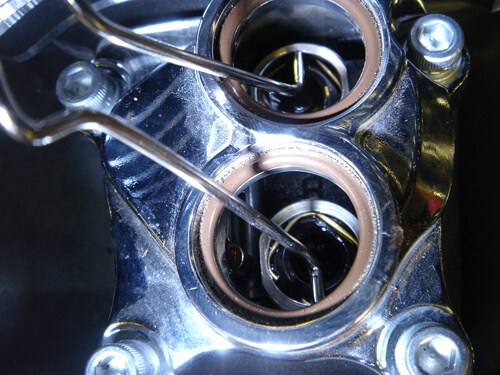
But make sure to get alignment bolts so you center the blocks over the oil passages when you go to install them,

Hence alignment bolts corner sides, install the hand tighten those bolts, remove the index bolts to install the final bolts in those channels, then final torque all the bolts in place. And for the love of christ, no sealant on the lifter block gaskets, since will be a nightmare if you need to pull them off down the line. Just use new gaskets, and make sure you have the sealing surfaces de-gasketed and clean.
On the evo lifter blocks, oils comes from the block on the jug side to the inner lifter channel, though/around the lifter to the center passage, and then into the outer channel from the center passage between the channels. So when installing the lifters, side oil passages will always face the jug side, since that is where the oil is coming from to them.
To add here, if motor is high mileage, before you order lifters, may want to gauge ball the old block bores, to see if standard OD lifters are going to work, or if you need to order increased sizer lifters/just get new Lifter blocks if the lifter channels are worn out too over sized isntead.
And no on just swapping out a nose cone cover while you have the old one off, since to do this, its cam bushing should really be reamed from the inside of the crank case before cam bearing is installed/crank is installed, to match up to the outboard side of the cam shaft end, to keep it tram to the needle bearing.
A lifter on the right, later B lifter on the left, so easy to tell if you have oem A or B lifters to start with.
The quick run down, not the best finish on the sealing ring part of the lifter piston face, and this can cause that part of the lifter to mar the sealing plate, and if plate is marred enough, the lifter does not want to stay pumped up correctly. With lifter not staying pumped up, this cause the roller to start to hammer on the cam lob, while takes the roller bearings and cam lob out on the quick side.
Take a close look at the sealing ring on the piston and you can see the less them perfect polish surface on the center ring, lots of side burs, and the sealing plate to the left that is marred to hell from the burs left on the sealing ring surface sides of the piston, that can cause the leaking problem to keep the lifter from stating pumped up.
Here, we have the piston ring seat surface polished to remove the id and od burs, and can flip the sealing plate over, to get more life out of the lifter, so long as you can catch the problem before pump up problems, and the roller is staring to get hammered off the cam lobs to take both out.
Simply, on the A lifters, due to the less then perfect piston sealing surface, HD wanted you to change the lifters out around the 20K mark, before the sealing plate was marred to the point to cause less then perfect sealing problems to keep the lifter pumped up /lifter did not stayed pumped up to start to take the roller bearings out isntead.
If you can pull the A lifters before you have problems, clean them up so you don't have pump up problems and the roller and roller needle bearings are still fine, no reason to not run them for 35K if the rest of the lifter body is still in good shape as well. Note there is an option of just replacing the needle bearings and rollers if you can find HD NOS parts, but would not rebuild the lifters with the ebay import needle bearing and rollers, since they are a joke to start with.
As for lifters, the Johnson standard 2303 are about $179 for a set of 4, and just as good at the HB B lifters for a stock motor. If you are running a more radical cam, then the slow leak down version is a better option instead. If running a very radical cam, then the slow leak down with limiters is the best option yet.
https://larrysmcymachineinc.square.site/
As for OEM B lifter, good for 40K, but HD is really proud of them, and go for around $300 for a set instead.
Also to point out, when you are checking the lifters, take a good look the cam as well. Yes if cam lob is scored to hell, pitted or has flat spots, it needs to be replace, but if the surface of the cam lobs are showing any sighs of their hardened faces being worn off, then cam need to be replaced as well.
From here, with cam removed, take a good look at the cam bearing.
Here is a Koyo B138 bearing,
While the older HD INA stock bearing may be this type on the left isntead.
https://www.*****************/attach...rr-jpg.237273/
If an INA bearing in play, replace it with a Koyo B138 bearing.
If B138 type bearing in play, use your finger to move the bearing needle all the way around, and make sure you do not feel any binding, or flat spots. If you do, replace it.
Before installing the cam, make sure to lube the bearing with assembly fluid, the lobs of the cam, and the nose cone cover sleeves for both the cam and the crank shaft.
Also to point out, on the older motors, the cam inner thrush washer will be the tab type, while the later evos just had a flat round type thrush washer in play instead.
https://i.ebayimg.com/images/g/T-EAA...V3/s-l1600.jpg
So before you remove the cam, look at the thrush washer to see that way the tabs are against the inside to back face, and when you go to reinstall the cam, use grease on the back side of the thrush washer to stick it to the inside face so it install the correct way, then install the cam through it, and add in the needed end shims that where installed as before. If changing cams, need to do the same, temp in the nose cone cover with gasket, then reach through the lifter block opening to make sure that you still have.005" to .010" that you can move the cam side to side inside the void area (where is where the outer shim on outbound comes into play, as well as making sure that with this side to side movement, cam lobs are centered on the lifter block passages.
As for lifter blocks, can use paper clip end to hold the lifters in place as you install them with the nose cone cover back in place,
But make sure to get alignment bolts so you center the blocks over the oil passages when you go to install them,
Hence alignment bolts corner sides, install the hand tighten those bolts, remove the index bolts to install the final bolts in those channels, then final torque all the bolts in place. And for the love of christ, no sealant on the lifter block gaskets, since will be a nightmare if you need to pull them off down the line. Just use new gaskets, and make sure you have the sealing surfaces de-gasketed and clean.
On the evo lifter blocks, oils comes from the block on the jug side to the inner lifter channel, though/around the lifter to the center passage, and then into the outer channel from the center passage between the channels. So when installing the lifters, side oil passages will always face the jug side, since that is where the oil is coming from to them.
To add here, if motor is high mileage, before you order lifters, may want to gauge ball the old block bores, to see if standard OD lifters are going to work, or if you need to order increased sizer lifters/just get new Lifter blocks if the lifter channels are worn out too over sized isntead.
And no on just swapping out a nose cone cover while you have the old one off, since to do this, its cam bushing should really be reamed from the inside of the crank case before cam bearing is installed/crank is installed, to match up to the outboard side of the cam shaft end, to keep it tram to the needle bearing.
Last edited by Dano523; Sep 24, 2023 at 10:13 PM.

Thread
Thread Starter
Forum
Replies
Last Post









