


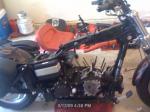


case boring?

Outstanding HDF Member
Joined: Oct 2007
Posts: 2,018
Likes: 6
From: Edmond, Ok

With your bike coming with a stock 96", anything over 107" would need case boring. They literally bore the area of your cases where the pistons come through to accomodate the larger diameter.

Sponsor
Joined: Dec 2007
Posts: 12,084
Likes: 829
The cases are split, and set up in a vertical mill, on a 90* precision angle plate, machined just for that application, square with the quill, and indicated dead nuts on center.
If using an Axtell 4 1/8" cylinder, a 2 step boring process then is established, and the dimensions are held to their exact specs.
Once that is completed, the center hole is then machined thru to the lifter side, and their proprietary hardware is then used.
Usually what follows that, is also a Timken bearing conversion in the left case half, as long as the crank is running true.
Scott
Last edited by Hillsidecycle.com; Mar 5, 2010 at 12:35 PM.

Tourer
Joined: May 2008
Posts: 446
Likes: 1
From:
We have been boring cases for over 20 years.
The cases are split, and set up in a vertical mill, square with the quill, and indicated dead nuts on center.
If using an Axtell 4 1/8" cylinder, a 2 step boring process then is established, and the dimensions are held to their exact specs.
Once that is completed, the center hole is then machined thru to the lifter side, and their proprietary hardware is then used.
Usually what follows that, is also a Timken bearing conversion in the left case half, as long as the crank is running true.
Scott
The cases are split, and set up in a vertical mill, square with the quill, and indicated dead nuts on center.
If using an Axtell 4 1/8" cylinder, a 2 step boring process then is established, and the dimensions are held to their exact specs.
Once that is completed, the center hole is then machined thru to the lifter side, and their proprietary hardware is then used.
Usually what follows that, is also a Timken bearing conversion in the left case half, as long as the crank is running true.
Scott

Intermediate
Joined: Apr 2009
Posts: 29
Likes: 0
Boring Job
Remove and disassemble engine.
Gut the block and reassemble the 2 halves.
Mount in milling machine, level, and center on the case bore.
Chuck up proper tooling, cut to desired diameter.
And as mentioned, a second step cut is done where necessary.
A twin cam A block goes like this.
Gut the block and reassemble the 2 halves.
Mount in milling machine, level, and center on the case bore.
Chuck up proper tooling, cut to desired diameter.
And as mentioned, a second step cut is done where necessary.
A twin cam A block goes like this.
Sponsor
Joined: Dec 2007
Posts: 12,084
Likes: 829
Trending Topics

Road Captain


Joined: Jan 2008
Posts: 667
Likes: 59
From: Lufkin, Tx.
That's where mine are headed come Monday morning.
HD Forum Stories
The Best of Harley-Davidson for Lifelong Riders

7 Surprising Harley-Davidson Products that Are Not Motorcycles
Verdad Gallardo
8 Best Harley-Davidson Motorcycles Ever
Pouria Savadkouei
10 Worst Harley-Davidson Motorcycles Ever
Pouria Savadkouei
Killer Custom's Jail Break Is The Breakout That Refused to Blend In
Verdad Gallardo
Crazy Bunderbike Build Looks Amazing, But Is It Impossible to Ride?
Verdad Gallardo
Harley-Davidson Reveals Super Cool Cafe Racer Concept
Verdad Gallardo
Engraved Rebellion: Inside Bundnerbike's Glam Rock II
Verdad Gallardo
10 Motorcycles You Should Never Buy
Joe Kucinski
