When you click on links to various merchants on this site and make a purchase, this can result in this site earning a commission. Affiliate programs and affiliations include, but are not limited to, the eBay Partner Network.
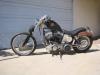
So I’m building up a rigid springer with a shovel motor and want to make it a somewhat performance bike of the pre war era style bikes. I’m trying to decide what size wheels to fit and all the racers of that era had big wheels anything from 19-21” front and rear. I’m guessing it was for better performance? Does anyone know why? And why do modern sports bikes have much smaller wheels now? I’m thinking of fitting a 21” front and a 19 or 21” rear similar to the brough superior racers of the day. I don’t suppose a narrow 20” rim exists that I could build up for the rear?
I'm guessing, but I'd say those large rear wheels were made for top speed.
Those high bank ovals the boardtrackers ran on may as well had been straight line racing compared to the road courses like MotoGP runs today. Those guys ran WFO from start to finish.
Personally, I really like the direction you're looking at. Sounds like a cool build.
20" rims for bicycles are common.
My thought is that the sizes were carried over from bicycles.
It is where the evolution of technology was at. Engines, transmissions and braking all need to be considered.
FWIW I would first consider what type of performance.
Board track (well maybe LOL), ovals, road course, TT. Pavement, dirt, jumps, combos, etc.?
How "hard" or "fast" are you going to ride this bike?
Motocrossers settled on front 21 and I recall even tried 23 in the year 1980s.
Road racers tried as small as front 16 also in the 80.
As perhaps an answer to your question larger fronts smooth bumps and made the front steering lighter.
Not sure about rear sizes, except to say to balance/ keep trail in spec, and wider rears can help with the acceleration traction.
Modern rubber sizes may also be a consideration. Compound and tread pattern.
Then you have the trail and rack mathematics of 21/19 or 19/19 or 17/17 etc. plus the cornering clearance and perhaps even ride height.
Anyway, written as if you did not consider the above.
Really awesome project to mod a classic in regards to performance handling and look to the period-correct insights from mods.
Some say, "Why race if you can't finish on the podium?" LOL.
I think the rim sizes Used for racing back in the day were more so just due to tire/rim size availability at the time. And that’s what most factory bike had prewar.
So I’m building up a rigid springer with a shovel motor and want to make it a somewhat performance bike of the pre war era style bikes. I’m trying to decide what size wheels to fit and all the racers of that era had big wheels anything from 19-21” front and rear. I’m guessing it was for better performance? Does anyone know why? And why do modern sports bikes have much smaller wheels now? I’m thinking of fitting a 21” front and a 19 or 21” rear similar to the brough superior racers of the day. I don’t suppose a narrow 20” rim exists that I could build up for the rear?
Large wheels provide better stability on the straight line. Smaller wheels allow better maneuvering in curves.
Harley-Davidson Fat Boy Becomes a Dark, Decepticon-Inspired Custom
Slideshow: Killer Custom's latest build relies on styling changes rather than performance upgrades, giving the cruiser an entirely different personality.
7 Surprising Harley-Davidson Products that Are Not Motorcycles
Slideshow: The bar-and-shield logo shows up on far more than motorcycles, some of the company's most unexpected products have nothing to do with riding.
Slideshow: From the troubled AMF years to modern misfires, these bikes earned reputations for reliability issues, questionable engineering, or disappointing performance.
Crazy Bunderbike Build Looks Amazing, But Is It Impossible to Ride?
Slideshow: The Swiss custom shop has taken a Harley Softail and stretched it into something so long and low that it looks closer to a rolling sculpture than a conventional motorcycle.
Engraved Rebellion: Inside Bundnerbike's Glam Rock II
Slideshow: A standard cruiser becomes an intricate metal canvas in the hands of a Swiss custom house known for pushing Harley-Davidson platforms far beyond their factory brief.












 Bigger wheels better handling?