




HP vs. TQ

Seasoned HDF Member


Joined: Nov 2004
Posts: 8,129
Likes: 1,981
From: Ottawa, CANADA
 RE: HP vs. TQ
ORIGINAL: sharkey
Here is my dyno. Note that I have 100ft lbs from 2200rpm (Thankyou HQ). When I ride, I normally keep it between 2000 - 4500rpm. After a while you can "feel" it...but when I want some metric cruiser for dessert, it's shifted as it hits6000. From a first gear WOT run, the front wheel will "float" about 6-8 inches thru second then pop up again in third and settle down by the time I grab fourth...all quite quickly. (It don't spend any time in first...) See how that relates to the power curve; or rather, plateau.....
[IMG]local://upfiles/32069/A13065F31C334C19A17B125AF144A17D.jpg[/IMG]
[IMG]local://upfiles/32069/635043C600294724A92737A8466EE504.jpg[/IMG]
Here is my dyno. Note that I have 100ft lbs from 2200rpm (Thankyou HQ). When I ride, I normally keep it between 2000 - 4500rpm. After a while you can "feel" it...but when I want some metric cruiser for dessert, it's shifted as it hits6000. From a first gear WOT run, the front wheel will "float" about 6-8 inches thru second then pop up again in third and settle down by the time I grab fourth...all quite quickly. (It don't spend any time in first...) See how that relates to the power curve; or rather, plateau.....
[IMG]local://upfiles/32069/A13065F31C334C19A17B125AF144A17D.jpg[/IMG]
[IMG]local://upfiles/32069/635043C600294724A92737A8466EE504.jpg[/IMG]
That's a good looking dyno sheet.
What are the specifics of your build and what exhaust are you running, if you don't mind my asking?
I got my heads done by HQ and installed a set of HQ-0039G gear drive cams and an HQ-6104 ignition last winter, which with stock 88" @ 9:1 compression and a crappy tune on my carb gave me 83 hp/89 ft-lbs. This winter I will complete the build by going to 95" @ 10:1 compression and removing the Dynojet kit form my carb and installing the HQ-2525 carb kit.
Thanks.
Cheers!
[sm=icon_rock.gif][sm=icon_rock.gif][sm=icon_rock.gif]

Ultimate HDF Member
Joined: Sep 2007
Posts: 8,831
Likes: 15
From: Nomad
RE: HP vs. TQ
This is an interesting thread! Thanks for getting the ball rolling, Herr Monk, and thanks for all the good replies, everyone. Will look at those links soon.
I'm going to take a shot at being wrong here and WELCOME being corrected.....I'm here to learn
TQ is really a nearly useless quantity unless it is measured at the rear wheel, true? It is a measure of the output of the whole drive train (engine, primary, and tranny). We lose TQ as we approach the upper end of the gear, because with our low-revving air-cooled V-twins, we run out of engine performance (RPMs) to apply power--ergo the diminishing returns at the upper end of any gear. Thus, we gear them to get all the turning force at lower RPMs than a sportbike.
HP is a measure of the engine's capacity to produce power. Period. That's why sportbikes are designed to rev well north of 10K and can do impressive roll-ons at 90mph and accelerate like they are just taking off from a red light. An engine that can produce it's HP across a broader performance (RPM) range will produce more TQ in any gear.
The two quantities have to be considered together: with an engine's given HP, we can manipulate the TQ (output) simply by changing something in the gearing. When we change the gearing to get more off-the-line zip, we sacrifice upper-limit performance. Obvious. The engine/drivetrain can only turn so fast. But when we change something in the engine (cams, exhaust, intake, etc.) we can make it easier for the engine to put out more power at different points in the powerband before max HP is reached., generating more TQ (output) at lower HP/RPMs. Thus, Stage I, Stage II, etc.
Harleys are often able to generate more TQ at a given (low) RPM than a sportbike, but a sportbike can push a lot more HP into any gear. So wen we talk about enjoying the feeling of TQ when we zip around from red light to red light, we are really talking about enjoying the TQ in *that gear* in that (low) RPM range. But when we are doing 50mph in 1st and try to accelerate, we are no longer praising the TQ.
Or at least that's how I understand it. But I'm scratching my head as I type this. I tend to overthink things, and I'm not an engineer. But, I really don't think about this stuff until the bikes are in winter storage and I forget about it in the spring
What I'm really curious about is the limitation of the air-cooled V-twin. Why is it limited to a short powerband? Is it that without the ability to regulate its own temp, the engine will heat up and expand at a certain (high) RPM? And that's why the rev limiters? Total guess--I have no idea.
I'm going to take a shot at being wrong here and WELCOME being corrected.....I'm here to learn
TQ is really a nearly useless quantity unless it is measured at the rear wheel, true? It is a measure of the output of the whole drive train (engine, primary, and tranny). We lose TQ as we approach the upper end of the gear, because with our low-revving air-cooled V-twins, we run out of engine performance (RPMs) to apply power--ergo the diminishing returns at the upper end of any gear. Thus, we gear them to get all the turning force at lower RPMs than a sportbike.
HP is a measure of the engine's capacity to produce power. Period. That's why sportbikes are designed to rev well north of 10K and can do impressive roll-ons at 90mph and accelerate like they are just taking off from a red light. An engine that can produce it's HP across a broader performance (RPM) range will produce more TQ in any gear.
The two quantities have to be considered together: with an engine's given HP, we can manipulate the TQ (output) simply by changing something in the gearing. When we change the gearing to get more off-the-line zip, we sacrifice upper-limit performance. Obvious. The engine/drivetrain can only turn so fast. But when we change something in the engine (cams, exhaust, intake, etc.) we can make it easier for the engine to put out more power at different points in the powerband before max HP is reached., generating more TQ (output) at lower HP/RPMs. Thus, Stage I, Stage II, etc.
Harleys are often able to generate more TQ at a given (low) RPM than a sportbike, but a sportbike can push a lot more HP into any gear. So wen we talk about enjoying the feeling of TQ when we zip around from red light to red light, we are really talking about enjoying the TQ in *that gear* in that (low) RPM range. But when we are doing 50mph in 1st and try to accelerate, we are no longer praising the TQ.
Or at least that's how I understand it. But I'm scratching my head as I type this. I tend to overthink things, and I'm not an engineer. But, I really don't think about this stuff until the bikes are in winter storage and I forget about it in the spring
What I'm really curious about is the limitation of the air-cooled V-twin. Why is it limited to a short powerband? Is it that without the ability to regulate its own temp, the engine will heat up and expand at a certain (high) RPM? And that's why the rev limiters? Total guess--I have no idea.
Seasoned HDF Member
Joined: Nov 2004
Posts: 8,129
Likes: 1,981
From: Ottawa, CANADA
RE: HP vs. TQ
ORIGINAL: faber
This is an interesting thread! Thanks for getting the ball rolling, Herr Monk, and thanks for all the good replies, everyone. Will look at those links soon.
I'm going to take a shot at being wrong here and WELCOME being corrected.....I'm here to learn
TQ is really a nearly useless quantity unless it is measured at the rear wheel, true? It is a measure of the output of the whole drive train (engine, primary, and tranny). We lose TQ as we approach the upper end of the gear, because with our low-revving air-cooled V-twins, we run out of engine performance (RPMs) to apply power--ergo the diminishing returns at the upper end of any gear. Thus, we gear them to get all the turning force at lower RPMs than a sportbike.
HP is a measure of the engine's capacity to produce power. Period. That's why sportbikes are designed to rev well north of 10K and can do impressive roll-ons at 90mph and accelerate like they are just taking off from a red light. An engine that can produce it's HP across a broader performance (RPM) range will produce more TQ in any gear.
The two quantities have to be considered together: with an engine's given HP, we can manipulate the TQ (output) simply by changing something in the gearing. When we change the gearing to get more off-the-line zip, we sacrifice upper-limit performance. Obvious. The engine/drivetrain can only turn so fast. But when we change something in the engine (cams, exhaust, intake, etc.) we can make it easier for the engine to put out more power at different points in the powerband before max HP is reached., generating more TQ (output) at lower HP/RPMs. Thus, Stage I, Stage II, etc.
Harleys are often able to generate more TQ at a given (low) RPM than a sportbike, but a sportbike can push a lot more HP into any gear. So wen we talk about enjoying the feeling of TQ when we zip around from red light to red light, we are really talking about enjoying the TQ in *that gear* in that (low) RPM range. But when we are doing 50mph in 1st and try to accelerate, we are no longer praising the TQ.
Or at least that's how I understand it. But I'm scratching my head as I type this. I tend to overthink things, and I'm not an engineer. But, I really don't think about this stuff until the bikes are in winter storage and I forget about it in the spring
What I'm really curious about is the limitation of the air-cooled V-twin. Why is it limited to a short powerband? Is it that without the ability to regulate its own temp, the engine will heat up and expand at a certain (high) RPM? And that's why the rev limiters? Total guess--I have no idea.
This is an interesting thread! Thanks for getting the ball rolling, Herr Monk, and thanks for all the good replies, everyone. Will look at those links soon.
I'm going to take a shot at being wrong here and WELCOME being corrected.....I'm here to learn
TQ is really a nearly useless quantity unless it is measured at the rear wheel, true? It is a measure of the output of the whole drive train (engine, primary, and tranny). We lose TQ as we approach the upper end of the gear, because with our low-revving air-cooled V-twins, we run out of engine performance (RPMs) to apply power--ergo the diminishing returns at the upper end of any gear. Thus, we gear them to get all the turning force at lower RPMs than a sportbike.
HP is a measure of the engine's capacity to produce power. Period. That's why sportbikes are designed to rev well north of 10K and can do impressive roll-ons at 90mph and accelerate like they are just taking off from a red light. An engine that can produce it's HP across a broader performance (RPM) range will produce more TQ in any gear.
The two quantities have to be considered together: with an engine's given HP, we can manipulate the TQ (output) simply by changing something in the gearing. When we change the gearing to get more off-the-line zip, we sacrifice upper-limit performance. Obvious. The engine/drivetrain can only turn so fast. But when we change something in the engine (cams, exhaust, intake, etc.) we can make it easier for the engine to put out more power at different points in the powerband before max HP is reached., generating more TQ (output) at lower HP/RPMs. Thus, Stage I, Stage II, etc.
Harleys are often able to generate more TQ at a given (low) RPM than a sportbike, but a sportbike can push a lot more HP into any gear. So wen we talk about enjoying the feeling of TQ when we zip around from red light to red light, we are really talking about enjoying the TQ in *that gear* in that (low) RPM range. But when we are doing 50mph in 1st and try to accelerate, we are no longer praising the TQ.
Or at least that's how I understand it. But I'm scratching my head as I type this. I tend to overthink things, and I'm not an engineer. But, I really don't think about this stuff until the bikes are in winter storage and I forget about it in the spring
What I'm really curious about is the limitation of the air-cooled V-twin. Why is it limited to a short powerband? Is it that without the ability to regulate its own temp, the engine will heat up and expand at a certain (high) RPM? And that's why the rev limiters? Total guess--I have no idea.
Now, a huge benefit of a longer stroke engine is that you get a lot of low rpm torque because each power stroke, has a heavier piston traveling a longer distance which creates a "stronger" pulse with each firing of the spark plug.
Hope I got all that right, heheheh...
Cheers!
[sm=icon_rock.gif][sm=icon_rock.gif][sm=icon_rock.gif]

Thread Starter
|
Elite HDF Member
Joined: Sep 2007
Posts: 4,541
Likes: 1
From: Nuevo México, Los Estados Unidos de América
RE: HP vs. TQ
So does that mean that a 103" is a lower reving engine than a 96"?
Seems like by that logic a stroker will have more low-end, and less high-end than an engine with the same bore, and less stroke. Is this true? Do you folks with 103"s and 107"s have to set the rev. limiter lower?
Seems like by that logic a stroker will have more low-end, and less high-end than an engine with the same bore, and less stroke. Is this true? Do you folks with 103"s and 107"s have to set the rev. limiter lower?

Cruiser
Joined: Jul 2006
Posts: 169
Likes: 0
From:
RE: HP vs. TQ
ORIGINAL: Herr Monk
(cut some)
How does tq versus hp at a given rpm translate into acceleration/seat of your pants feeling?
Thanks
(cut some)
How does tq versus hp at a given rpm translate into acceleration/seat of your pants feeling?
Thanks
Ultimate HDF Member
Joined: Sep 2007
Posts: 8,831
Likes: 15
From: Nomad
RE: HP vs. TQ
I get the bore & stroke issue. Thanks for spelling it out, Clammy. Cheers to ya.
Before I got my Harley this year, I messed around with 70s-vintage 650s/750s (Triumphs and Yamahas, mostly--still have a few). But I know what made the Hondas stand out back then was going to the 4 cyl 750 with smaller cylinders/pistons--essentially the first modern sportbike. But they just don't have the low-end pull of my old Bonnie or XS650s. That's my simple-minded way of understanding the difference between HP & TQ.
But.....the L-twin in the Ducati 1098 puts out 180hp stock! With 99 ft-lbs TQ (at a slightly lower RPM then peak HP, I'm guessing.) Calling that bike stock is like calling a Lamborghini stock, I know. The bore is bigger than HD but the stroke is shorter, as I recall (someone can look it up). So...more piston mass through a shorter range of motion and thus able to rev higher, I guess? And maybe the 90° angle gives engineers a little more breathing room to design for higher output (RPMs), as opposed to our iconic 45° twin. But the Ducati also is liquid-cooled and street-legal AND track ready--no Stage I/II, etc.
So, it's not the air-cooled issue that has us HD owners tuning for TQ, but the long-stroke V-twin. I guess I've been misled by those who hope that HD releases a liquid-cooled V-twin for the whole line. That would be good for other reasons, I guess, but not necessarily affect HP/TQ, right?
Winter storage.....
Before I got my Harley this year, I messed around with 70s-vintage 650s/750s (Triumphs and Yamahas, mostly--still have a few). But I know what made the Hondas stand out back then was going to the 4 cyl 750 with smaller cylinders/pistons--essentially the first modern sportbike. But they just don't have the low-end pull of my old Bonnie or XS650s. That's my simple-minded way of understanding the difference between HP & TQ.
But.....the L-twin in the Ducati 1098 puts out 180hp stock! With 99 ft-lbs TQ (at a slightly lower RPM then peak HP, I'm guessing.) Calling that bike stock is like calling a Lamborghini stock, I know. The bore is bigger than HD but the stroke is shorter, as I recall (someone can look it up). So...more piston mass through a shorter range of motion and thus able to rev higher, I guess? And maybe the 90° angle gives engineers a little more breathing room to design for higher output (RPMs), as opposed to our iconic 45° twin. But the Ducati also is liquid-cooled and street-legal AND track ready--no Stage I/II, etc.
So, it's not the air-cooled issue that has us HD owners tuning for TQ, but the long-stroke V-twin. I guess I've been misled by those who hope that HD releases a liquid-cooled V-twin for the whole line. That would be good for other reasons, I guess, but not necessarily affect HP/TQ, right?
Winter storage.....
Grand HDF Member

Joined: May 2007
Posts: 3,870
Likes: 499
From: Alberta
RE: HP vs. TQ
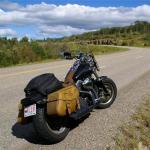
Clammy; mine is a 103 with hq heads, ign, 033G cams, 51CV and the dyno was done with 2" Cycle Shacks. I've since put on V&H stepped drags with quiet baffles (Pictured...)
One of my brothers has a very stout 95" by HQ with the 39 cams; believe he's at 100/100 with lots of torque down low...bikes built for his 300lb carcass...
Gone for a week now; see ya'll later.....
[IMG]local://upfiles/32069/E965C38ED6704C58B58FCB58A70F78AE.jpg[/IMG]
One of my brothers has a very stout 95" by HQ with the 39 cams; believe he's at 100/100 with lots of torque down low...bikes built for his 300lb carcass...
Gone for a week now; see ya'll later.....
[IMG]local://upfiles/32069/E965C38ED6704C58B58FCB58A70F78AE.jpg[/IMG]
HD Forum Stories
The Best of Harley-Davidson for Lifelong Riders

7 Surprising Harley-Davidson Products that Are Not Motorcycles
Verdad Gallardo
8 Best Harley-Davidson Motorcycles Ever
Pouria Savadkouei
10 Worst Harley-Davidson Motorcycles Ever
Pouria Savadkouei
Killer Custom's Jail Break Is The Breakout That Refused to Blend In
Verdad Gallardo
Crazy Bunderbike Build Looks Amazing, But Is It Impossible to Ride?
Verdad Gallardo
Harley-Davidson Reveals Super Cool Cafe Racer Concept
Verdad Gallardo
Engraved Rebellion: Inside Bundnerbike's Glam Rock II
Verdad Gallardo
10 Motorcycles You Should Never Buy
Joe Kucinski
10 Things Harley-Davidson Needs to Fix in 2026
Verdad Gallardo
Road Warrior
Joined: May 2007
Posts: 1,620
Likes: 117
From: ARIZONA
RE: HP vs. TQ
Only time you'd honestly EVER need to worry about when and where your engine is making power is when your racing... be it for money, slips, braket racing ect.
as others have stated, use yer butt and yer head and the situation involved to figure when to shift.
as others have stated, use yer butt and yer head and the situation involved to figure when to shift.
Seasoned HDF Member
Joined: Nov 2004
Posts: 8,129
Likes: 1,981
From: Ottawa, CANADA
RE: HP vs. TQ
ORIGINAL: sharkey
Clammy; mine is a 103 with hq heads, ign, 033G cams, 51CV and the dyno was done with 2" Cycle Shacks. I've since put on V&H stepped drags with quiet baffles (Pictured...)
One of my brothers has a very stout 95" by HQ with the 39 cams; believe he's at 100/100 with lots of torque down low...bikes built for his 300lb carcass...
Gone for a week now; see ya'll later.....
[IMG]local://upfiles/32069/E965C38ED6704C58B58FCB58A70F78AE.jpg[/IMG]
Clammy; mine is a 103 with hq heads, ign, 033G cams, 51CV and the dyno was done with 2" Cycle Shacks. I've since put on V&H stepped drags with quiet baffles (Pictured...)
One of my brothers has a very stout 95" by HQ with the 39 cams; believe he's at 100/100 with lots of torque down low...bikes built for his 300lb carcass...
Gone for a week now; see ya'll later.....
[IMG]local://upfiles/32069/E965C38ED6704C58B58FCB58A70F78AE.jpg[/IMG]
Cheers!
[sm=icon_rock.gif][sm=icon_rock.gif][sm=icon_rock.gif]