When you click on links to various merchants on this site and make a purchase, this can result in this site earning a commission. Affiliate programs and affiliations include, but are not limited to, the eBay Partner Network.
General Topics/Tech TipsDiscussion on break in periods, rider comfort, seats and pad suggestions. Tech tips as they become available will be posted here.
nice 2 angle valve seat, always used my dads Hall oscillating grinder. DO you have to lap the carbide cut seat before assembly?
I did lap them, but chiefly to confirm the width and location of the sealing angle on the valve (see pic). Here, you can see I just barely stayed on the valve's sealing angle--but obviously if I'd have cut deeper, the sealing band would've been better centered. I did it this way because I wanted whatever settling that might occur to result in longer valve life. The cutters leave a really smooth face on the seat, but lapping can't hurt!
This valve job ran for several thousand miles before I rebuilt the bottom end, and has now been running for over six thousand since I DIY supercharged my Midget, which runs about 5 psi (at 6,000 ft.) on stock 8.8:1 pistons. No issues.
Oh, P.S. - it's actually a three-angle job. The final 'exit' angle is that narrow bright stripe at the bottom (toward the head) of the pink sealing band. Kinda hard to see--and really gravy, as you can see the beginning of the port I left alone, so the third angle isn't really doing anything. I think I just got eager to get the darned thing on the road again, so stopped short of porting the head, too!
You can get away with running lower octane, but I always run the highest I can in my bikes, even my Pan. I did have to replace the guides in the Panhead when lead was phased out as the lack of lubricity caused some galling and wear. Try to avoid ethanol as much as you can. Chances are even with low octane fuel you won't get pinging unless you set a lot of advance.
I remember when the 76 station down the road was selling 102 octane leaded for under a buck a gallon. Good times!
yep, the aluminum heads have steel seats. i never had issues with my 74fxe. now the smaller displacement 74ch did have some issue when ambient temps were high mostly at clutch off or roll on but if the rpm was up, no problem, these engines do not like lugging!
You can get away with running lower octane, but I always run the highest I can in my bikes, even my Pan. I did have to replace the guides in the Panhead when lead was phased out as the lack of lubricity caused some galling and wear. Try to avoid ethanol as much as you can. Chances are even with low octane fuel you won't get pinging unless you set a lot of advance.
Okay, good info--thanks. I will make sure that the guides if not worn out are appropriate for today's no-lead gas. I assume they sell bronze guides for Shovelheads.
They do sell premium in the low '90s in NM pretty universally, so I should be fine for in-state putts. If I can afford to take time off next year, I'd like to take some road trips, like maybe out Route 66 in an easterly direction and for sure out to the Pacific. So, good to know I can get by without too much fiddling with the distributor.
I'm getting one of those Saddleman Tactical Tunnel Bags and plan on mounting a reproduction chrome rack to the rear fender (though the thing looks awfully cool bare, as seen in these pics). Looks like the Saddleman would hold enough stuff and keep the load above the top shotgun pipe. I just don't like riding long distances (or at all, really) with a backpack...
yep, the aluminum heads have steel seats. i never had issues with my 74fxe. now the smaller displacement 74ch did have some issue when ambient temps were high mostly at clutch off or roll on but if the rpm was up, no problem, these engines do not like lugging!
Cool, thanks. I do have a tall sprocket, 25 teeth I think, because people drive so fast in NM that it's unsafe to go slower than 70~75 on the interstate--and then you'd better be in the right-hand lane. I am installing an oil cooler and spin-on filter (which should fit right-rear just under the lower shotgun pipe - see pic of similar exhaust), so I'm hoping that will help on hotter high desert days.
Run the highest octane pump gas you can find from Top Tier stations (no Wal-Mart or 7-11 etc), period. And if there is non ethanol fuel available at the same octane, pay more for that if necessary.
Shovelheads, like mostly all older bikes, do not have a detonation sensor to retard the igintion. Detonation is bad for the engine and can burn the top off the piston. I assume you are still running points and manual advance so I'd watch out for pinging on hot days and retard the timing if necessary.
I ran the OEM seats on my 1976 FXE until I sold it in 2002 with no problems. I owned it since 1976 and had the top end apart several times and never noticed any excessive wear or other problems with the seats. If yours are worn out or nearly so, definately replace them with hardened seats and valves.
If you replace the valve guides, you must clean all the carbon off the bottom of the guides before driving them out. Otherwise the carbon will gouge the guide holes in the heads and oil can leak into the port and cylinder though the gouges. On shovelheads, the rocker arm geometry tends to push the valve stem sideways, so I'd wouldn't run bronze guides because they are too soft and wear out quickly. On a street bike, I'd run the cast iron guides instead. Kibblewhite of Manley is typically what I used.
Run the highest octane pump gas you can find from Top Tier stations (no Wal-Mart or 7-11 etc), period. And if there is non ethanol fuel available at the same octane, pay more for that if necessary.
Shovelheads, like mostly all older bikes, do not have a detonation sensor to retard the igintion. Detonation is bad for the engine and can burn the top off the piston. I assume you are still running points and manual advance so I'd watch out for pinging on hot days and retard the timing if necessary.
I ran the OEM seats on my 1976 FXE until I sold it in 2002 with no problems. I owned it since 1976 and had the top end apart several times and never noticed any excessive wear or other problems with the seats. If yours are worn out or nearly so, definately replace them with hardened seats and valves.
If you replace the valve guides, you must clean all the carbon off the bottom of the guides before driving them out. Otherwise the carbon will gouge the guide holes in the heads and oil can leak into the port and cylinder though the gouges. On shovelheads, the rocker arm geometry tends to push the valve stem sideways, so I'd wouldn't run bronze guides because they are too soft and wear out quickly. On a street bike, I'd run the cast iron guides instead. Kibblewhite of Manley is typically what I used.
Paul
Paul,
This is great, useful information--thank you.
My bike still has points (and starts easily), but the distributor is an 'auto-advance' unit, so I assume uses centrifugal weights and springs like most distributors of that simple design. I didn't remove the plate when installing new points, just lubed the cam. But I assume that's what is under there. Reminds me, I need to get a spare set of springs for the weights and toss them in the onboard tool kit with the spare points and condenser.
I'm glad to hear the valve seats on Shovelheads are durable. The heads on this Pan-Shovel are from a '66, if I'm deciphering the Harley parts numbers correctly: 05 66 (front head) 07 66 (rear head).
Thanks for the tips on installing guides. Great to hear from someone with hands-on experience what the good quality stuff is. This will give me some confidence for my first shakedown cruise--out to El Cabezon in Indian Country west of Bernalillo. If that goes well, I'll drive her up to my brother's cabin in the Jemez above Cuba. The neighbor's cabin is even higher, around 9,000 ft., so it'll be interesting to see how the Super E handles the elevation change, roughly 4,000 ft. up from Bernalillo.
If it needs guides, heat the head and freeze the new guides before installing them. I always used a very little bit Hylomar at the top of the guides by the flange to ensure a good seal. If the seats are worn out, take the heads to a good machine shop and let them do the work because you don't want a seat coming lose in a running engine.
Most guides are tapered at the bottom to help get them started straight, so if you don't have a fixture to install the guides, start slow to keep them straight or you will never get the seats cut correctly. When you cut the seats, if you have them installed straight you will have to cut off very little seat material and they will be concentric. Otherwise the guide is not installed straight and you will never get them cut correctly. One side of the seat will be wide and the other narrow.
Yes, it sounds like you have early short reach plug heads. They are ok, but have some weak places so I wouldn't grind on them or try to port them. Most people install valve stem seals. And I would check the cylinders for roundness and taper. If they are straight and round, lightly hone and install new rings. Check the rocker arms for wear or pits where they contact the valve stems.
Auto advance is fine, just make sure the advance weights move freely and it is timed correctly.
If it needs guides, heat the head and freeze the new guides before installing them. I always used a very little bit Hylomar at the top of the guides by the flange to ensure a good seal. If the seats are worn out, take the heads to a good machine shop and let them do the work because you don't want a seat coming lose in a running engine.
Most guides are tapered at the bottom to help get them started straight, so if you don't have a fixture to install the guides, start slow to keep them straight or you will never get the seats cut correctly. When you cut the seats, if you have them installed straight you will have to cut off very little seat material and they will be concentric. Otherwise the guide is not installed straight and you will never get them cut correctly. One side of the seat will be wide and the other narrow.
Yes, it sounds like you have early short reach plug heads. They are ok, but have some weak places so I wouldn't grind on them or try to port them. Most people install valve stem seals. And I would check the cylinders for roundness and taper. If they are straight and round, lightly hone and install new rings. Check the rocker arms for wear or pits where they contact the valve stems.
Auto advance is fine, just make sure the advance weights move freely and it is timed correctly.
Paul
Fantastic detail - much appreciated.
Yes, first thing I did was install new points and time her to ride home (just a few blocks and very c-a-r-e-f-u-l-l-y on rotted tires). Started on the second or third kick.
Hylomar: I actually have a tube I bought for some task on the blown Midget and didn't end up using it. So, I'm happy to have a use for it. I see that the Kibblewhite cast iron guides say they need machining to accept the stem seals. Just a little groove above the flange for the seal to cling to?
For sure, the seats in the earlier picture I posted were installed by the local shop, Knighton's (which recently closed after 50+ years--my 1275cc A-Series was one of their last engines). I restricted my role to cutting them, same care as you suggest.
Ah, okay, I didn't know there were longer-reach heads later on. Good to know I should leave them be re: the ports. But I probably would've left them alone, as this is a highway cruiser and 'you forgot the milk!' retriever; I won't be racing anybody. I do intend to go over the rockers carefully; I've got new bushes and shims, etc. Very eager to see how this engine looks inside.
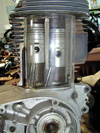
Okay, for sure I'll mic the cylinders (and pistons). I bought Cometic MLS gaskets, as they've been 100% leak proof in the A-Series running 8.8:1 pistons @ 5 psi of boost, so I figure they'd keep this engine oil tight on top. I was told the engine was driven maybe 5,000 miles after a rebuild just before my neighbor bought the bike and essentially parked it 15 years ago. The tranny has no discernible wear, so she may be giving me the straight poop. We'll soon see...
7 Surprising Harley-Davidson Products that Are Not Motorcycles
Slideshow: The bar-and-shield logo shows up on far more than motorcycles, some of the company's most unexpected products have nothing to do with riding.
Slideshow: From the troubled AMF years to modern misfires, these bikes earned reputations for reliability issues, questionable engineering, or disappointing performance.
Crazy Bunderbike Build Looks Amazing, But Is It Impossible to Ride?
Slideshow: The Swiss custom shop has taken a Harley Softail and stretched it into something so long and low that it looks closer to a rolling sculpture than a conventional motorcycle.
Engraved Rebellion: Inside Bundnerbike's Glam Rock II
Slideshow: A standard cruiser becomes an intricate metal canvas in the hands of a Swiss custom house known for pushing Harley-Davidson platforms far beyond their factory brief.
Slideshow: Harley-Davidson's challenges aren't abstract; they show up in dropping shipments, shrinking dealer traffic, and strategic decisions that aren't yet translating into growth.