



65 XLCH ironhead help

Stellar HDF Member

Joined: Feb 2006
Posts: 3,035
Likes: 17
From: Houston Texas
 RE: 65 XLCH ironhead help
Patrick.....
Something got lost in the translation here.
I said 1972 in reference to the engine the man now has. Not implying that the wet clutch was the great event of 1972.
The great event of 1971 was the wet clutch arriving, as you well know.
My 1971 has a wet clutch. It is by far the best thing that ever happened to a Sportster.
I rode a 1961 XLCH in Class C TT races for a number of years.
I had two KRs that I rode during this same time frame. One was a dirt tracker and the other was a road race machine.
All three machines had the dry clutch
. All three have caused me clutch pain.
Aligning the outer clutch plate is a pain.
Keeping the oil off the clutch plates is a pain.
Maintaining the clutch rod and the crappy mechanism on the right side k/s cover where the cable attaches is a pain.
Can you hear me now? I have had a lot of experience with dry clutches on race tracks and cannot think of one single good feature that they had. I guess that is why the dry clutch disappeared, don't you think?
If they were any good HD would have kept them and saved many $$$ in retooling cost needed to proceed to the next step, aka the wet clutch.
If you were around here back in those days, working on and riding the bikes yourself, I think you may be singing a different tune.........pg
Something got lost in the translation here.
I said 1972 in reference to the engine the man now has. Not implying that the wet clutch was the great event of 1972.
The great event of 1971 was the wet clutch arriving, as you well know.
My 1971 has a wet clutch. It is by far the best thing that ever happened to a Sportster.
I rode a 1961 XLCH in Class C TT races for a number of years.
I had two KRs that I rode during this same time frame. One was a dirt tracker and the other was a road race machine.
All three machines had the dry clutch
. All three have caused me clutch pain.
Aligning the outer clutch plate is a pain.
Keeping the oil off the clutch plates is a pain.
Maintaining the clutch rod and the crappy mechanism on the right side k/s cover where the cable attaches is a pain.
Can you hear me now? I have had a lot of experience with dry clutches on race tracks and cannot think of one single good feature that they had. I guess that is why the dry clutch disappeared, don't you think?
If they were any good HD would have kept them and saved many $$$ in retooling cost needed to proceed to the next step, aka the wet clutch.
If you were around here back in those days, working on and riding the bikes yourself, I think you may be singing a different tune.........pg
Club Member
Joined: Feb 2008
Posts: 18,575
Likes: 4
From: Norfolk, VA
RE: 65 XLCH ironhead help
Super,
You did GOOD! I got my 900 in 1986 for $2K.....The 'ol 900's are VERY hard to get for a reasonable price nowadays.....You will certainly turn some heads goin' down the road because there just aren't many 900's still doin' street service.
You did GOOD! I got my 900 in 1986 for $2K.....The 'ol 900's are VERY hard to get for a reasonable price nowadays.....You will certainly turn some heads goin' down the road because there just aren't many 900's still doin' street service.
Club Member
Joined: Feb 2008
Posts: 18,575
Likes: 4
From: Norfolk, VA
RE: 65 XLCH ironhead help
I heard that! I ran a set of "wet" Barnett friction plates in my 900 for years and had no problems other than those damn clutch pushrods that run through the main-shaft to disengage the clutch....Those pushrodswear with the stiffer clutch spring pressure needed to keep the clutch from slipping and need constant end-play adjustment.......Find neutral before stopping because those pushrods will grind down and cause embarassment.....

Advanced
Joined: Jul 2006
Posts: 50
Likes: 0
From:
RE: 65 XLCH ironhead help
Hi Pinion...
I'm not saying the H-D dry clutch is the best thing since sliced bread, just that I like it better than the wet one!!! And sorry for not remembering the wet came in 71!!!!!!!!
I was a bit too young to be going racing in the sixties, but, riding Sportsters since the early eighties, I know which one I feel happy with. Yes they have their faults, but their advantages outweight all their defects and the onesI found on the wet set up (crappy lifter, too many plates for decent release, totally unadjustable, drag or slip: the margin is tight...). Going through busy towns with my 76 XLH or my XLCR soon cured me of any love I might have had for the wet one... As I've said, I'm not the Hulk!!!
By the way, H-D generally NEVER changed to something because it was better, more like they change things when they find a cheaper way to do it!!! Specially in the AMF and later years.
Patrick
I'm not saying the H-D dry clutch is the best thing since sliced bread, just that I like it better than the wet one!!! And sorry for not remembering the wet came in 71!!!!!!!!
I was a bit too young to be going racing in the sixties, but, riding Sportsters since the early eighties, I know which one I feel happy with. Yes they have their faults, but their advantages outweight all their defects and the onesI found on the wet set up (crappy lifter, too many plates for decent release, totally unadjustable, drag or slip: the margin is tight...). Going through busy towns with my 76 XLH or my XLCR soon cured me of any love I might have had for the wet one... As I've said, I'm not the Hulk!!!
By the way, H-D generally NEVER changed to something because it was better, more like they change things when they find a cheaper way to do it!!! Specially in the AMF and later years.
Patrick
Stellar HDF Member
Joined: Feb 2006
Posts: 3,035
Likes: 17
From: Houston Texas
RE: 65 XLCH ironhead help
I guess we cannot agree on much.
In my opinion, and that's all it is, the best thing to happen to a Sportster was the wet clutch.
The best thing to happen to Harley was when the family bought back the company.
However, the second best thing to happen to Harley was when AMF bought them.
The infusion of huge amounts of AMF money is what kept the Motor Company alive until a time that it could be taken back over. The life of those who did so was not an easy one for a number of years after the buyout either.
But without the AMF I really think Harley Davidson would have been out of business.
Prior to AMF Harley was a different place. The union workers were a pain in the ***. They were never happy. There were strikes. There was sabotage on the assembly line.
In one incident that I recall clearly, the workers were going to go on strike back around 1962. They would run an ice pick into new innertubes just before they went into the box to be shipped to a dealer.
The dealer who I rode for got hit so bad he almost went out of business at that time. The trick the union jerks came up with was to fail to case harden an FLH's piniongear. The bikes shipped out to dealers with this defect. (You may note I take my handle from the incident)
Back then the cost of the gear was $6.
Here is the way the warranty worked: The Motor Company warranty covered the parts replacement cost. Their partner (the dealer) covered the labor cost for any bike he sold.
The owner of my race bikes sold 20 FLH machines to the Pasadena (Texas) Police Dept.
This was the biggest one time sale he had ever made. All 20 bikes sheared the teeth on the pinion. You have any idea of how much labor it takes to replace the $6 pinion gear on 20 FLH machines? A lot! Add to that he was a one man shop, and it almost put him out of business.
So, from my prospective.....AMF was a very good thing. The end result of it all is today's Harley Davidson is the finest machine the Motor Company has ever made. People are always going to complain. Let them!
Back in the AMF days everyone complained about how AMF was ruining the company. I believe that is where this AMF legend got started and you see it parrotted today by a lot of people who were not even born yet in the1960's. They simply repeat what they have heard and carry this mis-informed idea forward.
The great thing is we can each have our own opinion about things, and as one who was there at AMF time, and can look back and see what the trail looks like, it was a good thing........pg
In my opinion, and that's all it is, the best thing to happen to a Sportster was the wet clutch.
The best thing to happen to Harley was when the family bought back the company.
However, the second best thing to happen to Harley was when AMF bought them.
The infusion of huge amounts of AMF money is what kept the Motor Company alive until a time that it could be taken back over. The life of those who did so was not an easy one for a number of years after the buyout either.
But without the AMF I really think Harley Davidson would have been out of business.
Prior to AMF Harley was a different place. The union workers were a pain in the ***. They were never happy. There were strikes. There was sabotage on the assembly line.
In one incident that I recall clearly, the workers were going to go on strike back around 1962. They would run an ice pick into new innertubes just before they went into the box to be shipped to a dealer.
The dealer who I rode for got hit so bad he almost went out of business at that time. The trick the union jerks came up with was to fail to case harden an FLH's piniongear. The bikes shipped out to dealers with this defect. (You may note I take my handle from the incident)
Back then the cost of the gear was $6.
Here is the way the warranty worked: The Motor Company warranty covered the parts replacement cost. Their partner (the dealer) covered the labor cost for any bike he sold.
The owner of my race bikes sold 20 FLH machines to the Pasadena (Texas) Police Dept.
This was the biggest one time sale he had ever made. All 20 bikes sheared the teeth on the pinion. You have any idea of how much labor it takes to replace the $6 pinion gear on 20 FLH machines? A lot! Add to that he was a one man shop, and it almost put him out of business.
So, from my prospective.....AMF was a very good thing. The end result of it all is today's Harley Davidson is the finest machine the Motor Company has ever made. People are always going to complain. Let them!
Back in the AMF days everyone complained about how AMF was ruining the company. I believe that is where this AMF legend got started and you see it parrotted today by a lot of people who were not even born yet in the1960's. They simply repeat what they have heard and carry this mis-informed idea forward.
The great thing is we can each have our own opinion about things, and as one who was there at AMF time, and can look back and see what the trail looks like, it was a good thing........pg
Cruiser
Joined: Mar 2008
Posts: 113
Likes: 0
From:
RE: 65 XLCH ironhead help
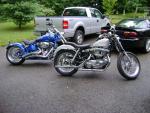
Thanks piniongear. It's very refreshing to here someone with real knowledge of the early days talk about the myths of the AMF's. As we all know there are problems with all productionperiods and there always will be, whetherthe 1970's or 2008. I'm proud to ride my 73 AMFXLCH. 35 years old, allstock, all original (except paint and pipes)and a real eye catcher. I appreciate you sharing your knowledge of the older bikes. All anyone has to do is go to a shop, ask for help on one of these bikes and get the "deer in the headlights look" from the new era service people. They admire them, but are lost. Hell, my bike is older than they are, ha ha.
Stellar HDF Member
Joined: Feb 2006
Posts: 3,035
Likes: 17
From: Houston Texas
RE: 65 XLCH ironhead help
Ahem Bro.
And to all of you out there on this forum, I apologize to you for the rant that I got onto. I just feel strongly about some things and when I see information that I feel is incorrect, I have this burning desire to run my yap off. A bit like a barking dog. Sorry..........pg
And to all of you out there on this forum, I apologize to you for the rant that I got onto. I just feel strongly about some things and when I see information that I feel is incorrect, I have this burning desire to run my yap off. A bit like a barking dog. Sorry..........pg
Advanced
Joined: Jul 2006
Posts: 50
Likes: 0
From:
RE: 65 XLCH ironhead help
Hi Pinion,
Thought you might like to read this, it's from Jesse O'Brien, brother of Dick of H-D racing fame. He did work for a while at H-D after a long spell at NASA...
"Goodbye NASA, Hello Harley-Davidson
2000 others and I left the Space Program and I went to work for a H-D dealer in Fort Lauderdale for six months building his son's race bikes. I then got a call from Dick who asked me to come up and go to work for the factory. So that winter I came to Milwaukee just in middle of a 12" snow drop. The kids loved the snow, but my wife was ready to leave me. I told her Milwaukee was not like Florida and that it was a dry cold and not so bad. When it got to minus 20 degrees, she called me an Irish liar. I spent about six months in training in all departments. Engineering, Design, Sales, Parts,Production, Quality Control and answering service calls. My territory was to cover 120plus dealers in 13 states covering the Midwest.
I would visit the dealers in summer and spend part of winter teaching service school. I had to teach and service all bikes, snowmobiles, golf cars, both gas and electric. It was when I was working in quality control that I knew Harley-Davidson was in big trouble. The QC manager also worked at the Cape and came to H-D a couple years ahead of me. He had meinspecting parts and overseeingmachining. Before long I'm scraping what seems to be a heck of a lot of parts. He came up to me one day and said, "It's not like NASA, is it?” I asked him how much stuff is being scraped and he said about 70% that is if we can't rig or patch it in order keep the production line going. My first run, of all things, was with Dave Mortin who was John Davidson's Nephew. I just finished doing a magnaflux on 250 flywheel pinion shafts for the Sportster to see if there were flaws from heat-treating and they all had cracks and had to be tagged scrap. About this time, this guy is tearing my tags off the box so I asked him who he was and what authority gave him the right to remove those tags. He told me he was production line manager and they were out of pinion shafts on the line... I informed him that these shafts could break and send the flywheels flying out of the crankcases and cost the dealers a lot of money. He then loaded up the cases on a dolly, turned around, looked at me and said "Nuts on the dealers, we'll sent them replacement parts”. The QC manager walked up to me laughing and said, "welcome to real Harley-Davidson".
Teaching Service School is hazardous to one’s health…
Teaching service school at Harley-Davidson was a test on one’s nerves. The room was about 40 feet square and had five workbenches, for 6 people around each bench on stools. One bench for FL, one for XL, one for Aermacchi, one for shop practice and last, one for electrical systems. You couldn't talk loud for disrupting other benches and at the same time you could hear the noise from the experimental dept’s dyno, humming down stairs AND the racing dept’s dyno, right next door!!! To top this, the room was cold and there was the constant dust from the pipes high on the open ceiling. We use to take the students (mostly dealer’s mechanics) on factory assembly and production lines tours until they noticed the union production line people were not properly assembling the engines . When we got back to class, the students asked if they were to do as we taught them or as factory did it? From that point on we skipped the tours...
"On the road as a H-D service rep
[size=3]I get issued a Chevy Impala and I'm out to serve 120 dealers in thirteen states and all of Canada from Michigan across North Dakota… I was glad to get out of that depressing factory. I was one of only four ser
Thought you might like to read this, it's from Jesse O'Brien, brother of Dick of H-D racing fame. He did work for a while at H-D after a long spell at NASA...
"Goodbye NASA, Hello Harley-Davidson
2000 others and I left the Space Program and I went to work for a H-D dealer in Fort Lauderdale for six months building his son's race bikes. I then got a call from Dick who asked me to come up and go to work for the factory. So that winter I came to Milwaukee just in middle of a 12" snow drop. The kids loved the snow, but my wife was ready to leave me. I told her Milwaukee was not like Florida and that it was a dry cold and not so bad. When it got to minus 20 degrees, she called me an Irish liar. I spent about six months in training in all departments. Engineering, Design, Sales, Parts,Production, Quality Control and answering service calls. My territory was to cover 120plus dealers in 13 states covering the Midwest.
I would visit the dealers in summer and spend part of winter teaching service school. I had to teach and service all bikes, snowmobiles, golf cars, both gas and electric. It was when I was working in quality control that I knew Harley-Davidson was in big trouble. The QC manager also worked at the Cape and came to H-D a couple years ahead of me. He had meinspecting parts and overseeingmachining. Before long I'm scraping what seems to be a heck of a lot of parts. He came up to me one day and said, "It's not like NASA, is it?” I asked him how much stuff is being scraped and he said about 70% that is if we can't rig or patch it in order keep the production line going. My first run, of all things, was with Dave Mortin who was John Davidson's Nephew. I just finished doing a magnaflux on 250 flywheel pinion shafts for the Sportster to see if there were flaws from heat-treating and they all had cracks and had to be tagged scrap. About this time, this guy is tearing my tags off the box so I asked him who he was and what authority gave him the right to remove those tags. He told me he was production line manager and they were out of pinion shafts on the line... I informed him that these shafts could break and send the flywheels flying out of the crankcases and cost the dealers a lot of money. He then loaded up the cases on a dolly, turned around, looked at me and said "Nuts on the dealers, we'll sent them replacement parts”. The QC manager walked up to me laughing and said, "welcome to real Harley-Davidson".
Teaching Service School is hazardous to one’s health…
Teaching service school at Harley-Davidson was a test on one’s nerves. The room was about 40 feet square and had five workbenches, for 6 people around each bench on stools. One bench for FL, one for XL, one for Aermacchi, one for shop practice and last, one for electrical systems. You couldn't talk loud for disrupting other benches and at the same time you could hear the noise from the experimental dept’s dyno, humming down stairs AND the racing dept’s dyno, right next door!!! To top this, the room was cold and there was the constant dust from the pipes high on the open ceiling. We use to take the students (mostly dealer’s mechanics) on factory assembly and production lines tours until they noticed the union production line people were not properly assembling the engines . When we got back to class, the students asked if they were to do as we taught them or as factory did it? From that point on we skipped the tours...
"On the road as a H-D service rep
[size=3]I get issued a Chevy Impala and I'm out to serve 120 dealers in thirteen states and all of Canada from Michigan across North Dakota… I was glad to get out of that depressing factory. I was one of only four ser
HD Forum Stories
The Best of Harley-Davidson for Lifelong Riders

7 Surprising Harley-Davidson Products that Are Not Motorcycles
Verdad Gallardo
8 Best Harley-Davidson Motorcycles Ever
Pouria Savadkouei
10 Worst Harley-Davidson Motorcycles Ever
Pouria Savadkouei
Killer Custom's Jail Break Is The Breakout That Refused to Blend In
Verdad Gallardo
Crazy Bunderbike Build Looks Amazing, But Is It Impossible to Ride?
Verdad Gallardo
Harley-Davidson Reveals Super Cool Cafe Racer Concept
Verdad Gallardo
Engraved Rebellion: Inside Bundnerbike's Glam Rock II
Verdad Gallardo
10 Motorcycles You Should Never Buy
Joe Kucinski
10 Things Harley-Davidson Needs to Fix in 2026
Verdad Gallardo
Advanced
Joined: Jul 2006
Posts: 50
Likes: 0
From:
RE: 65 XLCH ironhead help
Don't get me wrong, Pinion,
I don't hate AMF bikes!!!! It's just that I think they tried too hard to up the production, got new unexperiencedand too numerous employees to cope with the increase, open new factory in Yorketc...
Still, my best Sportster ever was my 76 XLH, a cracker... Still hate its clutch but there you go... It eventually went in a bang one day while drafting a Jaguar type E flat out on the motorway, speedo and tacho needles on their stopbut speedstill rising...
If you want to read all the Jesse's articles,they're on my site:
http://www.harleykrxlrtt.com/jesse.htm
There's quite a bit on his famous brother, Dick, who's one of my heroes as well... H-D could have done better by having more dedicated people like him at all stages of production. Even he had to cope with in-fighting in his then very small department, Ralph Bernt comes to mind...
Yes, as soon as he retired in late 1983, the race shop went to pots. These days, it's just a memory. The last one standing was Pieter Zylstra, he came in 1969 on a 3 months contract from Holland to draft the Iron XR and was still there, updating the Alloy one, until quite recently. He must be on the brink or just retired now...
Tell us more about your KR days... I have a 1966 XLRTT, what a brute!!!
That's Dick in the late 40's in his dirt car days:

Patrick
I don't hate AMF bikes!!!! It's just that I think they tried too hard to up the production, got new unexperiencedand too numerous employees to cope with the increase, open new factory in Yorketc...
Still, my best Sportster ever was my 76 XLH, a cracker... Still hate its clutch but there you go... It eventually went in a bang one day while drafting a Jaguar type E flat out on the motorway, speedo and tacho needles on their stopbut speedstill rising...
If you want to read all the Jesse's articles,they're on my site:
http://www.harleykrxlrtt.com/jesse.htm
There's quite a bit on his famous brother, Dick, who's one of my heroes as well... H-D could have done better by having more dedicated people like him at all stages of production. Even he had to cope with in-fighting in his then very small department, Ralph Bernt comes to mind...
Yes, as soon as he retired in late 1983, the race shop went to pots. These days, it's just a memory. The last one standing was Pieter Zylstra, he came in 1969 on a 3 months contract from Holland to draft the Iron XR and was still there, updating the Alloy one, until quite recently. He must be on the brink or just retired now...
Tell us more about your KR days... I have a 1966 XLRTT, what a brute!!!
That's Dick in the late 40's in his dirt car days:
Patrick