




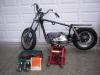
1973 ironhead sportster XLH, First ever build
Thread Starter
|
Intermediate
Joined: Feb 2014
Posts: 28
Likes: 0
From: NE Ohio

Thanks for the info, I guess I am getting ahead of my self. Just figured since the jugs/heads were off I should take the opportunity to do something. I have searched the service manual and cant find anywhere that tells me what the cylinders should be mic at. I do have access to a machine shop that can mic. the cylinders but not able to do the work. But as said before, he can refer me to someone that can do the work. My question, when measuring the ID of the cylinders. What should I be looking at as far as stock/board numbers. Just looking for an idea so I don't get screwed into something I don't need.
In the 99848-78 factory service manual see page 1-1 for the stock bore size. Then page 3-1 gives the piston fit-in-cylinder, ring gap, etc. These are the basic numbers that the machine shop guy will need. I would bring him the entire manual along with the parts.
Pages 3-17-on give the procedure he will need to follow.
I would not leave these with a guy who has an attitude about "hey, we do this stuff all the time; we know what to do" or someone who really wants you to think they know it all. If they do not specialize in vintage engines then they do not do this all the time, and they do not know it all.
Pages 3-17-on give the procedure he will need to follow.
I would not leave these with a guy who has an attitude about "hey, we do this stuff all the time; we know what to do" or someone who really wants you to think they know it all. If they do not specialize in vintage engines then they do not do this all the time, and they do not know it all.
Thread Starter
|
Intermediate
Joined: Feb 2014
Posts: 28
Likes: 0
From: NE Ohio
Thanks IronMick, never looked at the first pages. Just been looking at what/how to put the top end back together. Stock cylinder should read 3.188 (81mm) This give me great numbers to go by. Thanks
Are the piston tops clean? If not clean them of any carbon etc. Then the size should be noted top center {STD, 010, 020, ...., 070} indicating the piston size, standard, .010 over, etc.
You could use oven cleaner but do not leave it on for a long time - apply, watch, scrape off.
You could use oven cleaner but do not leave it on for a long time - apply, watch, scrape off.
Thread Starter
|
Intermediate
Joined: Feb 2014
Posts: 28
Likes: 0
From: NE Ohio
Surprisingly, the pistons are clean. I do remember seeing something stamped on them but didn't pay any attention because I didn't know what I was doing. LOL...... Been learning a lot the past couple weeks. I'll get some more photos up next weekend.
Tourer


Joined: Mar 2009
Posts: 408
Likes: 125
From: Iowa
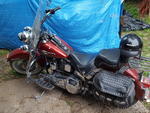
Still working on the look but I have found the sound I want. http://youtu.be/NIfVBbGU8ng.
RedJada, Congrats on getting your bike. Looks like you're having fun making it your own and getting it road-ready.
Regarding the sound in the video.... I love that sound too, that easy, slow "potato potato" lope of an idling Harley. But other much more knowledgeable Ironhead people than I will tell you that an idle on a Ironhead that's as slow as that one, will damage the engine over time. The oil pump/oiling system on an ironhead doesn't move enough oil to keep things properly lubricated if it's not idling fast enough.
My FSM says the idle on my '82 should be 900 to 950 rpm, many others keep theirs at 1000 rpm or even higher to avoid damage. I don't think the idle on the bike in the video is anywhere near 900 rpm.
Having said that, I'm a big believer in everyone doing whatever the hell they want with their own bikes. It won't bother me even a tiny bit to hear your bike idling at 650 or 700 rpm. It'll be sweet music to my ears.
Good luck with your build.
Last edited by yellowstone kelly; Mar 2, 2014 at 02:50 PM.
HD Forum Stories
The Best of Harley-Davidson for Lifelong Riders

8 Best Harley-Davidson Motorcycles Ever
Pouria Savadkouei
10 Worst Harley-Davidson Motorcycles Ever
Pouria Savadkouei
Killer Custom's Jail Break Is The Breakout That Refused to Blend In
Verdad Gallardo
Crazy Bunderbike Build Looks Amazing, But Is It Impossible to Ride?
Verdad Gallardo
Harley-Davidson Reveals Super Cool Cafe Racer Concept
Verdad Gallardo
Engraved Rebellion: Inside Bundnerbike's Glam Rock II
Verdad Gallardo
10 Motorcycles You Should Never Buy
Joe Kucinski
10 Things Harley-Davidson Needs to Fix in 2026
Verdad Gallardo
Southpaw Super Glide: A Left-Hand-Drive 1979 Harley FXE Built to Fit the Rider
Verdad Gallardo
Thread Starter
|
Intermediate
Joined: Feb 2014
Posts: 28
Likes: 0
From: NE Ohio
Two days until I bring her home. First on the list is to have the cylinders checked out. The machine shop I use for work and get a good measurement of the ID, out or round and squareness but wont do any machine work if needed. So, my question is. If I need to get the cylinders bored/honed. What kind of questions so I be asking to make sure things are done right?
I would bring the 99484-78 shop manual and point out the specs at the beginning of chapter 3 and the detail procedures throughout chapter 3. Note that some like fit-in-cylinder may change if you do not use stock-type pistons.
Does the shop regularly work on vintage, cast iron engines? I had a very bad experience with a shop where the guy was actually quite arrogant, acted as if he was THE expert, then i think he just passed the job off onto his tech kid; engine blew up within 100 miles.
Does the shop regularly work on vintage, cast iron engines? I had a very bad experience with a shop where the guy was actually quite arrogant, acted as if he was THE expert, then i think he just passed the job off onto his tech kid; engine blew up within 100 miles.

Thread
Thread Starter
Forum
Replies
Last Post