





Apparent proof that tire weight affects Dynojet results

Thread Starter
|
Stellar HDF Member


Joined: Feb 2014
Posts: 2,710
Likes: 529
From: Lethbridge, Alberta Canada
 Apparent proof that tire weight affects Dynojet results
Apparent proof that tire weight affects Dynojet results
This posting will show that changing to a lighter weight rear tire does indeed appear to increase the torque and power REPORTED by a Dynojet dyno, even when no actual engine power improvement has been made.
Many of you know that there are two entirely different types of motorcycle dynamometers. “Steady state” dynamometers (e.g. Factory Pro brand) keep the motorcycle at a steady engine rpm and measure the maximum torque and therefore power that the motorcycle engine can produce at each rpm. “Inertia” dynamometers (e.g. Dynojet brand) instead force the motorcycle to accelerate a heavy drum of known moment of inertia, and calculate the engine torque and power based upon how quickly the motorcycle engine can accelerate that drum of known inertia. Each approach has different advantages and disadvantages.
A key difference is that when you measure the torque and power on the steady state dyno, the engine is at a steady rpm for each individual torque versus rpm reading – it is not “accelerating”, whereas the engine being tested on a Dynojet IS accelerating (changing rpm), and at a very rapid rate. An entire Dynojet dyno run on my bike (which is not unusual) takes a TOTAL of 6.X seconds, during which the engine itself is accelerated from about 2500 rpm to about 6200 rpm, while simultaneously accelerating the dyno drum.
This engine acceleration requires the engine to accelerate not only the drum (whose acceleration is being measured by the dyno), but also its own wheel, tire, belt/chain/driveshaft, its transmission gears, its primary drive, and the engine’s own internal components, including, in my case, the Softail balancing mechanism used on all Softail engines to smooth them out. It obviously requires power to accelerate these components from 2500 to 6200 rpm. However, the acceleration of all these components beyond the drum is NOT being measured by the Dynojet. In other words, the engine torque and power being diverted to accelerate these other components is not being measured, and so, without any “corrections” to recognize this diverted torque and power, the reported torque and power will be lower than actual.
Although Dynojet keeps its assumptions and algorithms confidential, it apparently claims to “allow for” the power being diverted by using a “factor” of some sort. But no mathematically calculated “factor” can be correct for ALL motorcycles, since motorcycles vary considerably in the size and weight of rotating engine and driveline components! The torque and power required to accelerate these components of varying size and weight is proportional to their COMBINED “moments of inertia”.
“Moment of inertia” is a physical property that COULD be determined for each component, by Physics formulae, in theory, but it would require having data not available to either Dynojet or any interested scientist, without either disassembling each and every different motorcycle and determining the individual moment of intertia for each component of each bike, or by running a series of specific motorcycle driveline acceleration tests without engine power before introducing the load of a dyno drum. This is clearly, not very practical.
Bikes with heavier components tend to require much more torque and power to accelerate their engines and drivelines, while bikes with lighter components require much less torque and power to accelerate their engines and components. (This is why racing teams spend so much time and money pulling weight out of rotating components.
I have previously had my 2014 HD Breakout with HD “Stage 4 race kit “ dyno tested by Mike Lozano at Lozano Brothers. During those prioe dyno runs, Mike commented that beyond the simply heavy nature of all big twin Harley’s, my Breakout will under-report its torque and power on a Dynojet simply because it’s ridiculously heavy chrome Turbine rear wheel, the heavy stock Dunlop Elite 240mm tire (21.75 lb), and the Softail balancer mechanism all combine to penalize it even versus other Harley bikes.
When I recently changed the rear tire to a much lighter Pirelli Diablo 240mm tire (15.55 lb, or 6.2 lb lighter!!), Mike and I figured I should bring it in some time to dyno it again, and see how much different the reported torque and power are. I did that today.
Below are the results. The blue lines are from the last prior dyno test. The red lines are from today’s dyno test:
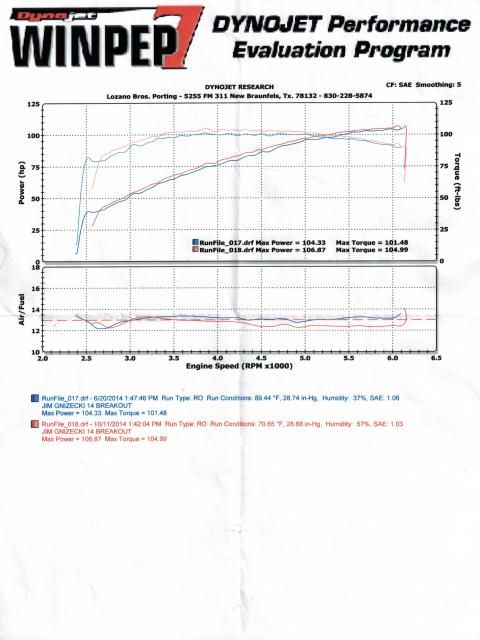
Notice that the peak torque increased from 101.5 to 105, a gain of 3.5 ft lb.
Notice that the peak power increased from 104.3 to just under 107 rwhp, a gain of over 2 ½ horsepower. From a lighter tire!
Notice that there was a gain at every rpm.
Notice that the gains were especially noticeable at low and mid range rpm, where the lower total engine power available(versus peak) makes the diversion of any power more significant.
Mike and I also suspect that the gain might actually be higher than reported today. This is because about 150 miles before this dyno test, the bike went into the HD dealership for its 5000 mile service (550 miles early because the dealership had a “special” on labor charges at that time). At that service, despite the fact that I specifically required the shop’s best mechanic to do the work, he over-oiled the air filter rather dramatically, to the point that K&N filter oil has been dripping off of it onto the exhaust and rear of the bike in sufficient volume to have required two washes since the service 150 miles ago! Note the effect in the chart on the high rpm AFR. Mike just shook his head, pointed out that the AFR was notably rich now versus the tune he had done this spring (and FI bikes don’t “lose” their tune), and suggested that when the over-oiled filter was finished creating its oil spill, we should perhaps try dynoing again. ☺
At any rate, the bike’s measured output has always been constant until today, and the only changes are the lighter tire (a positive change) and the over-oiled air filter (a negative change), and what we see in this chart is the net effect of the two changes.
Now this is not a rigidly controlled before and after test by any means, but it sure seems to suggest that a lighter rear tire does indeed make a MEASURABLE difference in power and torque reported on a Dynojet dyno.
To reinforce this, Mike told me that when he changed from alloy to carbon fiber wheels on one of his bikes, the reported power went up by 6% !
And, those of you Breakout owners running the 250mm Dunlop (22.3 lb !) versus the 240mm Dunlop, might keep that extra rotating weight in mind when dynoing your bikes. That’s almost 7 lb heavier than the Pirelli I am running.
Jim G
This posting will show that changing to a lighter weight rear tire does indeed appear to increase the torque and power REPORTED by a Dynojet dyno, even when no actual engine power improvement has been made.
Many of you know that there are two entirely different types of motorcycle dynamometers. “Steady state” dynamometers (e.g. Factory Pro brand) keep the motorcycle at a steady engine rpm and measure the maximum torque and therefore power that the motorcycle engine can produce at each rpm. “Inertia” dynamometers (e.g. Dynojet brand) instead force the motorcycle to accelerate a heavy drum of known moment of inertia, and calculate the engine torque and power based upon how quickly the motorcycle engine can accelerate that drum of known inertia. Each approach has different advantages and disadvantages.
A key difference is that when you measure the torque and power on the steady state dyno, the engine is at a steady rpm for each individual torque versus rpm reading – it is not “accelerating”, whereas the engine being tested on a Dynojet IS accelerating (changing rpm), and at a very rapid rate. An entire Dynojet dyno run on my bike (which is not unusual) takes a TOTAL of 6.X seconds, during which the engine itself is accelerated from about 2500 rpm to about 6200 rpm, while simultaneously accelerating the dyno drum.
This engine acceleration requires the engine to accelerate not only the drum (whose acceleration is being measured by the dyno), but also its own wheel, tire, belt/chain/driveshaft, its transmission gears, its primary drive, and the engine’s own internal components, including, in my case, the Softail balancing mechanism used on all Softail engines to smooth them out. It obviously requires power to accelerate these components from 2500 to 6200 rpm. However, the acceleration of all these components beyond the drum is NOT being measured by the Dynojet. In other words, the engine torque and power being diverted to accelerate these other components is not being measured, and so, without any “corrections” to recognize this diverted torque and power, the reported torque and power will be lower than actual.
Although Dynojet keeps its assumptions and algorithms confidential, it apparently claims to “allow for” the power being diverted by using a “factor” of some sort. But no mathematically calculated “factor” can be correct for ALL motorcycles, since motorcycles vary considerably in the size and weight of rotating engine and driveline components! The torque and power required to accelerate these components of varying size and weight is proportional to their COMBINED “moments of inertia”.
“Moment of inertia” is a physical property that COULD be determined for each component, by Physics formulae, in theory, but it would require having data not available to either Dynojet or any interested scientist, without either disassembling each and every different motorcycle and determining the individual moment of intertia for each component of each bike, or by running a series of specific motorcycle driveline acceleration tests without engine power before introducing the load of a dyno drum. This is clearly, not very practical.
Bikes with heavier components tend to require much more torque and power to accelerate their engines and drivelines, while bikes with lighter components require much less torque and power to accelerate their engines and components. (This is why racing teams spend so much time and money pulling weight out of rotating components.
I have previously had my 2014 HD Breakout with HD “Stage 4 race kit “ dyno tested by Mike Lozano at Lozano Brothers. During those prioe dyno runs, Mike commented that beyond the simply heavy nature of all big twin Harley’s, my Breakout will under-report its torque and power on a Dynojet simply because it’s ridiculously heavy chrome Turbine rear wheel, the heavy stock Dunlop Elite 240mm tire (21.75 lb), and the Softail balancer mechanism all combine to penalize it even versus other Harley bikes.
When I recently changed the rear tire to a much lighter Pirelli Diablo 240mm tire (15.55 lb, or 6.2 lb lighter!!), Mike and I figured I should bring it in some time to dyno it again, and see how much different the reported torque and power are. I did that today.
Below are the results. The blue lines are from the last prior dyno test. The red lines are from today’s dyno test:

Notice that the peak torque increased from 101.5 to 105, a gain of 3.5 ft lb.
Notice that the peak power increased from 104.3 to just under 107 rwhp, a gain of over 2 ½ horsepower. From a lighter tire!
Notice that there was a gain at every rpm.
Notice that the gains were especially noticeable at low and mid range rpm, where the lower total engine power available(versus peak) makes the diversion of any power more significant.
Mike and I also suspect that the gain might actually be higher than reported today. This is because about 150 miles before this dyno test, the bike went into the HD dealership for its 5000 mile service (550 miles early because the dealership had a “special” on labor charges at that time). At that service, despite the fact that I specifically required the shop’s best mechanic to do the work, he over-oiled the air filter rather dramatically, to the point that K&N filter oil has been dripping off of it onto the exhaust and rear of the bike in sufficient volume to have required two washes since the service 150 miles ago! Note the effect in the chart on the high rpm AFR. Mike just shook his head, pointed out that the AFR was notably rich now versus the tune he had done this spring (and FI bikes don’t “lose” their tune), and suggested that when the over-oiled filter was finished creating its oil spill, we should perhaps try dynoing again. ☺
At any rate, the bike’s measured output has always been constant until today, and the only changes are the lighter tire (a positive change) and the over-oiled air filter (a negative change), and what we see in this chart is the net effect of the two changes.
Now this is not a rigidly controlled before and after test by any means, but it sure seems to suggest that a lighter rear tire does indeed make a MEASURABLE difference in power and torque reported on a Dynojet dyno.
To reinforce this, Mike told me that when he changed from alloy to carbon fiber wheels on one of his bikes, the reported power went up by 6% !
And, those of you Breakout owners running the 250mm Dunlop (22.3 lb !) versus the 240mm Dunlop, might keep that extra rotating weight in mind when dynoing your bikes. That’s almost 7 lb heavier than the Pirelli I am running.
Jim G
Last edited by JimGnitecki; Oct 12, 2014 at 03:58 PM.

Ultimate HDF Member
Joined: Nov 2013
Posts: 7,492
Likes: 103
From: Stuttgart, Germany
Bikes with heavier components tend to require much more torque and power to accelerate their engines and drivelines, while bikes with lighter components require much less torque and power to accelerate their engines and components. (This is why racing teams spend so much time and money pulling weight out of rotating components.
Racing teams do not specifically try to reduce weight of rotating components but to reduce the weight of the whole system (vehicle).
Notice that the peak torque increased from 101.5 to 105, a gain of 3.5 ft lb.

Notice that the peak power increased from 104.3 to just under 107 rwhp, a gain of over 2 ½ horsepower.

From a lighter tire!
BTW - What racing teams are much more converned about is the proper rubber mixture of their tires as well as the precise tire temperature as these factors significantly affect the friction of the tires and thereby the traction of the vehicle. Same applys to your bike. Did you measure/compare the tire temperature, tire geometry, pressure (by 1% accuracy) etc. etc.???
The marginal differences you noticed when dynoing your bike may as well be primarily caused by the different/better traction provided by your Pirelli tire.
Road Warrior
Joined: May 2014
Posts: 1,962
Likes: 245
From: Triune, TN
I thought everybody knew that it takes more energy (or power) to move or rotate larger or heavier mass. Why do you think drag bikes and drag cars use the lightest crankshaft, pistons, rods, driveshaft, flywheel, rear wheel and tire possible? The heavier an object is the more power it takes to move it.
The lighter your rotating mass, the more power to the ground. That is old news
The lighter your rotating mass, the more power to the ground. That is old news
Trending Topics

Outstanding HDF Member
Joined: Aug 2012
Posts: 3,217
Likes: 90
From: Detroit
HD Forum Stories
The Best of Harley-Davidson for Lifelong Riders

7 Surprising Harley-Davidson Products that Are Not Motorcycles
Verdad Gallardo
8 Best Harley-Davidson Motorcycles Ever
Pouria Savadkouei
10 Worst Harley-Davidson Motorcycles Ever
Pouria Savadkouei
Killer Custom's Jail Break Is The Breakout That Refused to Blend In
Verdad Gallardo
Crazy Bunderbike Build Looks Amazing, But Is It Impossible to Ride?
Verdad Gallardo
Harley-Davidson Reveals Super Cool Cafe Racer Concept
Verdad Gallardo
Engraved Rebellion: Inside Bundnerbike's Glam Rock II
Verdad Gallardo
10 Motorcycles You Should Never Buy
Joe Kucinski
10 Things Harley-Davidson Needs to Fix in 2026
Verdad Gallardo
Ultimate HDF Member
Joined: Nov 2013
Posts: 7,492
Likes: 103
From: Stuttgart, Germany
Not an expert in engine tuning, either. But you are right, the AFR chart shows a noticable difference between both runs. The changed/richer mixture (lower AFR) may have resulted in the performance gain over the leaner mixture of the previous run. And where the AFR lines meet/cross in the lower band the difference between power and torque lines is not as distinct. But I may be mistaken with this rather superficial estimation.
