




nasty wobble
Thread Starter
|
Road Master
Joined: May 2011
Posts: 1,240
Likes: 14
From: lancaster,ca
 nasty wobble
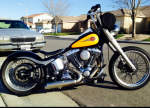
Well im trying to narrow down a bad wobble I have so far I'm thinking its beacuse my rear is slammed an 1.5 and the front is stock. I have repalced the front tire which was cupped and it did helpo a little but I still have a wobble at 70-80 MPH. Could it be the Ape hangers? I was at a big ride this weekend and ran into the tru track guy and he convinced me to install one which I said sure if you think it will fix the problem so I brought the bike in to get it installed and went back about 3 hours later only to be told they couldnt do it because it was a softail and the engine is mounted different? If it is the lowering that is causing it do you think lowering the front will fix it?
Road Warrior


Joined: Mar 2008
Posts: 1,465
Likes: 3
From: Montclair, CA.
It could be a number of things. Rear wheel spokes loose, steering head torque out of specs, loose, Rear swing arm bushings worn, front fork tubes worn or loose, wheel balance, etc etc.
You will need to start at one point and check all of the above and there are probably others that I haven't mentioned.
Just my
You will need to start at one point and check all of the above and there are probably others that I haven't mentioned.
Just my
Stellar HDF Member


Joined: Aug 2012
Posts: 2,664
Likes: 184
From: Indiana, USA
The rake and trail of the stock bike prohibit wobble and in a perfect setup the Apes should not cause wobble. Agree with Ramboamt, the alignment is out somewhere in the driveline or loose spokes. Check spoke tension with something solid like a 3/8 socket extension. Tap each spoke and listen to the tone. Dead spokes are loose and loose spokes allow the wheel or bike to wobble. If the spokes are good, jack it up and look for play in the swingarm.
Thread Starter
|
Road Master
Joined: May 2011
Posts: 1,240
Likes: 14
From: lancaster,ca
It could be a number of things. Rear wheel spokes loose, steering head torque out of specs, loose, Rear swing arm bushings worn, front fork tubes worn or loose, wheel balance, etc etc.
You will need to start at one point and check all of the above and there are probably others that I haven't mentioned.
Just my
You will need to start at one point and check all of the above and there are probably others that I haven't mentioned.
Just my
Stellar HDF Member
Joined: Aug 2012
Posts: 2,664
Likes: 184
From: Indiana, USA
Not sure but it seems to me your lowered rear will result in more trail or more stability....
The 411 On Rake and Trail
For decades many motorcyclists have liked the look of raked and extended front-ends on their bikes. Lots of different ways of achieving that look have been tried and the quality of results has ranged from terrific to deadly. The best successes have been the result of good engineering. There are a few things you need to know before you chop your ride. One important area of knowledge is the combination of rake and trail.The 411 On Rake and Trail
“Rake” refers to the angle between the front forks and the ground or, in case we are talking about just a frame, the angle between the head tube and the ground. In most stock bikes the triple-trees hold the forks parallel to the head tube so rake is the same for the frame and the bike. Changing the rake by modifying the frame, the triple-tree or both can make dramatic changes in the trail and, therefore, in the bike's handling.
“Trail” is harder to explain and the diagrams below will help clarify it. Trail is the fore-and-aft distance between the pivot axis of the fork and the center of the contact patch of the front tire at the ground. Trail is one of the most important determiners of your bikes handling characteristics.
A bike with lots of trail will be directionally stable. It will tend to go straight and be easy to ride hands-off. It will not have its direction changed by every tiny bump in the road. Such a bike will take more physical effort to steer than a bike with less trail.
A bike with only a little trail will be livelier (some would say “squirrellier”). It will take very little effort to change its direction whether that effort comes from your hands on the bars or from a bump in the road.
Cruisers and touring bikes tend to have large trail dimensions and sportier bikes tend to have less. If you picture these kinds of bikes you will realize that manufacturers tend to combine large trail dimensions with wide handlebars and small trail dimensions with narrow bars. As a result, the personal level of effort to steer these bikes may be similar. If you get the opportunity, try riding a stock cruising bike then riding an identical bike with narrow drag bars. You will definitely feel the difference in effort required for steering.

Trail is the horizontal distance between the pivot axis and the center of the contact patch. If the pivot axis intersects the ground ahead of the center of the contact patch, trail is positive.
Trail causes the front wheel to act like a caster. The greater the trail dimension, the more forcefully the wheel tries to align itself with the direction of travel. Or put another way, the more stable the bike is. Nobody wants a bike so stable it can not be turned but we all want a bike that can be ridden no-handed for at least a few seconds without going out of control at the tiniest bump.
Generally, a trail dimension of about 4 inches provides a nice balance between stability and responsiveness.

When we increase the rake angle by raking the NECK 10 degrees we INCREASE the trail.

If we rake the front by putting 10 degrees all in the TRIPLE TREE we REDUCE the trail.

The best solution is to use a little of both. We start with stock rake of 33 degrees and add 5 degrees to the neck then add 5 degrees to the triple tree and get a pretty good result. Trail is reduced but positive. There is another design step we can take that is fairly simple and improves the overall result. It involves another change in the triple tree.

Triple trees have a dimension called off-set. It is the distance from the center of the fork tubes to the center of the neck pivot axis. It is an important factor in trail. The better manufacturers of raked triple trees reduce the off-set in order to increase trail in the final set-up.

With a rake of 5 degrees added to the frame and 5 degrees added to the triple tree and a reduction of off-set in the triple tree we have a bike with a longer wheel-base, a prettier front-end and a trail dimension close to the original.
Thread Starter
|
Road Master
Joined: May 2011
Posts: 1,240
Likes: 14
From: lancaster,ca
Hmmmm..I am do for my 10,000 mile service maybe I should take it in for that before I drop a ton of cash on it. I'm going to schedule a service now for saturday I will post how it is on sunday...I have my finger crossed because the one thing I think it could be is when I put the new wheels on it some how the belt drive pully was one tooth bigger so the axle is half way on the adjuster slot I'm not sure if this could make a difference but It's just a thought
Trending Topics
Cruiser
Joined: Aug 2011
Posts: 222
Likes: 1
From: Jacksonville, Fl
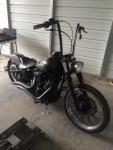
Mine is dropped a little over 2 in the rear and over 3 in the front. Over time I've adjusted it back and forth til i found where I was comfortable with the looks and the ride. The only time I had a wobble was when the front was too low. So I raised it some til it stopped. Supposedly, and again I say supposedly, the rear being lower does not matter. The front being lower does matter. I've seen it first hand now so i can almost confirm it. So I'm not sure what is causing yours but i would rule out the lowering of the rear as I lowered my rear first and the front was stock and I had no wobble. Good luck figuring it out.
HD Forum Stories
The Best of Harley-Davidson for Lifelong Riders

6 Weirdest Harley-Davidsons Ever Sold to the Public
Verdad Gallardo
7 Times Harley-Davidson Chucked Tradition Out the Window
Verdad Gallardo
7 Surprising Harley-Davidson Products that Are Not Motorcycles
Verdad Gallardo
8 Best Harley-Davidson Motorcycles Ever
Pouria Savadkouei
10 Worst Harley-Davidson Motorcycles Ever
Pouria Savadkouei
Killer Custom's Jail Break Is The Breakout That Refused to Blend In
Verdad Gallardo
Crazy Bunderbike Build Looks Amazing, But Is It Impossible to Ride?
Verdad Gallardo
Harley-Davidson Reveals Super Cool Cafe Racer Concept
Verdad Gallardo
Engraved Rebellion: Inside Bundnerbike's Glam Rock II
Verdad Gallardo
Elite HDF Member
Joined: Jun 2008
Posts: 4,109
Likes: 9
From: Connecticut
the rear on mine is low maybe 2-3" I have shotguns and run it low the ft has 2" under tubes and the ft is still higher and I have no wobble at all. I would bet on the neck bearings being too loose