






Soon to be new Harley Rider

Huh...wha... The other day mine never struggled, and when I looked down I was doing over 90 mph and it wasn't 'crawling' to go any faster. Decided that was fast enough and backed out of it.
My son has had his Iron up to 120 and he said the rev limiter kicked in. He's 25, young, dumb, and well you know the rest.
People told me my VLX wouldn't do over 70-80 mph, well with me AND my wife on it trying to outrun a nasty thunderstorm it easily did 85 mph and was still accelerating.
But hey, I'm happy with my 883 and that's all that matters.
My son has had his Iron up to 120 and he said the rev limiter kicked in. He's 25, young, dumb, and well you know the rest.
People told me my VLX wouldn't do over 70-80 mph, well with me AND my wife on it trying to outrun a nasty thunderstorm it easily did 85 mph and was still accelerating.
But hey, I'm happy with my 883 and that's all that matters.

Grand HDF Member
Joined: Jan 2017
Posts: 3,837
Likes: 1,430
From: NJ
I understand some are just speed junkies and that's fine. But, some don't want or need a mega cc motorcycle. The way some portray it, the 883 is good for nothing but running to the store to buy a gallon of milk.
I guess maybe I just have my testosterone under control.
 I dunno...
As stated earlier, once I know more I can better give advice. Its his money. I'm just being curious.
Grand HDF Member
Joined: Jan 2017
Posts: 3,837
Likes: 1,430
From: NJ
Just a thought: could be that he's wanting to learn to wrench on the bike... I would see it as a great way to learn personally. I started out with a bucket of bolts salvage title bike. I rebuilt EVERYTHING on it. I didn't lose out on much money other than a few parts and a ton of hours but I wouldn't trade that learning experience for anything. I wouldn't have started with a new bike though, just something that is safe to start with but needed some TLC
He said he liked the 107 but it was too much power for a starter bike. I get that.
So why is he trying to hop up an 883 out of the gate if power is a concern at this point? Just seems contradictory to me.
But I'm sure he has a plan. Just wondering what it is. Maybe some blunt opinion will be more beneficial to him than telling him all the "best" hop up parts to buy that will run $1500 and maybe add 10hp on a starter bike where he gets zero return
on those hop up parts.
but most of us did this at some point. I can't say that i ever did, i didnt really have the chance. But, thereare a ton of short shots and ugly silly air cleaners like hyper chargers out in the secondarymarket because of it. We'll have to see
would be best to just ride the bike around for a bit
.jpg)
Last edited by cvaria; Sep 6, 2017 at 09:00 PM.
Grand HDF Member


Joined: Jul 2015
Posts: 4,353
Likes: 1,966
From: PA
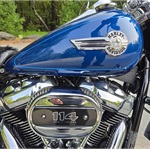
That's a very cool looking bike. The dealer can download a map which will adjust the tune somewhat, but the general consensus is that's not a very good option. You could also have it dyno tuned, but that can be pricey and is only applicable to your bike in its current configuration.
You can get a pretty economical tuner like a FuelMoto Micro EFI, which has to stay attached to the bike. I believe most tuners are "married" to the bike, including some which don't need to stay attached, but you can't use them on more than one bike.
You can get a pretty economical tuner like a FuelMoto Micro EFI, which has to stay attached to the bike. I believe most tuners are "married" to the bike, including some which don't need to stay attached, but you can't use them on more than one bike.
Last edited by Bluesrider.df; Sep 7, 2017 at 03:06 AM.
Road Master

Joined: May 2017
Posts: 897
Likes: 1,823
From: Wellsboro, PA
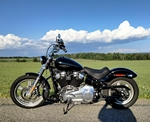
Welcome. Nice bike.
I'm 56 and an Iron 883 is my first motorcycle just purchased a few months ago. I'm lovin' it.
I'm 56 and an Iron 883 is my first motorcycle just purchased a few months ago. I'm lovin' it.
HD Forum Stories
The Best of Harley-Davidson for Lifelong Riders

8 Best Harley-Davidson Motorcycles Ever
Pouria Savadkouei
10 Worst Harley-Davidson Motorcycles Ever
Pouria Savadkouei
Killer Custom's Jail Break Is The Breakout That Refused to Blend In
Verdad Gallardo
Crazy Bunderbike Build Looks Amazing, But Is It Impossible to Ride?
Verdad Gallardo
Harley-Davidson Reveals Super Cool Cafe Racer Concept
Verdad Gallardo
Engraved Rebellion: Inside Bundnerbike's Glam Rock II
Verdad Gallardo
10 Motorcycles You Should Never Buy
Joe Kucinski
10 Things Harley-Davidson Needs to Fix in 2026
Verdad Gallardo
Southpaw Super Glide: A Left-Hand-Drive 1979 Harley FXE Built to Fit the Rider
Verdad Gallardo
Stellar HDF Member
Joined: Apr 2012
Posts: 3,117
Likes: 1,193
From: Maryland
Ok... I'll throw in my 2 cents... Nothing better to do anyhow...
The guy says he's from Belgium. Only concern I would have about his plan is what impact it might have on warranty. If it impacts warranty, I might just wait until it expires. Don't know though what goes over there across the pond.
If the guy wants to forego - for whatever reason - a 1200 and get a 883 then fine. More power to him. Many have done the same. Many later do the 1200/1250 conversion (only problem with that, in my mind, might be the gearing on the 883).
In any case (leaving it stock or later getting the conversion), who wouldn't want to stick new pipes and intake on the bike? Most would I suspect. Does it really matter that you might only get a 10% bump out of it? Does it matter that it doesn't make economic sense? I say "no" to each question. Bikes are not an investment. They are toys and as soon as you buy one you might as well accept that you're flushing money down the toilet in certain respects. Those new pipes and intake will produce enjoyment/satisfaction in other ways than just raw performance gains. So I say go ahead and do it if he wants. He'll like the way the bike looks and sounds. There is value in that.
Only pipes in his list that I have experience with are the V&H Side Shots. It's a decent set of pipes with reasonable compromises.
To the OP: If you want to look at dyno results, instead of reading/listening to a bunch of dubious opinions, go to Hammer's website and look at some of the dyno results they produced...
http://www.hammerperf.com/ttxlexhaust.shtml
You'll note that they used the Patriot Defender (no longer available) as the standard that others were measured against. You'll see that the PD produces fairly flat torque and power curves with decent overall numbers. The V&H SS's have a (slightly) less flat curve down low - little dip attributed to reversion (if memory serves). You'll also note that when the power curves for both pipes are overlaid on each other, there isn't a significant (my opinion) difference between the two up until about 6200 RPM (which is near/bumping up against the the stock setting for the rev limiter). Torque wise, look at the numbers at each major division...
3500: V&H 72 Lb-Ft, PD 73 Lb-Ft
4000: V&H 74 Lb-Ft, PD 78 Lb-Ft
4500: V&H 80 Lb-Ft, PD 82 Lb-Ft
5000: V&H 84 Lb-Ft, PD 84 Lb-Ft
5500: V&H 86 Lb-Ft, PD 85 Lb-Ft
6000: V&H 84 Lb-Ft, PD 85 Lb-Ft
So why did I say to look at the major divisions? If you'll note - the horizontal axis settings are not the same on both graphs. The wider axis and earlier starting point on the V&H graph tends to exaggerate the dip - where had it been the same as the PD graph it would have stretched it out a little bit and lessened the visual impact. By looking at the major divisions you can see that there's only a significant difference at around 4000 rpms. How significant? Meh? Not much as far as I'm concerned. My bet - not enough that any butt dyno will tell the difference. The overlaid power curves tend to bare this out as well.
The V&H Side Shots are a nice looking, well made, and decent sounding set of pipes in my opinion. However, I have no doubt that they are probably a bitch to install (as noted on Hammer's website). I can confirm that the wide band O2 sensors are problematic to install on these pipes because of the bung location and angle (on the front cylinder), but it can be done. This may be something to consider if you should decide one day to go with a DJ Power Vision with Target Tune.
Roughly about right with that one I'd say.
Do you need a tuner...? The answer to that would be another long winded reply... So I'll just say a couple of things and leave it at that. If you don't care to learn what you need to know to do DIY tuning effectively with a tuner, then just skip it and find yourself a competent shop that can do your tune with a dyno. There is a learning curve with trying to DIY with a tuner. For example, "Auto" tuning isn't really tuning. It's an attempt the calibrate the VE tables. I'm not a subscriber to the notion that one can just simply download a canned map and get the best (or even good) results. In answer to the question about needing to keep the tuner hooked up the bike - the answer is no. It's not required. You can simply flash the new tune and disconnect. But again, I believe you either need to do the requisite homework or seek out a pro.
The guy says he's from Belgium. Only concern I would have about his plan is what impact it might have on warranty. If it impacts warranty, I might just wait until it expires. Don't know though what goes over there across the pond.
If the guy wants to forego - for whatever reason - a 1200 and get a 883 then fine. More power to him. Many have done the same. Many later do the 1200/1250 conversion (only problem with that, in my mind, might be the gearing on the 883).
In any case (leaving it stock or later getting the conversion), who wouldn't want to stick new pipes and intake on the bike? Most would I suspect. Does it really matter that you might only get a 10% bump out of it? Does it matter that it doesn't make economic sense? I say "no" to each question. Bikes are not an investment. They are toys and as soon as you buy one you might as well accept that you're flushing money down the toilet in certain respects. Those new pipes and intake will produce enjoyment/satisfaction in other ways than just raw performance gains. So I say go ahead and do it if he wants. He'll like the way the bike looks and sounds. There is value in that.
Only pipes in his list that I have experience with are the V&H Side Shots. It's a decent set of pipes with reasonable compromises.
To the OP: If you want to look at dyno results, instead of reading/listening to a bunch of dubious opinions, go to Hammer's website and look at some of the dyno results they produced...
http://www.hammerperf.com/ttxlexhaust.shtml
You'll note that they used the Patriot Defender (no longer available) as the standard that others were measured against. You'll see that the PD produces fairly flat torque and power curves with decent overall numbers. The V&H SS's have a (slightly) less flat curve down low - little dip attributed to reversion (if memory serves). You'll also note that when the power curves for both pipes are overlaid on each other, there isn't a significant (my opinion) difference between the two up until about 6200 RPM (which is near/bumping up against the the stock setting for the rev limiter). Torque wise, look at the numbers at each major division...
3500: V&H 72 Lb-Ft, PD 73 Lb-Ft
4000: V&H 74 Lb-Ft, PD 78 Lb-Ft
4500: V&H 80 Lb-Ft, PD 82 Lb-Ft
5000: V&H 84 Lb-Ft, PD 84 Lb-Ft
5500: V&H 86 Lb-Ft, PD 85 Lb-Ft
6000: V&H 84 Lb-Ft, PD 85 Lb-Ft
So why did I say to look at the major divisions? If you'll note - the horizontal axis settings are not the same on both graphs. The wider axis and earlier starting point on the V&H graph tends to exaggerate the dip - where had it been the same as the PD graph it would have stretched it out a little bit and lessened the visual impact. By looking at the major divisions you can see that there's only a significant difference at around 4000 rpms. How significant? Meh? Not much as far as I'm concerned. My bet - not enough that any butt dyno will tell the difference. The overlaid power curves tend to bare this out as well.
The V&H Side Shots are a nice looking, well made, and decent sounding set of pipes in my opinion. However, I have no doubt that they are probably a bitch to install (as noted on Hammer's website). I can confirm that the wide band O2 sensors are problematic to install on these pipes because of the bung location and angle (on the front cylinder), but it can be done. This may be something to consider if you should decide one day to go with a DJ Power Vision with Target Tune.
I know that these upgrades need to be tuned for air to fuel ratio and will probably do that at the HD dealer.
What i'm not sure about is do i need to buy a tuner and keep it hooked up to the bike or can you use a tuner from someone else, upload the best map and be done with it?
What i'm not sure about is do i need to buy a tuner and keep it hooked up to the bike or can you use a tuner from someone else, upload the best map and be done with it?
Last edited by T^2; Sep 6, 2017 at 08:54 PM.

I've never seen so many people complain about somebody else buying an 883, and I hang out with all jap bike builders. The OP didn't ask if he should get a 1200, he's asking opinions on intake and exhaust, who cares where he spends his money. No matter what bike he gets, guess what he'll want to do first, you got it, intake and exhaust.
My only suggestion would be to may be look at something used, especially for a sportster. Other than that, most people aren't going to notice the "big" difference between a 2-1 or 2-2 exhaust, no matter what they say. Your best option is to get what looks and sounds good to you.
My only suggestion would be to may be look at something used, especially for a sportster. Other than that, most people aren't going to notice the "big" difference between a 2-1 or 2-2 exhaust, no matter what they say. Your best option is to get what looks and sounds good to you.