




Solid vs rubber mount

Cruiser
Joined: Mar 2008
Posts: 229
Likes: 20
From: Portland OR

I only seen one post about the '03 & earlier transmission door, sure the '04 & later Sportster with it's rubber mount motor is nice & all, but do you know that on a '04 & later Sportster you have to remove the motor and split the cases in order to work on the transmission? Basically Harley made a throw away bike, a gasket kit alone will run you about a $100 just for the gasket's & at around a $100 per hour for a dealer to work on your bike, we;; you might as well throw it away and buy a new bike! A '03 and older you can still remove the transmission with the motor still in the frame! I'm old School and would like to be able to work on my bike!

Club Member


Joined: Jun 2007
Posts: 45,429
Likes: 2,898
From: Bedford UK

Very simple! Since that design was introduced the performance of the engine has increased substantially and it is no longer robust enough. It is the same reason that Harley went to rubber-mounts on their big twins back in 1980 - reliability in the face of increased performance in an elderly design. You are much less likely to need to do maintenance on a current rubber-mount Sportster than an old solid-mount.

Stage III
Joined: Jan 2019
Posts: 3
Likes: 1
From: NH

Grand HDF Member


Joined: Nov 2018
Posts: 4,607
Likes: 3,312
From: Virginia
Very simple! Since that design was introduced the performance of the engine has increased substantially and it is no longer robust enough. It is the same reason that Harley went to rubber-mounts on their big twins back in 1980 - reliability in the face of increased performance in an elderly design. You are much less likely to need to do maintenance on a current rubber-mount Sportster than an old solid-mount.
But I'd bet a paycheck that the real reason for dumping the trap door transmission and going to a different case design on the 2004 and up Sportsters is because it is cheaper to manufacture.
Club Member
Joined: Jun 2007
Posts: 45,429
Likes: 2,898
From: Bedford UK

That is very likely a contributing factor, but the trapdoor is a flawed design, from the point of view of increasing power. Also when installing the engine in a rubber-mounted frame the crankcases need to be very strong, as they also bear the weight of the swingarm and rear wheel. We have seen similar major changes to the way the transmission and crankcase of the big twins are joined together, to make them stronger.
Stage III
Joined: Jan 2019
Posts: 3
Likes: 1
From: NH
I don't care, the way I still see it is no transmission door no new Sportster for me! Used to build the Harley US Twin race bikes and have had the transmission out to repair track side! Who is going to pay the dealer a $100 per hour to work on a 5-6 year old 883 that is worth ??? You might as well throw it away (what Harley is hoping) and buy a new bike! Do you remember the Harley ad's where they showed a Zippo lighter & a Bic lighter, under the Zippo they said our way of thinking & under the Bic they said their way of thinking? Well guess what?
Last edited by 1200S; Jan 17, 2019 at 11:02 AM.
Road Warrior
Joined: Sep 2017
Posts: 1,609
Likes: 694
From: over the mountain
The new transmissions are bullet proof. You hardly ever hear of any trans trouble. If you are as good as you say you shouldn't have any trouble splitting the cases. I am capable of doing any thing that needs doing to my 2014 Sportster including splitting the cases. Mine is right at 110 HP and I ride it hard. I've got 25000 + miles with no trans issues what so ever. None of the Sportsters riders I know have ever had to go into their trans and some of them have over a hundred thousand miles on them. Damned if I will set around and worry about something that may never happen.
Last edited by apache snow; Jan 17, 2019 at 11:10 AM.

Road Captain
Joined: Mar 2009
Posts: 654
Likes: 734
Back in the day, the XB Pro-Thunder bikes were all getting trap door conversions, for serviceability. Likewise the Buell XBRR factory road race bike (56 made) put 150hp to the rear wheel and used a trap door transmission. Rubber mounted motor, too.
I'm with VAFish. It was a cost reduction.
HD Forum Stories
The Best of Harley-Davidson for Lifelong Riders

7 Surprising Harley-Davidson Products that Are Not Motorcycles
Verdad Gallardo
8 Best Harley-Davidson Motorcycles Ever
Pouria Savadkouei
10 Worst Harley-Davidson Motorcycles Ever
Pouria Savadkouei
Killer Custom's Jail Break Is The Breakout That Refused to Blend In
Verdad Gallardo
Crazy Bunderbike Build Looks Amazing, But Is It Impossible to Ride?
Verdad Gallardo
Harley-Davidson Reveals Super Cool Cafe Racer Concept
Verdad Gallardo
Engraved Rebellion: Inside Bundnerbike's Glam Rock II
Verdad Gallardo
10 Motorcycles You Should Never Buy
Joe Kucinski
10 Things Harley-Davidson Needs to Fix in 2026
Verdad Gallardo
Club Member
Joined: Jun 2007
Posts: 45,429
Likes: 2,898
From: Bedford UK
Solid mount bikes, with their trap door transmission, are enormously more popular in drag racing than the rubber mounts. There are some awfully powerful bikes out there using Sportster trap door transmissions. The trans is very tough.They take a lot of abuse.
Back in the day, the XB Pro-Thunder bikes were all getting trap door conversions, for serviceability. Likewise the Buell XBRR factory road race bike (56 made) put 150hp to the rear wheel and used a trap door transmission. Rubber mounted motor, too.
I'm with VAFish. It was a cost reduction.
Back in the day, the XB Pro-Thunder bikes were all getting trap door conversions, for serviceability. Likewise the Buell XBRR factory road race bike (56 made) put 150hp to the rear wheel and used a trap door transmission. Rubber mounted motor, too.
I'm with VAFish. It was a cost reduction.
Road Captain
Joined: Mar 2009
Posts: 654
Likes: 734
The new transmissions are bullet proof. You hardly ever hear of any trans trouble. If you are as good as you say you shouldn't have any trouble splitting the cases. I am capable of doing any thing that needs doing to my 2014 Sportster including splitting the cases. Mine is right at 110 HP and I ride it hard. I've got 25000 + miles with no trans issues what so ever. None of the Sportsters riders I know have ever had to go into their trans and some of them have over a hundred thousand miles on them. Damned if I will set around and worry about something that may never happen.
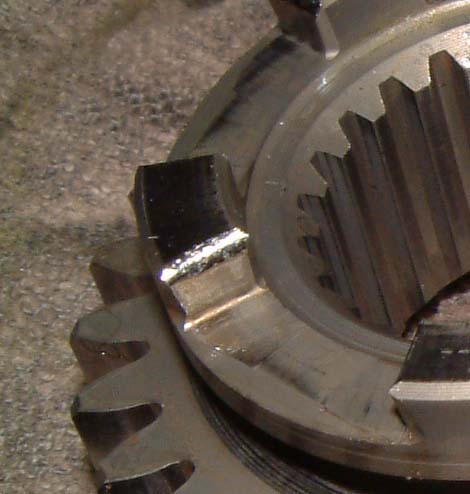
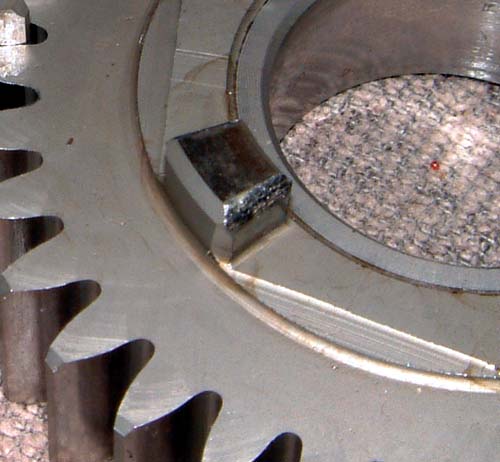
Once these get rounded like this, you start getting hop-out. Pretty easy to fix on a solid mount bike. Quite a bit more work on a rubber mount.
Don't get me wrong, I personally prefer the rubber mount bikes overall. But I view the loss of the trap door as a negative, and accept the fact that if I have a trans issue, I need to do a full tear down to fix it.
If you want rubber mount with a trap door trans,you can always get a pre-2003 Buell
