



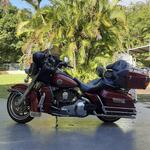

Faulty ABS Module-warning, rant in progress.

Seasoned HDF Member


Joined: Oct 2013
Posts: 9,238
Likes: 5,784
From: On the Big Blue marble


Seasoned HDF Member


Joined: Aug 2017
Posts: 7,323
Likes: 11,760
From: Omaha,NE
If you didn't test the moisture content with a tester, how do you know it wasn't full of moisture? Clean and clear doesn't mean anything. As a mechanic of 30 years (as am I), you ought to know that. Bike brake fluid has to be changed or at least tested every two years on an ABS bike, or you are gambling. Add to the fact that the ABS likely never cycled after the module replacement with the lack of use the bike had, you have a recipe for a failed ABS unit.

Seasoned HDF Member


Joined: Mar 2010
Posts: 38,543
Likes: 6,419
From: Honah Lee
Here we go-2013 FLHTK went 48k miles with no issues, owned by a close friend. Three years ago, his ABS module locked out the front brake. After flushing and bleeding, no change. He bought a new module from the local dealer, we installed it, flushed and bled and all was right with the world. He rode it maybe a dozen more times on short rides and parked it due to health issues. Last year, I bought the bike from him and found the front brake severely restricted but would work if pulled hard enough. It stops well with just the rear brake, but that is not how I ride. I recently went after the problem myself rebuilding the master cylinder-it was clean. No improvement. I found if I tapped on the module with a light hammer, it opened up, but would revert back even with the key off. I took to the local dealer to be told there was really no point in doing a power flush with Digitech as the module was faulty-likely due to moisture in the fluid. $1300 for a new module. I pointed out the system was thoroughly flushed when the module was replaced and the fluid was still clear and clean. He insisted on his lack of maintenance canned narrative, and I threw the BS card. For reference, I have 30years in automotive as tech, trainer and management. Also 8 years as a former HD service manager. The moisture narrative is just an excuse for a crap part. For context, I have a 1993 BMW R1100RS. This bike was the first major redesign for BMW in decades with first generation ABS and fuel injection. It still has all the original parts that still work perfectly. It is rarely ridden, but always works. I'm sorry for ranting a bit here, but there is no excuse for such a poorly designed part when really robust systems have been out there since the late 70s. As HD service manager, we replaced quite a few of these. Other forums have running threads on this issue. I don't know if anyone has a workaround other than bypassing the system altogether. It's amazing to me that the replacement part is still no better than the original, if not worse for such a critical system. At this point, I will be bypassing the system converting to non-ABS as I have no faith in the HD module.
In this case, it probably just set and corrosion stuck it.
I had thought the updated one was better since you don't see it on here much.
Someone ought to recall all of them simple how they fail. There supposed to fail safe. Maintaining normal braking with just a light.
Just like cars do. Cars also bleed just like non ABS systems did. They also fire the pump ever key on. Best I can tell, Harley's don't. So for some, the ABS may not get moved for year by some.
This system will kill you the way it fails.

Seasoned HDF Member

Joined: Apr 2015
Posts: 10,062
Likes: 5,317
I read somewhere that brake fluid has additives, among them are corrosion inhibitors, that break down over time. I would think when moisture is introduced, that speeds up corrosion. Also, I remember reading that the Dow brake fluid used in those bikes that were part of the 2018 recall was found to not meet Harley’s specifications. I’m only speculating, but I’ll bet the 2008-2011 bikes that were part of the recall were mainly affected by corrosion caused from the breakdown of the substandard additives and that’s what seized up one or both of the little plunger valves in the module.
Last edited by GalvTexGuy; Oct 9, 2023 at 05:55 PM.

Seasoned HDF Member


Joined: Jan 2007
Posts: 20,616
Likes: 4,440
From: anacoco, la
If you didn't test the moisture content with a tester, how do you know it wasn't full of moisture? Clean and clear doesn't mean anything. As a mechanic of 30 years (as am I), you ought to know that. Bike brake fluid has to be changed or at least tested every two years on an ABS bike, or you are gambling. Add to the fact that the ABS likely never cycled after the module replacement with the lack of use the bike had, you have a recipe for a failed ABS unit.
point is, just don't think if you do it every 2 years you're good. you could need it more often than that.
Understand, proper ABS systems have long tolerated moisture build-up in automotive systems and other motorcycle manufacturers. Only Harley is using the moisture excuse to provide cover for a defective part/design. Case in point-my 93 R1100RS. It's rarely ridden and hasn't been flushed in 10 years. Fluid is still clear and system is fully functional. Second issue is the fact the system randomly shuts off half the braking system leaving the rider at extreme risk. Were this a car, there would have been a huge recall. I talked to my friend, the previous owner, and he stated the bike probably wasn't ridden more than 100 miles after the module was replaced. I has been in closed storage until I bought it last year only being started every so often and the battery maintained.
HD Forum Stories
The Best of Harley-Davidson for Lifelong Riders

7 Surprising Harley-Davidson Products that Are Not Motorcycles
Verdad Gallardo
8 Best Harley-Davidson Motorcycles Ever
Pouria Savadkouei
10 Worst Harley-Davidson Motorcycles Ever
Pouria Savadkouei
Killer Custom's Jail Break Is The Breakout That Refused to Blend In
Verdad Gallardo
Crazy Bunderbike Build Looks Amazing, But Is It Impossible to Ride?
Verdad Gallardo
Harley-Davidson Reveals Super Cool Cafe Racer Concept
Verdad Gallardo
Engraved Rebellion: Inside Bundnerbike's Glam Rock II
Verdad Gallardo
10 Motorcycles You Should Never Buy
Joe Kucinski
10 Things Harley-Davidson Needs to Fix in 2026
Verdad Gallardo
Road Master
Joined: Sep 2008
Posts: 765
Likes: 1,152
Here's a question for an actual Harley tech working at a dealership in regards to the video above...
If someone was to bypass the ABS hydraulic valve unit like shown in the video or even gone a step further and replaced all the brake lines with standard lines direct from master cylinders to calipers is there a way using the HD digital tech software to reprogram the bike's ECM to now see a non-ABS bike and eliminate the ABS warning light? Or would this be viewed as tampering with the brake system with potential legal ramifications for the dealership? I'm talking about reprogramming the bike only with the owner swapping out brake lines for the non-ABS versions and bleeding the system accordingly.
If someone was to bypass the ABS hydraulic valve unit like shown in the video or even gone a step further and replaced all the brake lines with standard lines direct from master cylinders to calipers is there a way using the HD digital tech software to reprogram the bike's ECM to now see a non-ABS bike and eliminate the ABS warning light? Or would this be viewed as tampering with the brake system with potential legal ramifications for the dealership? I'm talking about reprogramming the bike only with the owner swapping out brake lines for the non-ABS versions and bleeding the system accordingly.