






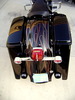




Powder coat question....

Tourer
Joined: Nov 2008
Posts: 457
Likes: 0
From: SoCal
Trending Topics

Road Captain
Joined: Sep 2007
Posts: 748
Likes: 1

Of course the thickness varies from person to person, but if applied correctly, a single coat of powder should range from 3-6 mils. Powder coat stays flexible after cure and that's what gives it it's durablity agianst chipping and cracking. The thicker it's applied, the less flexible it will be and will be more prone to crack.
phat96 - It sounds like what you saw on your front fender after powder coating was an orange peel effect. That will happen to some degree on larger, flatter surfaces like fenders and tanks. In fact, the same thing happens with liquid paint. However, powder coat can be wet sanded and buffed out just like your painter did after he shot the fender again.
phat96 - It sounds like what you saw on your front fender after powder coating was an orange peel effect. That will happen to some degree on larger, flatter surfaces like fenders and tanks. In fact, the same thing happens with liquid paint. However, powder coat can be wet sanded and buffed out just like your painter did after he shot the fender again.
HD Forum Stories
The Best of Harley-Davidson for Lifelong Riders

7 Surprising Harley-Davidson Products that Are Not Motorcycles
Verdad Gallardo
8 Best Harley-Davidson Motorcycles Ever
Pouria Savadkouei
10 Worst Harley-Davidson Motorcycles Ever
Pouria Savadkouei
Killer Custom's Jail Break Is The Breakout That Refused to Blend In
Verdad Gallardo
Crazy Bunderbike Build Looks Amazing, But Is It Impossible to Ride?
Verdad Gallardo
Harley-Davidson Reveals Super Cool Cafe Racer Concept
Verdad Gallardo
Engraved Rebellion: Inside Bundnerbike's Glam Rock II
Verdad Gallardo
10 Motorcycles You Should Never Buy
Joe Kucinski
10 Things Harley-Davidson Needs to Fix in 2026
Verdad Gallardo
Road Warrior
Joined: Nov 2008
Posts: 1,296
Likes: 3
From: Cheltenham, UK
Assuming by "mils" you mean mm, that sounds VERY thick to me and I very strongly suspect this is not the case. Most "white goods" domestic appliances are now powder coated, so if you have ever seen a chip in a refridgerator that should give you an idea.
When we paint industrial products we use a 2 pack epoxy resin paint. A primer plus base coat measures in at around 90 to 125um (1000 um = 1mm). Sometimes we get asked to paint to a thickness of 250um for offshore or marine applications, and believe me we really have to pile it on to get such a high build.
I am no expert in powder coating at all, but looking at the products that I have seen powder coated I would guess it ranges between 100 and 200um. If it was much thicker it would crack where it came in to contact with tightened bolts etc
When we paint industrial products we use a 2 pack epoxy resin paint. A primer plus base coat measures in at around 90 to 125um (1000 um = 1mm). Sometimes we get asked to paint to a thickness of 250um for offshore or marine applications, and believe me we really have to pile it on to get such a high build.
I am no expert in powder coating at all, but looking at the products that I have seen powder coated I would guess it ranges between 100 and 200um. If it was much thicker it would crack where it came in to contact with tightened bolts etc
Road Captain
Joined: Sep 2007
Posts: 748
Likes: 1
1 mil = .001 inches, or 1000th of an inch. In other words, 1000 mils = 1 inch so a single coat of powder should average .003 to .006 inches thick. The actual "optimum" thickness is suggested by the powder manufacturer for the specific powder being used on the MSDS or other data sheet provided with the product. Different powders will have slightly different suggested thickness requirements... but now I'm getting a little too deep. 