





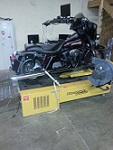

110 vs 103 Dyno Comparison

Outstanding HDF Member
Joined: Oct 2007
Posts: 3,437
Likes: 15

For the record, I wasn't putting your OP down, just informing ou about the differn't correction factors. As far as the "wavy" lines go, I can't see what the smoothing is, it's in the top right corner right by the correction factor. The C/F is a unit of measure, think of it like standard and metric tools. in the U.S. S.A.E. is the unit of measure we use on the dyno. STD gives higher results, around 4% or so. The smoothing factor is usually set at 5, if the smotthing factor is 5 and you still have the choppy lines, your timing could be off. Your 103 was run in horrible conditions, so that didn't help you any either. Just remember, the dyno is just a tool, used to tune your bike. Other than that it isn't worth anything except to give a guy bar stool bragging rights. Somebody mentioned here that the 103 wouldn't do anything but look at the 110's taillights. Depends, if the 110 was in an Ultra and the 103 was in a dyna i'd beg to differ.
Anyways, welcome to the forums. I remember when my status was "hang around", heck, everybody here was hang around once to, right?
Anyways, welcome to the forums. I remember when my status was "hang around", heck, everybody here was hang around once to, right?

Road Master
Joined: Jan 2008
Posts: 853
Likes: 5
From: Mnpls MN

That's the way that I chose to address the OP. He hasn't objected yet.
By the way Tatoo 1964-hang around, thanks for posting this comparison for everyone to chew on. It's a good one. I've learned some things today and it even brought back some recent memories.
By the way Tatoo 1964-hang around, thanks for posting this comparison for everyone to chew on. It's a good one. I've learned some things today and it even brought back some recent memories.
Road Captain


Joined: Sep 2007
Posts: 602
Likes: 51
From: central MN
To say that STD will always read 4% higher than SAE is wrong, at least as I understand it. I have seen back to back runs where one is SAE and one is STD where the STD shows HIGHER numbers, especially if it is really humid. Also, what is so horrible about the 103's run conditions? I always figured hot and humid was bad, hot and dry much better........

Banned
Joined: Sep 2009
Posts: 7,580
Likes: 7
From: The Internet (& Dyer, Indiana)
To say that STD will always read 4% higher than SAE is wrong, at least as I understand it. I have seen back to back runs where one is SAE and one is STD where the STD shows HIGHER numbers, especially if it is really humid. Also, what is so horrible about the 103's run conditions? I always figured hot and humid was bad, hot and dry much better........
You can change a map in Winpep 7 from SAE to STD and the numbers will jump accordingly (you can do this after the run even).
Not sure if there is a set rule or set percentage,.... but it's always been around 3 + 3 on the ones that I played around with.
Over a fairly wide range of atmospheric conditions (air pressure and temperature) STD will read roughly 2.6 percent higher than SAE on average. To convert STD to SAE, a reasonable estimate is to multiply the STD numbers by .974. Part of the problem is that the reference conditions for STD correction has changed over time. The reference temperature has changed, and the assumed mechanical efficiency has also varied between 85 and 100 percent. A few years ago, the difference between STD and SAE was even greater, more like 4.7 percent. A somewhat loose definition for the STD correction is one reason SAE has become the generally preferred correction.
Yeah, when i do that the "x" to close the window blocks the smoothing so I couldn't read it. Thanks

Outstanding HDF Member
Joined: Jun 2008
Posts: 2,132
Likes: 25
From: NorCal
HD Forum Stories
The Best of Harley-Davidson for Lifelong Riders

7 Surprising Harley-Davidson Products that Are Not Motorcycles
Verdad Gallardo
8 Best Harley-Davidson Motorcycles Ever
Pouria Savadkouei
10 Worst Harley-Davidson Motorcycles Ever
Pouria Savadkouei
Killer Custom's Jail Break Is The Breakout That Refused to Blend In
Verdad Gallardo
Crazy Bunderbike Build Looks Amazing, But Is It Impossible to Ride?
Verdad Gallardo
Harley-Davidson Reveals Super Cool Cafe Racer Concept
Verdad Gallardo
Engraved Rebellion: Inside Bundnerbike's Glam Rock II
Verdad Gallardo
10 Motorcycles You Should Never Buy
Joe Kucinski
10 Things Harley-Davidson Needs to Fix in 2026
Verdad Gallardo

Thread
Thread Starter
Forum
Replies
Last Post
