




Power Commander V ?????

Thread Starter
|
Advanced
Joined: Jan 2011
Posts: 50
Likes: 0
From: Indiana

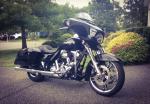
First week of my 5000 mile trip is done. Here is what I have learned. Gas milage varies greatly on brand of gas. And really sucks if it has 10 percent ethanol in it. Filled up once at a mom and pop station ( no others at the exit) , 89 octane 10 percent ethanol, got 28 mpg at 65 mph..ouch. So far with 91 octane and no ethanol 36 mpg to 45 mpg. Average is about 40. Been to Sturgis, Yellowstone. Heading for Vegas now.
Road Warrior
Joined: Mar 2010
Posts: 1,505
Likes: 56
From: Vancouver Island, British Columbia
I have a 2010 FLHTK with the same basic setup you have. When I installed my PCV my mileage went from 39 - 40 to 32. Wasn't happy with that, but it did run much better. After a few tanks at 32 i started modifying as stated above. I changed the numbers in the 2000 rpm to 3250 rpm to near zero by selecting them and decreasing them using the page down button. I had to turn the number lock off for this to work. I changed my fuel from the 2% to 20 throttle position range. I looked at the ignition and mine is 0 in 2% to 10% and 2 in the 15 to 20% position. I changed my fuel about 15% and didn't go any lower than -5. Mileage now 37 to 44. Oh and it still runs really well. Saw no difference in performance.

Road Warrior
Joined: Jun 2010
Posts: 1,717
Likes: 35
I agree. I just don't understand all the time, money and effort to squeeze another 1 or 2 MPG out of a motorcycle. Power and performance, yeah ok I can see that, but jeez for what your spending and the time it's what, the cost of a breakfast biscuit per tankful ?

Road Warrior
Joined: Apr 2010
Posts: 1,648
Likes: 37
From: Monroe, Louisiana
I suspect the reason is the differences in bikes. They are building maps that can handle variations and it is safe to be on the rich side. After leaning the cruise range mine still performs the same as the 32 mpg map. It also runs as cool in cruise as the 32 mpg map. If one map would work to the optimum performance on the same style bike there would only be a need to dyno one bike and just send it out for all the same combinations. It really doesn't work that way. The switch I used is a spst from radio shack. I didn't use the one they sell so no big expense there. Also saving from $5 to $7 per tank and filling up 3 or more times per week mounts up for me. I can buy lots of breakfast biscuits for that. I can also go 200 plus miles on tank of fuel vs 140.
Road Warrior
Joined: Jun 2010
Posts: 1,717
Likes: 35
I suspect the reason is the differences in bikes. They are building maps that can handle variations and it is safe to be on the rich side. After leaning the cruise range mine still performs the same as the 32 mpg map. It also runs as cool in cruise as the 32 mpg map. If one map would work to the optimum performance on the same style bike there would only be a need to dyno one bike and just send it out for all the same combinations. It really doesn't work that way. The switch I used is a spst from radio shack. I didn't use the one they sell so no big expense there. Also saving from $5 to $7 per tank and filling up 3 or more times per week mounts up for me. I can buy lots of breakfast biscuits for that. I can also go 200 plus miles on tank of fuel vs 140.

Elite HDF Member
Joined: Sep 2007
Posts: 4,928
Likes: 69
From: Near Myrtle Beach, SC
Unless i missed it, there was no mention of changing the head pipe or at least removing the cat. Why do what you done yet keep that restrictive, heat creating cat in there clogging uo your pipes?
All you have to do is research a little about experiences guys have had with dealers installing aftermarket performance hardware, then refusing warranty service to the motor if something goes wrong. Harley dealerships seem to have lots of turnover, so when your man is gone and you come in with a problem related to your pcv or other non hd hardware, good luck.
Thats why you should learn to do this simple stuff on your own.
All you have to do is research a little about experiences guys have had with dealers installing aftermarket performance hardware, then refusing warranty service to the motor if something goes wrong. Harley dealerships seem to have lots of turnover, so when your man is gone and you come in with a problem related to your pcv or other non hd hardware, good luck.
Thats why you should learn to do this simple stuff on your own.

Advanced
Joined: Feb 2009
Posts: 87
Likes: 0
Just sharing info...did some Interstate miles over the weekend on my 2009 Ultra. Fully loaded, running the Interstate at 75-80 for the most part on "cruise", temperature in the mid-nineties, Shell premium fuel, my average mpg was 44.8. Bike has Fuelmoto's package of Jackpots, SE A/C, and PC-V.
GP
GP
HD Forum Stories
The Best of Harley-Davidson for Lifelong Riders

7 Surprising Harley-Davidson Products that Are Not Motorcycles
Verdad Gallardo
8 Best Harley-Davidson Motorcycles Ever
Pouria Savadkouei
10 Worst Harley-Davidson Motorcycles Ever
Pouria Savadkouei
Killer Custom's Jail Break Is The Breakout That Refused to Blend In
Verdad Gallardo
Crazy Bunderbike Build Looks Amazing, But Is It Impossible to Ride?
Verdad Gallardo
Harley-Davidson Reveals Super Cool Cafe Racer Concept
Verdad Gallardo
Engraved Rebellion: Inside Bundnerbike's Glam Rock II
Verdad Gallardo
10 Motorcycles You Should Never Buy
Joe Kucinski
10 Things Harley-Davidson Needs to Fix in 2026
Verdad Gallardo
Extreme HDF Member
Joined: Sep 2005
Posts: 11,615
Likes: 50
From: Baton Rouge, LA
I have a friend with an '09 Ultra Stage II who had his PCV dyno-tuned by the local HD shop. He was getting <35mpg on rides where I was getting 46-48 mpg and wanted to improve his mileage, so I took a look at his map. It was very rich in the cruise range with double-digit numbers throughout. At the time I had a spare AT-100 (Auto-Tune) kit that we installed for some auto-tuning to establish two maps, one rich (13.5:1 in the cruise range) for cooling and another leaner map (14.5:1) for mileage. Once the two maps were created by accepting trims in the PC software we installed a map switch so he could toggle between the two maps while riding. He has been reporting 43 mpg in highway riding using the leaner map and heat has not been a problem, although he does have the option to toggle into the rich map at will. He says he only does this in heavy traffic when his oil temp starts to escalate. I unfortunately don't have the AT kit anymore to use again.
Fuel Moto maps tend to run a bit rich, for my taste anyway, as they tune for about 13.8:1 in the cruise range. You can subtract 5-7% in the cruise range (5-15% TP @ 2k-3k RPM) safely, how much depending on the year-model. If you are going to order a PCV from FM, just ask them to install the "mileage map" and they'll do this for you. A friend with a '10 SG bought an FM Power Package, I subtracted 7% from his cruise range, and his mileage has been in the mid-to-upper 40's in highway riding, right about where I am at this point. He has seen no adverse side-effects and oil temperatures have remained very good even without a cooler. I haven't succeeded in getting my bike or any other out of the upper-30's in city riding, so don't expect miracles.
Those of you who have the PCV and have had dyno tunes performed by a local tuner, you may be too rich in the cruise range, which will obviously affect mileage. If I was in that situation I would do the following:
1. Copy the map to your computer's hard drive and give it a unique, descriptive filename, like "ORIG-MAP.PVM".
2. Go to the PC website and download a map that's as close as possible to your hardware setup.
3. Transfer only the values in the Fuel Adj. tables (both cylinders) that correspond to the cruise range. We will assume the map has been tuned properly for WOT (around 13.0:1) so we'll leave that as well as the transition areas alone.
4. Subtract 7 from each value by selecting the entire range (5-15% TP @ 2k-3k RPM) with your mouse, just as you would select a group of files in Windows Explorer, and hitting the PG-DN key seven times.
That should get you into a safe AFR range that should improve gas mileage without causing too much of a heat increase. Test-ride the bike and check for any unacceptable heat, detonation, or surging. Some surging at low-TP (e.g. 5%) in lower gears, like cruising in a 30mph zone, is okay if not excessive and there is no hesitation. If all is well and mileage still isn't where you want it, subtract more from the cruise range, perhaps -3 at a time--but I wouldn't go more than -10% total or let the Fuel Adj. value in any given cell go much below zero. You can tell quite a bit about the AFR by the way the bike runs. AFRs that are too lean are usually indicated by detonation, surging, and increased heat, although my bike runs only slightly cooler (front-head temp) at a 13.5 AFR compared to 14.6--around 5-7°, which isn't much, and I can't feel any difference in heat or throttle response. YMMV, but these are my experiences. Those of you with AT-100 attached to the PCV may want to read this write-up about setting up a hardware switch so you can have your cake and eat it too.
Fuel Moto maps tend to run a bit rich, for my taste anyway, as they tune for about 13.8:1 in the cruise range. You can subtract 5-7% in the cruise range (5-15% TP @ 2k-3k RPM) safely, how much depending on the year-model. If you are going to order a PCV from FM, just ask them to install the "mileage map" and they'll do this for you. A friend with a '10 SG bought an FM Power Package, I subtracted 7% from his cruise range, and his mileage has been in the mid-to-upper 40's in highway riding, right about where I am at this point. He has seen no adverse side-effects and oil temperatures have remained very good even without a cooler. I haven't succeeded in getting my bike or any other out of the upper-30's in city riding, so don't expect miracles.
Those of you who have the PCV and have had dyno tunes performed by a local tuner, you may be too rich in the cruise range, which will obviously affect mileage. If I was in that situation I would do the following:
1. Copy the map to your computer's hard drive and give it a unique, descriptive filename, like "ORIG-MAP.PVM".
2. Go to the PC website and download a map that's as close as possible to your hardware setup.
3. Transfer only the values in the Fuel Adj. tables (both cylinders) that correspond to the cruise range. We will assume the map has been tuned properly for WOT (around 13.0:1) so we'll leave that as well as the transition areas alone.
4. Subtract 7 from each value by selecting the entire range (5-15% TP @ 2k-3k RPM) with your mouse, just as you would select a group of files in Windows Explorer, and hitting the PG-DN key seven times.
That should get you into a safe AFR range that should improve gas mileage without causing too much of a heat increase. Test-ride the bike and check for any unacceptable heat, detonation, or surging. Some surging at low-TP (e.g. 5%) in lower gears, like cruising in a 30mph zone, is okay if not excessive and there is no hesitation. If all is well and mileage still isn't where you want it, subtract more from the cruise range, perhaps -3 at a time--but I wouldn't go more than -10% total or let the Fuel Adj. value in any given cell go much below zero. You can tell quite a bit about the AFR by the way the bike runs. AFRs that are too lean are usually indicated by detonation, surging, and increased heat, although my bike runs only slightly cooler (front-head temp) at a 13.5 AFR compared to 14.6--around 5-7°, which isn't much, and I can't feel any difference in heat or throttle response. YMMV, but these are my experiences. Those of you with AT-100 attached to the PCV may want to read this write-up about setting up a hardware switch so you can have your cake and eat it too.
Last edited by iclick; Aug 1, 2011 at 11:36 AM.


Thread
Thread Starter
Forum
Replies
Last Post
Kevinmach1
Ignition/Tuner/ECM/Fuel Injection
2
Apr 16, 2012 01:27 PM
