




Losing oil need help

Ultimate HDF Member
Joined: Dec 2006
Posts: 5,878
Likes: 17
From: The Desert SouthWest

Yep, my '05 EGC used about 1.5 qts of oil during a 5000 mile interval. Lots of posts on here ref the '05's and valve guides leaking. You have to keep an eye on it. I just dealt with it as a fact of life as it didnt cause any problems other than the hassle of having to watch the oil level.
Last edited by Arizona; Oct 11, 2011 at 10:11 AM.

HDF Community Team


Joined: Jun 2006
Posts: 12,776
Likes: 2,607
From: san antonio

As Dawg pointed out, there were issues with the '05 valve guide seals; many were replaced under warranty. H-D will tell you that less than a litre in 2500 miles is acceptable. My '05 was consuming a quart in about 1200 miles; guide seals were replaced under warranty.
Look at the upside. Since the heads have to come off to replace the seals, have your cylinders bored and fitted to a set of SE cast flat top 95" pistons; about $300 but the labor is almost free.
Look at the upside. Since the heads have to come off to replace the seals, have your cylinders bored and fitted to a set of SE cast flat top 95" pistons; about $300 but the labor is almost free.
Grand HDF Member
Joined: Dec 2007
Posts: 4,999
Likes: 55
From: Bay Area
The bike is new to me i bought it with 7000 miles on it changed the oil ,,,i used castrol 20W50 with lucas oil treatment...I put 3000 miles on it... an it was down 3/4 of a litre so i topped it up put another 1000 miles or so an checked it the other day an it is down about 1/2 a litre.
HDF Community Team
Joined: Jun 2006
Posts: 12,776
Likes: 2,607
From: san antonio
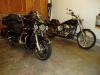
I have two Harley' in the garage right now; both performance motors and they are ridden hard. I change oil somewhere between 3000 and 5000 miles depending on several factors. Both bikes have over 30K miles and I usually add less than a 1/2 quart between changes and I don't run 1/2 quart low as some have suggested necessary to minimize oil passing through the crankcase breathers.
Last edited by djl; Oct 11, 2011 at 02:40 PM.
Elite HDF Member
Joined: Nov 2010
Posts: 3,846
Likes: 173
From: Simi Valley, CA
The spark plug on the OPs front cylinder is oil fouled; the valve guide seals are leaking. So, if he ignores that fact and just adds oil between changes carbon will build up on top of the piston(s) pretty quick. The carbon layer will build up until eventually that cylinder will start to detonate. Valve guide seals are not supposed to leak and should be replaced. Once they start to leak, the leaking will only get worse...

Thread Starter
|
Intermediate
Joined: Jul 2011
Posts: 38
Likes: 0
From: Nova Scotia
as we speak the oil is still in the bike with the lucas oil treatment getting ready to change the oil soon ...so you say not to put the oil treatment in ????
Grand HDF Member
Joined: Dec 2007
Posts: 4,999
Likes: 55
From: Bay Area
Basically any additives is just snake oil or a religion not a science, the more one believes in something the better it works. In my career over the last 30+ years I have monitored engines/transmissions and differentials for over 150 million miles including their oil samples. The modern oil has been superbly improved over the last 40-50 years, a properly operated and maintained engine will last a long long time and you dont need additives.
In the work I do the equipment has a life span od 12-14 years, 30 years ago we would rebuild the engines 2-3 times in that life span, today we have gone through 2 life cycles and never have rebuilt 1 engine, maybe replaced a few cylinders due to fuel wash out, but those can be counted on 1 hand. Anyway my point is proper maintenance and operation will take care of the equipment, without any snake oil. Sorry if this seems boring but Ive seen enough to believe that additives are just that. Of course to each their own.
In the work I do the equipment has a life span od 12-14 years, 30 years ago we would rebuild the engines 2-3 times in that life span, today we have gone through 2 life cycles and never have rebuilt 1 engine, maybe replaced a few cylinders due to fuel wash out, but those can be counted on 1 hand. Anyway my point is proper maintenance and operation will take care of the equipment, without any snake oil. Sorry if this seems boring but Ive seen enough to believe that additives are just that. Of course to each their own.
HD Forum Stories
The Best of Harley-Davidson for Lifelong Riders

7 Surprising Harley-Davidson Products that Are Not Motorcycles
Verdad Gallardo
8 Best Harley-Davidson Motorcycles Ever
Pouria Savadkouei
10 Worst Harley-Davidson Motorcycles Ever
Pouria Savadkouei
Killer Custom's Jail Break Is The Breakout That Refused to Blend In
Verdad Gallardo
Crazy Bunderbike Build Looks Amazing, But Is It Impossible to Ride?
Verdad Gallardo
Harley-Davidson Reveals Super Cool Cafe Racer Concept
Verdad Gallardo
Engraved Rebellion: Inside Bundnerbike's Glam Rock II
Verdad Gallardo
10 Motorcycles You Should Never Buy
Joe Kucinski
10 Things Harley-Davidson Needs to Fix in 2026
Verdad Gallardo
Lucas oil stabilizer is nothing more than thick oil. No additives,no organic or inorganic material. Basically by adding that junk you have effectively dilluted the original oils add pack and rendered the original formula basically useless. And I have seen for myself oil foaming after that junk was put in. If you use conventional oil it has a lower NOACK value and will evaporate quicker than synth. Which may explain some of our members oil disappearing. However yours seems to be valve guides. There are some additives that do work. STP contains zinc and phosphorus which are proven anti-wear agents however then again the original add pack of the oil are diluted and rendered less effective. I add lubro-moly (molybdenum disulfide) which is a friction modifier proven to protect engines at start up which is where most engine wear occurs. And because our bikes don't have a shared sump you can use it in the engine. If put in the primary you will be able to time the life of your clutch with a stopwatch because it will make the mating surfaces super slick and the clutch will just slide. Never to engage again. So to recap Lucas oil stabilizer is junk. Lucas octane booster makes my bikes noticeably more peppy at part throttle and the fuel additive make my riding lawn mower last longer per tank but that's the extent of my experience with their products. And the oil foaming is frightening simply because foamed up oil protects nothing. Might as well put water in there.