




Loose compensator bolt

Thread Starter
|
Stage IV
Joined: May 2009
Posts: 4
Likes: 0
 Loose compensator bolt
Yep, add me to the list, 05 SE 103 25k miles synthetic oil since new, started to hear a engine rattle at around 2700 rpm with no load, dont know why I did not check it first, really sounded more like a timing chain/tensioner issue so I tore into that first, everything looked good in there, so I went to the primary, compensator bolt was still under pressure just not tight by about 1/2 turn, inspected everything, cleaned the threads and locktight (red) torqued to 150lb then another 1/4 turn or so till it was real tight, havent started it yet to see if that fixed the rattle, but im pretty confident it will, want to let the lock tight set up real good before I start it, test ride this weekend hopefully.
Elite HDF Member
Joined: Nov 2010
Posts: 3,846
Likes: 173
From: Simi Valley, CA
150 ft. lbs.? Plus 1/4 turn? I wouldn't be surprised if you yielded either the bolt or the crankshaft threads. That's way too much torque for a grade 8 9/16-12 bolt.
150 ft. lbs. is at the upper end of the recommended torque for that size/grade fastener when dry. With the lubricity of the loctite it becomes even more questionable. Then another 1/4 turn?
By the way, HD specifies 140 ft. lbs.
Your lucky if you didn't cause any immediate damage, but the latent effects may haunt you down the road if you did in fact yield the bolt or the crankshaft threads.
EDIT: I assumed when the OP said bolt, he meant bolt. If it's another configuration with a nut and not a bolt, then please by all means disregard my comments.
150 ft. lbs. is at the upper end of the recommended torque for that size/grade fastener when dry. With the lubricity of the loctite it becomes even more questionable. Then another 1/4 turn?
By the way, HD specifies 140 ft. lbs.
Your lucky if you didn't cause any immediate damage, but the latent effects may haunt you down the road if you did in fact yield the bolt or the crankshaft threads.
EDIT: I assumed when the OP said bolt, he meant bolt. If it's another configuration with a nut and not a bolt, then please by all means disregard my comments.
Last edited by 2black1s; May 30, 2013 at 10:42 PM.

Elite HDF Member
Joined: Sep 2007
Posts: 4,928
Likes: 69
From: Near Myrtle Beach, SC
What does synthetic oil have to do with the price of eggs? You need a service manual my man. So you thought the "engine rattle" was on the right and you checked the cam chain/tensioners....then the rattle must have moved to the left so you popped off the primary cover? Bolt not tight by 1/2 a turn? What does that mean on a bolt that is "tight" when it has 140 lbs of torque applied? Anyway....if you are for real glad you found the issue.

Road Warrior
Joined: Oct 2009
Posts: 1,384
Likes: 3
From: California
You're either a lot more daring than me or have way better luck than I do! Hope that solves your problem without creating another issue.

Stellar HDF Member


Joined: Dec 2009
Posts: 2,561
Likes: 280
From: North Cental Iowa
Nothing like jumpin all over a guy on his first post, & by the way if you read accurately you would see he has a 05 which has a compensator nut, yea I know he said bolt, but it's a 05 & they use a nut! I don't have an early service manual in front of me since I sold it along with my 00 bike, but if memory serves me that sounds about right for the comp "nut". Anyway welcome to the forum & I hope your next experience here is better.
Thread Starter
|
Stage IV
Joined: May 2009
Posts: 4
Likes: 0
Darn I typed a good responce to all the posts, but by the time I was done with all the interuptions etc and posted it, it did not go through and was lost, hate it when that happens!
I will update after I run it and go for a good ride, god willing, and thanks for the welcome,
I will update after I run it and go for a good ride, god willing, and thanks for the welcome,
Elite HDF Member
Joined: Jan 2007
Posts: 4,020
Likes: 69
From: Twin Cities, MN
Trending Topics

HDF Community Team


Joined: Jun 2006
Posts: 12,774
Likes: 2,606
From: san antonio

Adding to DTTJGlides post aside from the fact that previous posters don't know much about the earlier models;
The pre -07 compensator nuts are designed to put enough clamping pressure on the assembly to keep it from coming loose. Manufacturing tolerances being what they are allow for proper torque to be applied but if tolerances are off a bit and the "stackup" dimension is too deep, the necessary clamping pressure will not be achieved.
Generally, when a torque to angle spec is given, that angle from a specific pre-set torque value is the one that has been shown to provide the proper clamp load for the assy in question. The method for obtaining that angle value is somewhat beyond the scope of this forum, but a google search for "torque to angle", "torque to yield", etc. should prove interesting for those so inclined to investigate further.
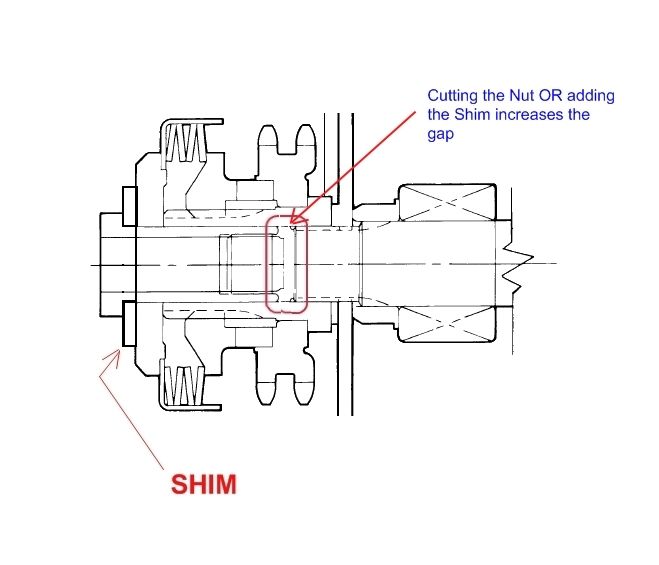
AFAIK, pre '03 (tapered roller main roller bearing) have a torque spec of 150-165 ft/lbs and the '03 and later motors use the to torque to value then to the specified angle. Whichever method is correct for your particular motor, it's a good idea to check and make sure that the compensator stackup is correct and the proper clamp load is being achieved. Trimming the compensator nut ~0.030 or using a shim under the nut are commonly done to solve any stackup issues. The OP may want to check out HD bulletin M-1170 ...
The photo below illustrates the point and how trimming the compensator nut will achieve the desired results.
The pre -07 compensator nuts are designed to put enough clamping pressure on the assembly to keep it from coming loose. Manufacturing tolerances being what they are allow for proper torque to be applied but if tolerances are off a bit and the "stackup" dimension is too deep, the necessary clamping pressure will not be achieved.
Generally, when a torque to angle spec is given, that angle from a specific pre-set torque value is the one that has been shown to provide the proper clamp load for the assy in question. The method for obtaining that angle value is somewhat beyond the scope of this forum, but a google search for "torque to angle", "torque to yield", etc. should prove interesting for those so inclined to investigate further.
AFAIK, pre '03 (tapered roller main roller bearing) have a torque spec of 150-165 ft/lbs and the '03 and later motors use the to torque to value then to the specified angle. Whichever method is correct for your particular motor, it's a good idea to check and make sure that the compensator stackup is correct and the proper clamp load is being achieved. Trimming the compensator nut ~0.030 or using a shim under the nut are commonly done to solve any stackup issues. The OP may want to check out HD bulletin M-1170 ...
The photo below illustrates the point and how trimming the compensator nut will achieve the desired results.

HD Forum Stories
The Best of Harley-Davidson for Lifelong Riders

7 Surprising Harley-Davidson Products that Are Not Motorcycles
Verdad Gallardo
8 Best Harley-Davidson Motorcycles Ever
Pouria Savadkouei
10 Worst Harley-Davidson Motorcycles Ever
Pouria Savadkouei
Killer Custom's Jail Break Is The Breakout That Refused to Blend In
Verdad Gallardo
Crazy Bunderbike Build Looks Amazing, But Is It Impossible to Ride?
Verdad Gallardo
Harley-Davidson Reveals Super Cool Cafe Racer Concept
Verdad Gallardo
Engraved Rebellion: Inside Bundnerbike's Glam Rock II
Verdad Gallardo
10 Motorcycles You Should Never Buy
Joe Kucinski
10 Things Harley-Davidson Needs to Fix in 2026
Verdad Gallardo
Elite HDF Member
Joined: Sep 2007
Posts: 4,928
Likes: 69
From: Near Myrtle Beach, SC
I confess I didn't and assumed it had a bolt instead of a nut. Thanks for keeping me straight. The oldest HD I've ever owned was a 2000 RKC. I would like one day to purchase a couple of the older bikes to have and learn.
HDF Community Team
Joined: Jun 2006
Posts: 12,774
Likes: 2,606
From: san antonio
I am strongly considering replacing one of them with a 2014 Indian; the MoCo is about to have some serious competition from a motorcycle truly made in the USA. Maybe the competition will motivate the MoCo to get off their collective dead a$$e$ and up their game but that is a topic for another post.