





Trailering questions

Elite HDF Member
Joined: Apr 2009
Posts: 3,542
Likes: 161
From: Booming metropolis

I pulled off of the handle bars in this photo but don't recommend it. Take it from the crash bars if you can. I also put one of the HD loops straps around each passenger floorboard bracket and pulled sideways. The bike was in gear and the side to side straps kept it upright when I removed the front straps. I ran one threw the rim too pulling it forward. Worked for me but I only went about 90 miles

Last edited by hog95023; Oct 20, 2013 at 09:08 PM.
Advanced
Joined: Mar 2013
Posts: 87
Likes: 0
From: Michigan
So, in less than 2 months, the Navy is sending me back VA Beach and I need to get my RK there. Letting the movers take it is out of the question... Anyways, I have a 5X10 Big Tex open utility trailer that will more than cover the weight and will be pulling it with a half-ton Silverado (5.3). What I need to know is:
1. What is the best chock I can get for the trip? Not too worried about price, I just want it to be able to nearly hold the bike by itself.
2. How are y'all tying them down? I plan on getting a couple sets of the soft "things" that are supposed to not scratch when wrapped around parts and using my ratchet straps. And I've seen on ebay these brackets that bolt to the RK windshield mounts, but I can't imagine those two bolts on each side being able to support much.
Moving down here I brought my Vrod, but I didn't chock it. I just threw 8 tie downs on it and screwed a couple boards behind each tire. Sad to say, but I didn't have the same connection with that bike as I do this one. I treat this one as if its one of my kids. Lol
Any help or any other tips you can provide would be greatly appreciated.
Chris
1. What is the best chock I can get for the trip? Not too worried about price, I just want it to be able to nearly hold the bike by itself.
2. How are y'all tying them down? I plan on getting a couple sets of the soft "things" that are supposed to not scratch when wrapped around parts and using my ratchet straps. And I've seen on ebay these brackets that bolt to the RK windshield mounts, but I can't imagine those two bolts on each side being able to support much.
Moving down here I brought my Vrod, but I didn't chock it. I just threw 8 tie downs on it and screwed a couple boards behind each tire. Sad to say, but I didn't have the same connection with that bike as I do this one. I treat this one as if its one of my kids. Lol
Any help or any other tips you can provide would be greatly appreciated.
Chris

Tourer
Joined: Apr 2012
Posts: 312
Likes: 0
From: 85205
Harbor freight chock, 6 'soft' straps, 2 to the chock, 4 to corner tie downs, fronts tied to 'fender ' mounts, rear tied to passenger foot rest mounts. Rear wheel rests 1/2 forward of tailgate of Ram 1500. 2000 miles trouble free.
Now I have a 5x10 trailer, strapped the same way.
Much easier to handle when it's in back of the truck though.
Now I have a 5x10 trailer, strapped the same way.
Much easier to handle when it's in back of the truck though.
I use the Condor as well. Attach straps to the forks just above where the fender bolts to them. That way you don't compress the suspension at all. This is how they ship from the factory. Harley sell really good straps that have built in soft straps- love mine! Also attach straps to passenger floorboard mounts to keep rear whelk from moving. 4 straps all pulling towards the Condor wheel chock. Thousands of no problem miles this way. Good luck!

Thread Starter
|
Road Warrior

Joined: Dec 2007
Posts: 1,498
Likes: 213
From: Atoka, TN
One thing you NEVER want to do and that is to put your straps just above the fender on the lowers. You want my professional opinion, for the side to side straps you put them inbetween the trees on the fork tubes. It's not going to hurt the bike compressing the forks a little. Putting one on the front rim is good for a "just in case" only and shouldn't be ratcheted down tight at all. Same goes for the rear rim. I'll explain, putting the straps just above the fender will put outward pressure and could bend the forks, i've seen it happen. Putting one on the front rim pulling will also put outward pressure on the forks, seen that too. Same goes for the rear rim, just as a precaution with no major tension. Everyone has all kinds of opinions and this is mine only because of what i've seen happen in these instances. Hope this was helpful.
Tie to the triple trees...
I actually bought the tie down brackets from Harley, available for most models now I believe.
They bolt where the fairing bolts on the side of the forks on my Limited.
I use softies everywhere a strap is on the bike.
I use 6 straps per bike, and have towed mine across country many times. 1 strap each to the trees on each side front, one on either side to a frame member near the rear, I use the saddlebag support, but not SUPER tight, these simply keep the rear end from bouncing around, then 2 relatively low, like bottom of the engine guard strapped pulling backward, just in case the chock fails.
How I do it, and YMMV
I actually bought the tie down brackets from Harley, available for most models now I believe.
They bolt where the fairing bolts on the side of the forks on my Limited.
I use softies everywhere a strap is on the bike.
I use 6 straps per bike, and have towed mine across country many times. 1 strap each to the trees on each side front, one on either side to a frame member near the rear, I use the saddlebag support, but not SUPER tight, these simply keep the rear end from bouncing around, then 2 relatively low, like bottom of the engine guard strapped pulling backward, just in case the chock fails.
How I do it, and YMMV
Advanced
Joined: Mar 2013
Posts: 87
Likes: 0
From: Michigan
One thing you NEVER want to do and that is to put your straps just above the fender on the lowers. You want my professional opinion, for the side to side straps you put them inbetween the trees on the fork tubes. It's not going to hurt the bike compressing the forks a little. Putting one on the front rim is good for a "just in case" only and shouldn't be ratcheted down tight at all. Same goes for the rear rim. I'll explain, putting the straps just above the fender will put outward pressure and could bend the forks, i've seen it happen. Putting one on the front rim pulling will also put outward pressure on the forks, seen that too. Same goes for the rear rim, just as a precaution with no major tension. Everyone has all kinds of opinions and this is mine only because of what i've seen happen in these instances. Hope this was helpful.
They are not using those as tie downs just stabilization. Look at them closer and you will see. Like i said before, i've seen what happens when you put outward force for a length of time on the lowers. It screws up the seals and ***** the shaft to the side. SafetyMan has the right idea.
HD Forum Stories
The Best of Harley-Davidson for Lifelong Riders

7 Surprising Harley-Davidson Products that Are Not Motorcycles
Verdad Gallardo
8 Best Harley-Davidson Motorcycles Ever
Pouria Savadkouei
10 Worst Harley-Davidson Motorcycles Ever
Pouria Savadkouei
Killer Custom's Jail Break Is The Breakout That Refused to Blend In
Verdad Gallardo
Crazy Bunderbike Build Looks Amazing, But Is It Impossible to Ride?
Verdad Gallardo
Harley-Davidson Reveals Super Cool Cafe Racer Concept
Verdad Gallardo
Engraved Rebellion: Inside Bundnerbike's Glam Rock II
Verdad Gallardo
10 Motorcycles You Should Never Buy
Joe Kucinski
10 Things Harley-Davidson Needs to Fix in 2026
Verdad Gallardo
Elite HDF Member
Joined: Jun 2007
Posts: 3,873
Likes: 13
From: NW Arkansas
Well I speed read the thread. Saw some not so good ideas relating to tie down points IMHO. Yes I have trailered long distance a half dozen times or so. Had my 5x10 V nose, single axle up on one wheel and the bike never moved. So I figure since it has never moved, and I've never damaged the finish from straps, I know what I'm doing. (Self Proclaimed Expert! ) My advice: The Harbor Freight "Condor" type chock will work just fine. Use a strap thru the front wheel to the chock. Now if nothing happens that is enough. However, I would/do continue with two straps http://powertye.com/store/index.php?...&product_id=45 off the front down tubes angled forward pulling the bike into the chock. Yes, I have a Ultra. No, the lowers are not in the way. It is all about the angle. (Crash bars and handle bars will bend too easy if anything happens so don't fasten straps to them.) Put a block of wood under the frame and tighten your straps down until the frame contacts the wood. This prevent collapse of the suspension. (I haven't always used the block of wood method and you can get away without doing it if you use the "condor" type chock, but it is a good idea.) A couple of straps off the rear passenger board mounting brackets to keep the rear end from moving around and you are good to go. (I use old socks around the floorboard brackets under the straps.) Oh yeah, kick stand up, tranny in neutral.
) My advice: The Harbor Freight "Condor" type chock will work just fine. Use a strap thru the front wheel to the chock. Now if nothing happens that is enough. However, I would/do continue with two straps http://powertye.com/store/index.php?...&product_id=45 off the front down tubes angled forward pulling the bike into the chock. Yes, I have a Ultra. No, the lowers are not in the way. It is all about the angle. (Crash bars and handle bars will bend too easy if anything happens so don't fasten straps to them.) Put a block of wood under the frame and tighten your straps down until the frame contacts the wood. This prevent collapse of the suspension. (I haven't always used the block of wood method and you can get away without doing it if you use the "condor" type chock, but it is a good idea.) A couple of straps off the rear passenger board mounting brackets to keep the rear end from moving around and you are good to go. (I use old socks around the floorboard brackets under the straps.) Oh yeah, kick stand up, tranny in neutral.
Last edited by mike5511; Oct 21, 2013 at 02:56 AM.
Road Master
Joined: Jul 2011
Posts: 1,170
Likes: 14
From: washington dc
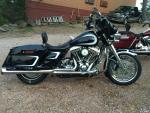
I am unsure about this claim, and this is how I strap my SG to my Kendon trailer, which also has a wheel chock. I most frequently have seen recommendations that we strap our bikes in a way that does not require compressing the forks for the obvious reason that if the forks are not bottomed out then the bike is going to bounce (a lot). Of course, the block of wood under the frame method is an alternative that solves the bouncing bike issue.
Has anyone that straps at the lowers just above the fender experienced any fork problems? I have not, but I've only been doing it for the summer, which included a few short trips and one long trip.
Also, another vote for Condor. I have one in my garage and would also have one on my trailer if the trailer did not already have a chock. Things are fantastic. Roll into the garage and onto the Condor. Step off.